.png)
.png)
.png)

Daniel Saks
Chief Executive Officer


Most B2B leaders think they need to choose between technical automation and human performance when building their go-to-market engine, but the truth is that the most successful organizations implement both GTM Engineering and Sales Enablement as complementary disciplines. Landbase's agentic AI platform bridges these worlds by providing the technical infrastructure that GTM Engineers need while delivering the AI-qualified audiences that Sales Enablement teams can activate immediately.
GTM Engineering emerged as a distinct discipline in 2023-2024 specifically because modern AI capabilities made complex automation accessible to non-engineers. Meanwhile, Sales Enablement has evolved into a mature strategic function that equips sales teams with the tools, training, and content they need to close more deals. Companies implementing GTM Engineering achieve 56% higher conversion rates and 93% higher revenue growth, while organizations with formal Sales Enablement programs see 49% win rates on forecasted deals versus 42.5% without.
The real breakthrough happens when these disciplines work together—GTM Engineering builds the automated systems, and Sales Enablement develops the human capabilities that run through those systems.
Before diving into the differences between GTM Engineering and Sales Enablement, it's essential to understand what a go-to-market (GTM) strategy actually is. At its core, a GTM strategy is your company's plan for delivering unique value to customers and achieving competitive advantage in the marketplace.
A comprehensive GTM strategy includes market analysis, customer segmentation, value proposition development, distribution channel selection, pricing strategy, and product-market fit validation. Without a solid foundation in these areas, neither GTM Engineering nor Sales Enablement can deliver maximum impact.
The modern GTM landscape has become increasingly complex, with B2B sales representatives spending only 28-36% of their time on actual selling activities. The remaining time is consumed by administrative tasks, manual prospecting, and navigating fragmented systems. This inefficiency contributes to sales-marketing misalignment costs of approximately $1 trillion annually across the B2B landscape.
GTM Engineering represents one of the first true AI-native professions, emerging specifically in 2023-2024 when generative AI, large language models, and no-code automation platforms made complex workflows accessible to teams without traditional engineering backgrounds. As Everett Berry, Head of GTM Engineering at Clay, explains, "GTM Engineering is one of the first AI-native jobs. It's a role that literally couldn't exist without modern AI capabilities."
GTM Engineering combines technical skills (APIs, data pipelines, AI workflow design) with deep go-to-market knowledge (funnels, buyer journeys, ICP validation) to build automated revenue systems. Unlike traditional RevOps, which focuses on maintaining existing systems, GTM Engineering is about building new infrastructure that drives growth through experimentation and innovation.
GTM Engineers are responsible for building the technical infrastructure that powers modern revenue operations:
The economic impact of GTM Engineering is substantial. A single GTM Engineer can replace 5-7 SDRs through intelligent automation, creating significant cost savings while improving consistency and scalability. While most SaaS companies spend approximately $322K/year across SDR + Campaign Manager + RevOps contractor + Marketing Automation Specialist roles, a GTM Engineer earning ~$150-180K can deliver overlapping output via scalable systems.
GTM Engineers also save each sales rep 8-12 hours per week through automation of lead routing, scoring, and real-time data enrichment. This translates directly to revenue impact, as companies implementing GTM Engineering achieve 56% higher conversion rates and 93% higher revenue growth compared to traditional approaches.
Sales Enablement is the strategic process of equipping sales teams with the tools, resources, training, and information they need to close more deals and improve sales performance.
Sales Enablement encompasses three core areas: sales training, sales content management, and sales analytics. The function works to ensure sales representatives have access to the right resources at every stage of the sales cycle, from initial prospecting through to deal closure and post-sale expansion.
Sales Enablement teams focus on human performance enhancement through:
The impact of Sales Enablement is measurable and significant. Organizations with dedicated enablement programs achieve 49% win rates on forecasted deals compared to 42.5% for those without enablement. Additionally, sales cycles can be reduced by up to 49% with enablement.
While both GTM Engineering and Sales Enablement aim to improve revenue generation, they approach the problem from fundamentally different angles.
GTM Engineering takes a strategic, systems-oriented approach focused on building automated infrastructure that scales. Sales Enablement takes a tactical, human-oriented approach focused on developing the skills and resources that individual sales representatives need to succeed.
GTM Engineers think in terms of workflows, data pipelines, and system architecture. Sales Enablement professionals think in terms of training modules, content assets, and coaching frameworks.
GTM Engineering is fundamentally about technology implementation—building the technical systems that automate revenue processes. Sales Enablement is fundamentally about skills development—improving human performance through training, coaching, and resource provision.
As Yash Tekriwal, the first GTM Engineer at Clay, explains: "RevOps is 'keep the plane flying' while GTM engineering is 'constantly innovating to stay ahead of the market.' GTM engineering turns ops from a support function into a growth engine by adding experimentation capabilities."
GTM Engineering focuses on automating repetitive tasks like prospect research, lead scoring, and data enrichment. Sales Enablement focuses on creating content and training that helps sales representatives handle complex, high-value interactions that require human judgment and relationship-building skills.
The compensation structures reflect these different focuses: GTM Engineers earn an average of $182,412 per year with 25-50% of compensation tied to variable/OTE linked to pipeline goals and revenue metrics. Sales Enablement roles typically earn between $118,000-$129,000 with compensation structured more like operational roles than revenue roles.
Sales Enablement leaders face constant pressure to deliver more qualified opportunities while reducing the administrative burden on their sales teams. Landbase's platform provides the perfect solution by delivering AI-qualified audiences that enable sales representatives to focus on what they do best—building relationships and closing deals.
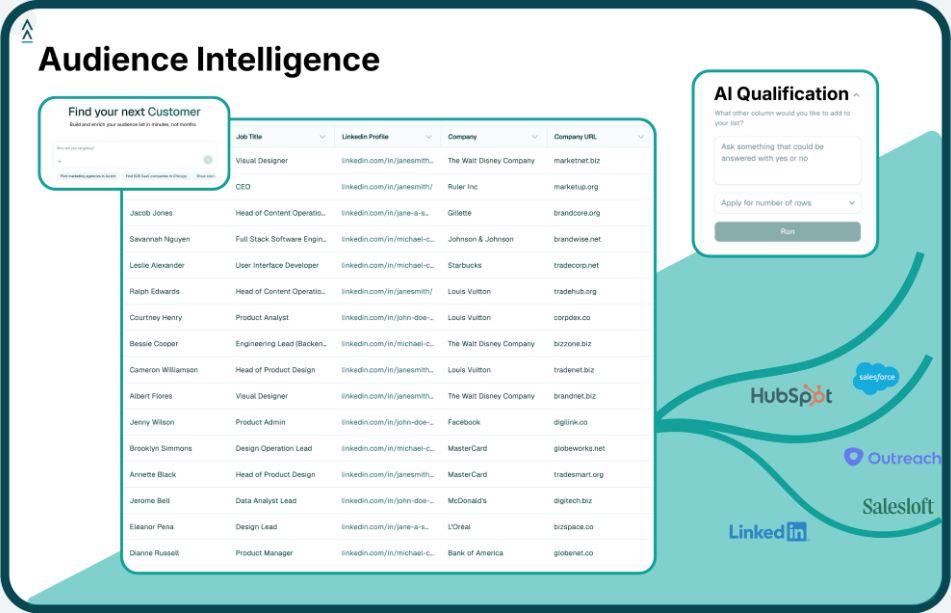
Landbase's free, no-login audience builder allows Sales Enablement leaders to quickly generate AI-qualified exports of up to 10,000 contacts, eliminating the time-consuming process of manual list building. This capability is particularly valuable for targeted campaigns like "Sales Enablement leaders at large media companies undergoing org restructuring"—examples that demonstrate Landbase's precision targeting capabilities.
By providing AI-qualified audiences ready for immediate activation, Landbase reduces the 66% of sales team productive time that is typically lost to dealing with fragmented systems and manual processes. Sales Enablement leaders can use Landbase Outbound to identify and qualify prospects along their journey, building targeted lists that move fast and generate pipeline consistently.
Landbase's mission aligns perfectly with Sales Enablement's focus on human performance: "When machines handle the mundane, humans can focus on what they do best—building relationships and closing deals." By automating the repetitive work of audience discovery and qualification, Landbase enables Sales Enablement teams to focus their efforts on high-value activities like coaching, training, and strategic selling skills development.
The most successful organizations don't choose between GTM Engineering and Sales Enablement—they integrate both disciplines to create a compounding effect on revenue generation. Leading companies like Clay, Anthropic, Notion, and Canva all implement both functions, not as competing approaches but as complementary capabilities.
Integration starts with a unified go-to-market strategy that leverages both technical automation and human performance enhancement. GTM Engineers build the automated infrastructure that handles routine tasks, while Sales Enablement teams create the training, content, and coaching that runs through those systems.
This "systems-plus-people" approach ensures that automation handles administrative tasks while human enablement focuses on high-value strategic selling skills. The result is a revenue engine that scales efficiently while maintaining the human relationships that drive complex B2B sales.
Both GTM Engineering and Sales Enablement rely on high-quality data, but they use it differently. GTM Engineers use data to build automated workflows and scoring models, while Sales Enablement teams use data to create targeted training programs and personalized content recommendations.
Landbase's B2B database with 300M+ contacts and 24M+ companies provides the foundation that both disciplines need. GTM Engineers can leverage the 1,500+ unique signals for building sophisticated qualification models, while Sales Enablement teams can use the same data to create buyer personas and targeted content strategies.
The modern sales technology stack has become increasingly fragmented, with companies juggling 10+ tools per deal on average. GTM Engineering addresses this fragmentation by building integrations and workflows that connect disparate systems, while Sales Enablement ensures that sales representatives can effectively use the tools that are available.
Landbase's integrations with Gmail, Outlook, and LinkedIn provide immediate activation capabilities, with CRM integrations with Salesforce, HubSpot, and Pipedrive coming soon. This approach reduces tool sprawl while providing the connectivity that both GTM Engineers and Sales Enablement teams need.
AI is transforming both GTM Engineering and Sales Enablement, but in fundamentally different ways that reflect their distinct purposes.
In GTM Engineering, AI serves as the foundational enabling technology for automating prospect research, generating personalized messaging at scale, and building data pipelines. Landbase's GTM-2 Omni is the first agentic AI model specifically built for go-to-market, trained on billions of GTM data points from 50M+ B2B campaigns.
This agentic AI interprets natural-language queries to build and qualify audiences instantly, leveraging the 1,500+ signals to ensure precision targeting. For GTM Engineers, this represents a massive productivity multiplier that eliminates the need for custom engineering for tasks that previously required either manual research or specialized development talent.
In Sales Enablement, AI is primarily used for personalizing training paths, providing automated content recommendations, delivering AI role-play coaching, and generating predictive analytics for rep performance. According to Highspot's State of Sales Enablement Report 2025, 90% of companies have either implemented AI or plan to do so. Teams using AI for sales training are 35% more likely to increase average deal size.
Both disciplines benefit from AI's ability to automate repetitive tasks, but they apply this capability differently. GTM Engineers use AI to build systems that handle entire workflows autonomously, while Sales Enablement teams use AI to reduce the administrative burden on individual sales representatives.
Landbase's AI Qualification (Online + Offline) ensures precision in audience discovery and qualification, providing AI-qualified audiences ready for immediate activation. This capability serves both GTM Engineers, who can integrate it into larger automated workflows, and Sales Enablement teams, who can use it to provide their sales representatives with high-quality prospect lists without manual effort.
Revenue Operations (RevOps) serves as the overarching function that coordinates GTM Engineering and Sales Enablement efforts, ensuring alignment across marketing, sales, and customer success functions.
A modern RevOps framework includes:
RevOps acts as the bridge between the technical focus of GTM Engineering and the human focus of Sales Enablement. While GTM Engineering builds new capabilities and Sales Enablement develops human skills, RevOps ensures that both functions align with overall business objectives and work together effectively.
This coordination is critical because 95% of AI pilots in SaaS companies fail to deliver meaningful business impact, largely because companies jump to complex automation without building foundational data hygiene, organizational capabilities, and clear success metrics first.
Effective RevOps frameworks measure impact across both technical and human dimensions. Technical metrics include system uptime, data accuracy, and automation efficiency. Human metrics include sales productivity, win rates, and rep satisfaction.
The ultimate measure of RevOps success is revenue growth, with companies that effectively integrate GTM Engineering and Sales Enablement achieving 93% higher revenue growth compared to traditional approaches.
The future of B2B sales lies in combining the efficiency of AI automation with the relationship-building capabilities of human sellers. Landbase's philosophy captures this perfectly: "Relationships and trust still matter in sales. We're creating technology that enhances the human element rather than replacing it."
AI should enhance, not replace, the human elements that drive B2B sales success. Complex enterprise sales with 18-month cycles still require human relationship-building, trust development, and strategic consultation. AI's role is to eliminate the administrative tasks that prevent sales representatives from focusing on these high-value activities.
This approach aligns with Marit Parten's perspective: "As a sales professional, being able to be in the shoes of your prospect or customer is invaluable. AI will change things, but let's just keep empathetic and real and see what [our customers'] needs are."
By handling repetitive tasks like prospect research, data enrichment, and initial qualification, AI enables sales representatives to focus on building deeper customer relationships. Landbase's platform embodies this philosophy by providing the technical infrastructure that frees sellers to be more human.
The result is a sales process that combines the efficiency of automation with the effectiveness of human relationships. Sales representatives spend more time on actual selling activities and less time on administrative tasks, leading to improved productivity and better customer experiences.
The future belongs to organizations that can effectively integrate technical automation and human performance. AI-native companies outperform traditional peers by 25-40% across core metrics.
However, the most successful organizations will be those that recognize that AI is a tool to enhance human capabilities, not replace them. The role of the sales representative is evolving from data gatherer to strategic advisor.
Agentic AI supports GTM Engineering by providing the technical infrastructure needed for automated workflows—interpreting natural-language queries, building data pipelines, and qualifying audiences at scale. For Sales Enablement, agentic AI delivers AI-qualified audiences that eliminate manual list building, allowing sales teams to focus on high-value selling activities. This dual capability makes it valuable for both technical automation and human performance enhancement.
Early-stage companies (pre-$1M ARR) can succeed with founder-led sales without formal GTM Engineering or Sales Enablement functions. Companies between $1-5M ARR benefit most from Sales Enablement to improve human performance. Companies above $5M ARR achieve maximum impact by implementing both GTM Engineering and Sales Enablement working together in a complementary fashion.
Integration creates compounding benefits: companies achieve 56% higher conversion rates with GTM Engineering and 49% win rates with Sales Enablement. Combined, these disciplines create a "systems-plus-people" approach where automation handles routine tasks while human enablement focuses on strategic selling skills. This integrated approach delivers 93% higher revenue growth compared to traditional methods.
Landbase's free, no-login audience builder allows sales professionals to generate AI-qualified exports of up to 10,000 contacts instantly using natural-language prompts. This eliminates the manual prospecting and list-building tasks that typically consume 66% of sales team productive time. By automating audience discovery and qualification, Landbase enables representatives to focus on building relationships and closing deals.

Tool and strategies modern teams need to help their companies grow.







