.png)
.png)
.png)

Daniel Saks
Chief Executive Officer


Most companies think of operations as keeping the lights on, but Growth Operations (Growth Ops) is something entirely different—it's the strategic engine that transforms fragmented marketing, sales, and customer success efforts into a unified growth machine. Organizations implementing Growth Ops frameworks can generate 38% more qualified leads at 27% lower cost per lead. Unlike traditional departmental operations that optimize for local maxima, Growth Ops orchestrates the entire customer lifecycle around scalable, data-driven systems powered by AI and automation. With platforms like Landbase's agentic AI, teams can now build AI-qualified audiences in seconds, turning Growth Ops from theoretical framework into measurable reality.
The shift from siloed operations to unified Growth Ops isn't just about efficiency—it's about creating a culture where growth becomes intentional rather than accidental. Companies with mature Growth Ops processes achieve stronger revenue growth and higher customer retention, proving that integration drives momentum. As AI becomes fundamental infrastructure rather than experimental technology, Growth Ops provides the organizational foundation that allows companies to leverage agentic AI effectively without automating broken processes.
Growth Operations functions as the "COO 2.0" for modern businesses, orchestrating marketing, sales, customer success, and partner operations under one unified umbrella. According to HLX Practice Lead Melissa McCready, "Growth Ops is the complete orchestration of the business operationally. It includes Sales Ops, Marketing Ops, Partner Ops, and Customer Ops under one umbrella." This comprehensive approach recognizes that growth isn't just about acquiring new customers—it's about maximizing customer lifetime value across the entire relationship.
The terminology shift from "Revenue Operations" to "Growth Operations" is strategic, not cosmetic. "The term 'Growth' is preferred because it's a shared, universal concern across the firm, partners, and customers, creating common culture and shared experience," McCready explains. This framing helps overcome the inherent sales-centricity that can make marketing and customer success teams feel subordinate in traditional RevOps structures.
Core characteristics of Growth Operations include:
Growth Operations represents the maturity stage of operational evolution—moving beyond departmental efficiency to holistic business orchestration. While around 75% of high-growth companies have adopted RevOps, only a fraction have achieved full maturity, indicating significant opportunity as organizations recognize the limitations of siloed approaches.
Growth Operations transforms business performance through systematic process optimization and data unification. Companies implementing mature Growth Ops frameworks achieve measurable outcomes across multiple dimensions of business performance.
Quantified business impact includes:
The ROI comes from three primary mechanisms: increased sales efficiency through streamlined processes and AI automation, improved lead quality via predictive scoring and unified data, and enhanced customer retention through seamless handoffs and proactive success management. For instance, companies using predictive lead scoring within unified Growth Ops processes report 15-30% improvements in conversion rates.
Growth Ops also addresses the critical challenge of scaling plateau—what got companies to $20M in revenue won't necessarily get them to $100M. By establishing systematic operations rather than relying on heroic individual efforts, Growth Ops creates the foundation for sustainable, predictable growth at scale.
Growth Operators serve as the strategic architects who design and maintain the operational infrastructure that enables scalable growth. Rather than focusing on tactical execution within a single department, Growth Operators think systemically about how all customer-facing functions work together to create maximum value.
Key responsibilities of Growth Operators include:
Growth Operators need specialized skills that span multiple domains—data analysis, process improvement, tool implementation, performance monitoring, strategic planning, and cross-departmental collaboration. They must be fluent in the languages of marketing, sales, and customer success while maintaining an objective, systems-thinking perspective.
Christopher Nault, CEO of Growth Operations Firm, emphasizes that "Growth Operations isn't just a framework; it's how modern companies scale with precision. When strategy, systems, and people align, growth becomes intentional." This intentional approach requires Growth Operators to balance short-term tactical needs with long-term strategic vision, ensuring that operational decisions support broader business objectives.
Growth Operations transforms go-to-market strategy from a series of disconnected campaigns into a cohesive, data-driven system. By unifying audience segmentation, campaign execution, and performance measurement across all channels, Growth Ops enables companies to move faster and convert more effectively.
GTM optimization capabilities include:
For example, a SaaS company implementing unified Growth Ops reduced launch delays by 30% by holding weekly cross-functional planning meetings between product, marketing, and sales teams. This coordination ensured that marketing campaigns, sales enablement materials, and customer success onboarding were all aligned from day one.
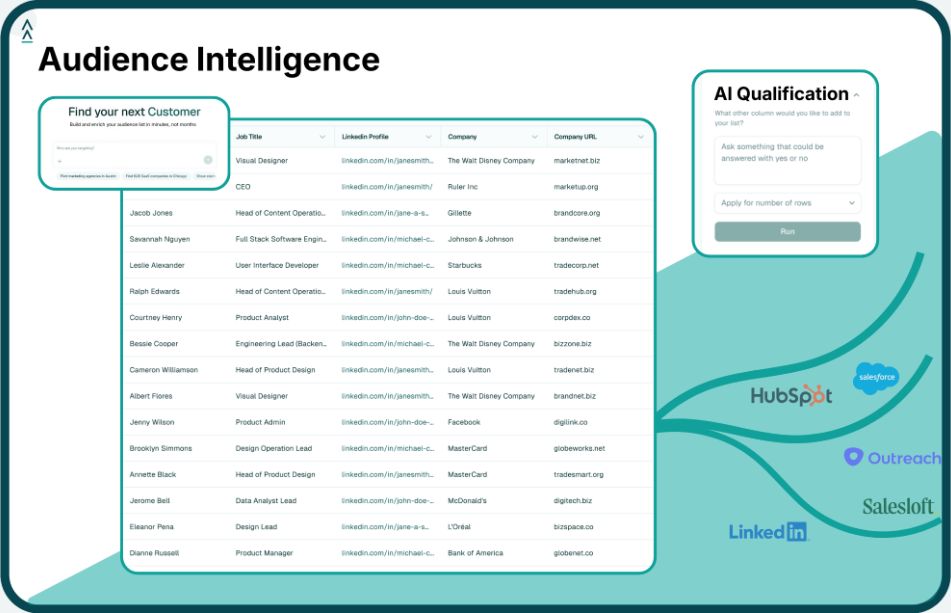
Growth Operations also enables more sophisticated audience targeting through AI-powered qualification. Platforms like Landbase's GTM-2 Omni allow teams to build targeted lists instantly using natural language prompts, then activate these AI-qualified audiences across their existing tools. This capability eliminates the traditional bottleneck of manual list building and ensures that outreach efforts are focused on prospects most likely to convert.
Successful Growth Operations rests on four foundational pillars that work together to create a systematic approach to growth.
The four operational pillars include:
Companies using weekly agile sprints to test marketing ideas and measure results can reduce launch delays by 30% and cut customer acquisition costs while improving conversion rates. This systematic approach transforms growth from guesswork into a repeatable, scalable process.
Landbase Intelligence supports these pillars by providing growth signals, Trust Score, and TAM data that inform strategic decisions. With access to 1,500+ unique signals and real-time market intelligence, Growth Operators can make data-driven decisions about where to focus their efforts for maximum impact.
AI has become the fundamental enabling technology for modern Growth Operations, transitioning from experimental to business-critical infrastructure in 2024-2025. The key shift is from reactive automation to proactive orchestration—AI agents that anticipate outcomes and recommend actions without human intervention.
AI applications in Growth Operations include:
Organizations using AI within Growth Ops frameworks report 2-3x better outcomes than those using AI in isolated functions, indicating the importance of systematic integration. However, AI implementations fail without unified data, clear processes, and organizational alignment that Growth Ops provides—AI doesn't fix broken operations; it accelerates good ones.
Landbase's VibeGTM interface exemplifies this AI-native approach, allowing users to "type a prompt and get an AI-qualified export" in seconds. This capability streamlines audience building for efficiency while ensuring that outreach efforts are focused on prospects showing genuine buying intent across 1,500+ unique signals.
While the terms Growth Operations and Revenue Operations are often used interchangeably, they represent fundamentally different approaches to business operations. Revenue Operations focuses primarily on aligning sales, marketing, and customer success around revenue generation and operational efficiency within those functions. Growth Operations takes a broader view, encompassing the entire growth engine including product development, customer experience, partner operations, and experimentation culture.
Key differences include:
Andy Mowat, VP of GTM Ops at Carta, argues that "If you're just reporting to the Head of Sales or Head of Marketing, you cannot drive deep change through the funnel." This organizational independence is crucial for Growth Ops success, as it enables objective decision-making that serves the entire business rather than individual departmental interests.
Customer Operations (CS Ops) represents the fastest-growing component of Growth Ops, reflecting the market reality that expanding existing customer relationships is often more cost-effective than acquiring new ones. This focus on customer expansion and retention distinguishes Growth Ops from traditional RevOps, which often treats customer success as secondary to new sales.
Growth Operations requires specialized organizational structures and skill sets that differ significantly from traditional departmental operations. The 2025 Growth Ops team includes diverse roles that work together to create unified operational excellence.
Essential Growth Ops roles include:
Organizations are shifting from departmental ops (Sales Ops, Marketing Ops) to centralized Growth Ops to eliminate silos and create one source of truth. This structural change requires careful change management and executive sponsorship to overcome organizational inertia.
The ideal Growth Ops team combines technical expertise with business acumen, requiring members who understand both the operational details of their specific functions and the broader strategic objectives of the organization. Cross-functional experience is particularly valuable, as Growth Operators must be able to translate between different departmental languages and priorities.
Growth Operations success is measured through a comprehensive set of metrics that span the entire customer lifecycle, not just revenue-related KPIs. These metrics provide the feedback loop necessary for continuous improvement and strategic decision-making.
Key Growth Ops metrics include:
Landbase helps gain insights with detailed performance metrics to monitor list quality and signal accuracy, enabling Growth Operators to make data-driven decisions about audience targeting and campaign optimization. This real-time visibility is crucial for agile optimization and rapid course correction.
The most effective Growth Ops teams establish dashboards that provide a single source of truth accessible to all customer-facing functions. These dashboards enable transparent performance tracking and create shared accountability for growth outcomes across departments.
Landbase stands out as a purpose-built platform for modern Growth Operations teams seeking to leverage AI for audience discovery and qualification. Unlike traditional data providers that require complex workflows and technical expertise, Landbase's GTM-2 Omni AI enables anyone to "find your next customer in seconds" using natural-language prompts.
The platform's free, no-login audience builder embedded on landbase.com eliminates the traditional bottleneck of manual list building, allowing Growth Operators to focus on strategic optimization rather than tactical execution. With access to 300M+ contacts and 24M+ companies across 1,500+ unique signals, Landbase provides the comprehensive data foundation that Growth Ops requires.
What truly differentiates Landbase is its AI Qualification capability—both online and offline—which ensures precision targeting by evaluating audience fit and timing across multiple dimensions. This goes beyond simple firmographic filtering to identify prospects showing genuine buying intent through signals like recent funding, job postings, technology stack changes, and website engagement.
For Growth Operations teams implementing the four foundational pillars, Landbase provides immediate value:
The platform's ability to export up to 10,000 contacts instantly and activate them in existing tools makes Landbase the ideal companion for Growth Ops initiatives seeking to accelerate revenue growth while reducing operational complexity.
The primary goal of Growth Operations is to transform fragmented marketing, sales, and customer success efforts into a unified, data-driven growth engine that maximizes customer lifetime value across the entire relationship. Unlike traditional operations that optimize for departmental efficiency, Growth Ops orchestrates the complete customer lifecycle around scalable systems and shared objectives. This approach creates intentional, predictable growth rather than relying on disconnected departmental efforts. Growth Ops enables companies to scale efficiently while maintaining alignment across all customer-facing functions.
Growth Operations differs from traditional business operations by focusing specifically on growth-related activities rather than general business efficiency. While traditional operations might optimize internal processes like HR or finance, Growth Ops unifies customer-facing functions around systematic growth frameworks. It emphasizes experimentation, cross-functional alignment, and data-driven decision making rather than maintaining existing workflows. Growth Ops treats the entire customer journey as an interconnected system that requires holistic optimization.
Essential technologies for Growth Operations include unified data platforms that eliminate siloed systems, AI-powered tools for predictive analytics and automation, CRM systems with cross-functional visibility, and experimentation frameworks that enable rapid testing. Platforms like Landbase that combine comprehensive data with AI-native interfaces are particularly valuable for enabling Growth Ops teams to move quickly without technical complexity. The key is integration—technologies must work together to create a single source of truth across all customer-facing functions.
Yes, small businesses can significantly benefit from Growth Operations principles, even without dedicated operational staff. The core concepts of data-driven decisions, experimentation, and cross-functional alignment apply at any scale. Small businesses often see faster results from Growth Ops implementation because they have fewer organizational silos to overcome and can adapt more quickly. Growth Ops frameworks help small companies establish scalable processes early, preventing the need for painful reorganizations as they grow.
Tool and strategies modern teams need to help their companies grow.