.png)
.png)
.png)

Daniel Saks
Chief Executive Officer


The knowledge management market is experiencing unprecedented growth, projected to exceed $74 billion by 2034 as AI transforms how organizations capture and leverage institutional knowledge. From enterprise AI search to industry-specific solutions, these 10 companies are leading the charge in making organizational knowledge accessible, actionable, and AI-ready. For go-to-market teams, knowing which platforms lead in AI-powered audience discovery and qualification is just as important as choosing the right knowledge management solution. Agentic AI platforms like Landbase now sit alongside these KM leaders, transforming how teams find and engage their ideal customers through natural-language targeting and AI-qualified audiences.
Glean provides AI-powered enterprise search that indexes information across 100+ internal applications, creating a unified knowledge layer that respects existing permissions. The platform connects disparate data sources including documents, emails, code repositories, and databases into a single searchable interface with natural language understanding.
Glean represents the enterprise search layer that organizations need to make their fragmented information architecture accessible and actionable. By connecting 100+ applications with real-time permissions enforcement, Glean enables employees to find what they need without switching context or compromising security. The platform achieved a $7.25 billion valuation in 2024, demonstrating investor conviction in AI-powered knowledge management as critical enterprise infrastructure. According to Forrester research, Glean saves up to 110 hours per user annually, with strong enterprise adoption across 100+ large enterprise customers.
Bloomfire offers an AI-powered knowledge management platform that features self-healing capabilities, deep indexing across all content formats (including video and audio), and AI-powered authoring tools. The platform enables organizations to create dynamic, AI-ready knowledge layers that automatically identify and flag stale or duplicate content.
Bloomfire is redefining knowledge management by moving from static storage to dynamic, self-maintaining knowledge systems. The platform's ability to automatically identify stale content and maintain knowledge quality addresses one of the biggest challenges in enterprise KM—keeping information current and relevant. This "self-healing" approach ensures that knowledge bases remain valuable assets rather than becoming liability sources of outdated information. The platform serves Global 2000 enterprises with enterprise-grade security (SOC2, GDPR compliant) and received recognition as one of KMWorld's 100 Companies That Matter in 2025.
ClickUp combines project management, documentation, and knowledge management into a single unified platform. The solution offers customizable workflows with goals, folders, whiteboards, and AI-powered writing assistance, enabling teams to manage both tasks and knowledge in one place.
ClickUp represents the convergence trend in knowledge management, where teams seek integrated solutions that combine task management with knowledge storage. By eliminating the need for separate PM and KM tools, ClickUp reduces context switching and ensures that project documentation stays connected to actual work. This integrated approach appeals to organizations looking to simplify their tech stack while maintaining comprehensive knowledge capture. The platform serves millions of users globally with highly customizable views and AI-powered task automation.
Guru specializes in knowledge verification and distribution, offering real-time knowledge verification workflows and browser extensions that deliver knowledge directly in context. The platform ensures information stays current through unique verification systems and integrates with CRM and support tools to provide knowledge without context switching.
Guru addresses one of the fundamental challenges in knowledge management—keeping information current. In fast-moving business environments, knowledge can become outdated quickly, leading to customer service issues and sales inefficiencies. Guru's verification workflows ensure that teams always have access to the most current information, while its in-workflow delivery model eliminates the need to switch between applications to find answers. The platform focuses specifically on sales and customer support teams, addressing critical business functions.
Notion provides an all-in-one workspace that combines notes, tasks, wikis, and databases in a flexible, blocks-based editor. The platform's modular system allows unprecedented customization, enabling users to create everything from personal notes to comprehensive company wikis with beautiful, consumer-grade UI.
Notion achieved explosive growth by making knowledge management accessible and beautiful for individual users and teams. The platform's viral adoption model demonstrated that compelling user experience could drive enterprise adoption without traditional sales motions. Notion's flexibility makes it suitable for diverse use cases, from personal productivity to comprehensive organizational knowledge bases, appealing to both individual contributors and enterprise teams. The platform has grown to serve over 30 million users with AI writing assistance and content generation capabilities.
Confluence is the market-leading team collaboration and documentation platform, offering team workspaces with pages, blogs, comments, and extensive template libraries. The platform integrates deeply with Jira and the broader Atlassian ecosystem, making it the gold standard for software development documentation.
Confluence remains the gold standard for software development documentation and technical knowledge bases. Its deep integration with Jira and other Atlassian tools creates a seamless workflow for engineering teams, ensuring that documentation stays connected to actual development work. This integration advantage makes Confluence difficult to displace in software organizations, where it has become essential infrastructure for technical knowledge management. The platform serves over 75,000 organizations and received recognition as one of KMWorld's 100 Companies That Matter in 2025.
Document360 specializes in self-service knowledge base creation for both customer-facing and internal documentation. The platform offers advanced analytics, content performance tracking, and strong customization options, focusing specifically on making knowledge accessible to end users without requiring support team intervention.
Document360 addresses the growing need for self-service knowledge bases, which are becoming essential for customer support efficiency and user satisfaction. By providing a specialized platform for both customer-facing and internal documentation, Document360 enables organizations to reduce support ticket volume while improving knowledge accessibility. The platform's focus on analytics helps teams understand which content performs best and continuously improve their knowledge base effectiveness. Recognized as one of KMWorld's 100 Companies That Matter in 2025, the platform primarily serves SaaS companies and product teams.
ServiceNow Knowledge Management provides enterprise-grade knowledge capabilities integrated within the broader ServiceNow platform. The solution offers structured knowledge creation with workflows and approvals, knowledge lifecycle management, and deep integration with IT service management (ITSM) processes.
ServiceNow Knowledge represents enterprise-grade KM at massive scale, integrated into the workflows of thousands of Fortune 500 companies. The platform's integration with IT service management ensures that knowledge creation and usage are embedded in actual business processes, rather than being a separate activity. This workflow integration makes knowledge management operational rather than optional, driving higher adoption and effectiveness in large enterprises. ServiceNow serves 7,700+ enterprise customers and maintains a market cap exceeding $150 billion.
Stardog Union provides an enterprise knowledge graph platform that enables organizations to connect disparate data sources through semantic relationships. The platform specializes in complex data relationships for regulated industries like pharma, finance, and supply chain, offering data fabric solutions and AI data assistants.
Stardog represents the knowledge graph approach to knowledge management, which is becoming critical for AI applications that need to understand complex data relationships. Unlike traditional search that finds documents, knowledge graphs understand the relationships between entities, enabling more sophisticated reasoning and inference. This technology is particularly valuable in regulated industries where understanding data lineage and relationships is essential for compliance and decision-making. The platform has raised $32.5M and ranks among the top 6 of 556 competitors.
Shelf.io is a next-generation knowledge management platform purpose-built for the generative AI era. The platform focuses on data quality and eliminating bad data in documents before it becomes bad GenAI answers, handling unstructured data specifically for AI applications.
Shelf.io addresses the critical challenge of ensuring knowledge quality for AI applications, positioning itself at the intersection of knowledge management and generative AI. As organizations increasingly rely on AI to answer questions and provide insights, the quality of underlying knowledge becomes paramount. Shelf.io's focus on data quality ensures that AI applications provide accurate, trustworthy responses rather than perpetuating errors or outdated information. The platform received recognition as one of KMWorld's 100 Companies That Matter in 2025 for its next-generation approach.
These fastest-growing knowledge management companies demonstrate how AI is transforming internal knowledge systems. However, having comprehensive internal knowledge is only half the equation for business success. Companies also need to understand their external market landscape—who their ideal customers are, what signals indicate buying intent, and when prospects are most receptive to outreach.
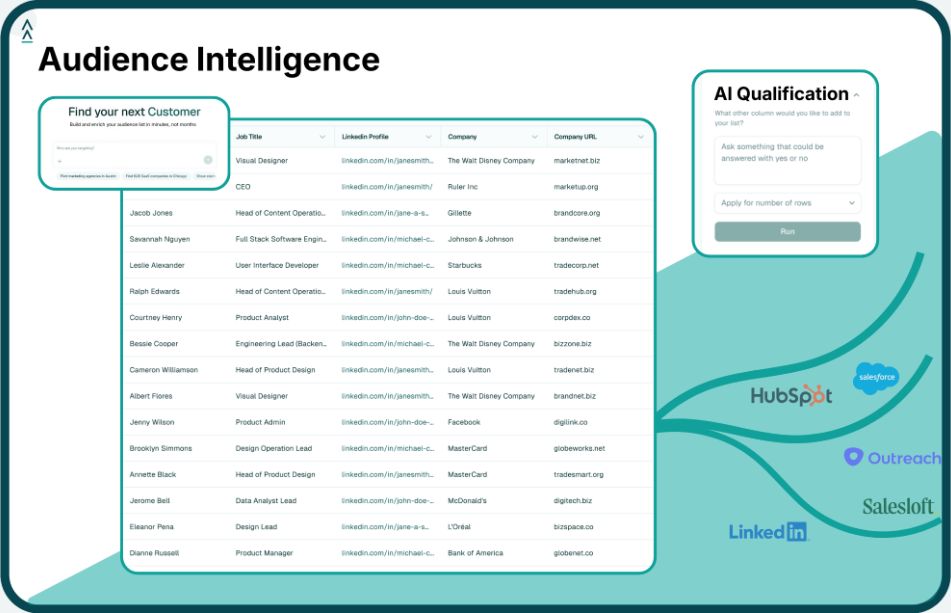
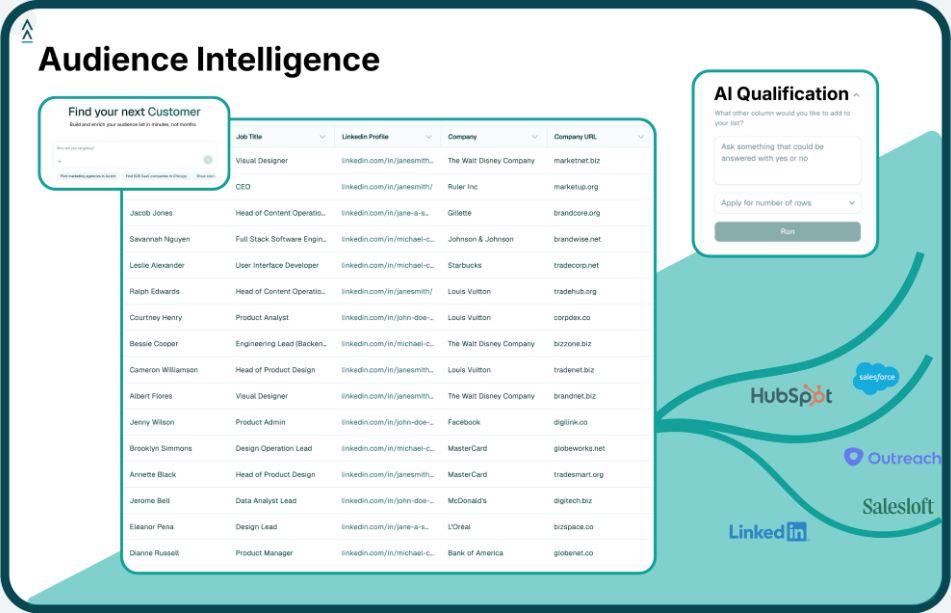
This is where AI-powered go-to-market platforms complement internal knowledge management systems. While KM platforms like Glean and Bloomfire help organizations leverage their internal knowledge, Landbase's agentic AI helps teams discover and qualify external prospects using natural-language targeting. By combining 1,500+ unique signals across firmographic, technographic, intent, hiring, and funding data, Landbase enables sales and marketing teams to build AI-qualified audiences in seconds.
For example, while a company's internal knowledge base might contain best practices for engaging cybersecurity prospects, Landbase can identify specific cybersecurity companies that are actively hiring for security roles, recently raised funding, or are attending relevant conferences like RSA Conference 2025. This external market intelligence, when combined with internal knowledge about effective engagement strategies, creates a powerful synergy that drives more effective go-to-market execution.
The knowledge management landscape is evolving rapidly, with two key trends shaping the future:
AI Integration as Standard: AI is no longer a differentiator but a requirement. Companies that fail to integrate AI capabilities into their knowledge management systems risk falling behind. The top performers on this list—Glean, Bloomfire, Shelf.io—all have AI at their core, whether for search, content verification, or GenAI readiness.
Vertical Specialization: While general-purpose platforms like Notion and ClickUp serve broad markets, specialized solutions like Bolo.ai (energy) and Seek (business intelligence) are gaining traction by addressing industry-specific challenges. This vertical approach allows for deeper domain expertise and more effective solutions for regulated industries.
For go-to-market teams, the implication is clear: effective knowledge management requires both internal systems to capture and organize institutional knowledge, and external intelligence platforms to understand market dynamics and identify high-value prospects. The combination of comprehensive internal knowledge and real-time external market intelligence creates a powerful foundation for AI-powered go-to-market strategies that can adapt to changing market conditions and customer needs.
Platforms like Landbase's VibeGTM interface enable teams to leverage external market intelligence through natural-language prompts, building targeted audiences based on real-time signals without requiring complex database queries or technical expertise. This accessibility, combined with the rich internal knowledge captured by the KM platforms on this list, creates a comprehensive intelligence foundation that drives more effective sales and marketing execution.
A fastest-growing knowledge management tech company demonstrates exceptional funding momentum through recent rounds in 2024, user adoption growth, valuation increases, and market expansion. These companies typically show strong investor confidence through significant funding rounds, growing customer bases, and innovative approaches to AI integration. For example, Glean's $7.25 billion valuation achieved through a $150M Series F round in 2024 exemplifies this growth trajectory, while newer entrants like Bolo.ai secured $8.1M in seed funding despite being founded only in 2024.
AI contributes to knowledge management effectiveness by enabling natural language search, automating content organization, ensuring knowledge freshness through verification workflows, and preparing knowledge bases for generative AI applications. According to McKinsey research, robust AI-enabled knowledge management systems can enhance productivity by up to 25% and reduce information search time by as much as 35%. AI also enables self-healing knowledge bases that automatically identify stale content before it affects search quality, as demonstrated by platforms like Bloomfire and Shelf.io.
High-growth knowledge management companies most demand AI engineers, data scientists, machine learning specialists, natural language processing experts, and product managers with AI experience. Companies like Glean (founded by former Google Search executives) prioritize advanced AI/ML talent to develop sophisticated search and indexing capabilities. Additionally, there's strong demand for domain experts in vertical-specific companies like Bolo.ai (energy industry specialists) and customer success roles to support enterprise implementations across platforms like ServiceNow and Confluence.
Innovative platforms like Landbase impact sales and marketing teams by enabling them to build targeted audiences in seconds using natural-language prompts instead of complex database queries. By leveraging 1,500+ unique signals across firmographic, technographic, intent, and behavioral data, teams can identify high-intent prospects based on real-time market signals like funding rounds, hiring activity, and technology stack changes. This capability complements internal knowledge management systems by providing external market intelligence that drives more effective go-to-market strategies, higher engagement rates, and better conversion outcomes when combined with the institutional knowledge captured in KM platforms.
Tool and strategies modern teams need to help their companies grow.