.png)
.png)
.png)

Daniel Saks
Chief Executive Officer


The fraud detection landscape is undergoing unprecedented transformation. In Q3 2025 alone, AI-powered fraud detection startups secured record-breaking funding as global fraud losses surpassed $500 billion in 2024. From Agentic AI defense to deepfake detection and behavioral biometrics, these companies are redefining how financial institutions, fintechs, and enterprises protect themselves against increasingly sophisticated threats. For go-to-market teams in the fraud detection space, identifying and engaging the right prospects at financial institutions requires precision targeting capabilities. Platforms like Landbase's agentic AI enable fraud detection vendors to find financial institutions actively researching security solutions, ensuring their AI-powered offerings reach the organizations that need them most.
Arkose Labs provides a proactive fraud deterrence platform specifically designed to neutralize AI agents and LLM-powered attacks. The company's technology focuses on stopping automated attacks before they can cause damage, using a combination of risk assessment and challenge mechanisms that distinguish between legitimate users and malicious bots.
Arkose Labs addresses the critical gap in fraud prevention as attackers increasingly deploy AI agents and LLM-powered bots. Their proactive approach prevents attacks rather than just detecting them after the fact, which is essential as 98% of enterprises express confidence in their current security but 71% lack Agentic AI capability. The company is the only fraud detection provider with 5 consecutive years on Deloitte's Technology Fast 500 (2021-2025), demonstrating exceptional and sustained revenue growth. The Fast 500 list includes companies that achieved revenue growth ranging from 122% to 29,738% from 2021-2024, validating Arkose Labs' position as an industry leader.
Funding details not publicly disclosed, though consistent Deloitte Fast 500 ranking demonstrates strong revenue growth and market validation.
SEON offers a unified fraud prevention and AML compliance platform powered by 900+ real-time data signals. The company serves major global brands with rapid deployment capabilities, averaging just 14 days to full operationalization compared to months for competitors.
SEON's 900+ proprietary data signals provide superior fraud detection compared to competitors relying on resold data. Their rapid deployment model enables businesses to implement robust fraud prevention quickly, which is critical as digital payment fraud losses continue to escalate. The company achieved #1 ranking on G2 for fraud prevention and demonstrated impressive customer results including 200 basis point improvement for Revolut and 32x ROI for Lottoland. Their ability to serve major global brands like Revolut, Plaid, Nubank, Afterpay, and Spotify validates their enterprise-grade capabilities.
Feedzai provides an AI-native financial crime prevention platform that processes 90 billion events annually and secures $8 trillion in payments. The company is the only vendor recognized as a leader in behavioral biometrics, transaction fraud, and AML simultaneously.
Feedzai's triple leadership status across behavioral biometrics, transaction fraud, and AML makes it uniquely positioned to address comprehensive financial crime prevention needs. Their partnership with the European Central Bank for digital euro fraud detection validates their enterprise credibility and technological sophistication in handling the most critical financial infrastructure. The company delivers 62% more fraud detected and 73% fewer false positives compared to previous solutions, demonstrating measurable impact on financial crime prevention.
Doppel specializes in AI-native social engineering defense, protecting organizations against impersonation and phishing attacks. The company's technology focuses on identifying and preventing sophisticated social engineering tactics that leverage AI to mimic trusted individuals or entities.
Doppel addresses the critical and growing threat of social engineering attacks, which have become increasingly sophisticated with AI assistance. As attackers leverage AI to create convincing impersonations, specialized defense platforms like Doppel are essential for protecting enterprise communications and preventing credential theft. The company's impressive valuation of over $600 million and investment from CrowdStrike CEO George Kurtz demonstrates strong market confidence in their AI-native approach to social engineering defense.
IVIX provides AI-powered financial crime detection specifically designed for government agencies and law enforcement. The company uses large language models and graph analytics to detect complex financial crimes including illicit offshore assets, layered money laundering, and cryptocurrency networks.
IVIX fills a critical gap in financial crime detection for public sector organizations. While most fraud detection companies focus on commercial applications, IVIX's government-specific approach addresses the unique challenges faced by law enforcement agencies in tracking sophisticated financial crimes that often cross international boundaries. Their technology combines LLMs with graph analytics to uncover hidden relationships in complex financial crime networks that traditional methods miss.
1Kosmos provides passwordless authentication and digital identity verification using AI-driven identity verification, biometric authentication, and blockchain-based identity proofing. The company focuses on preventing fraud through verified digital identities rather than just detecting fraudulent transactions.
1Kosmos represents the shift from reactive fraud detection to proactive fraud prevention through identity-first security. By eliminating passwords and establishing verified digital identities, the company addresses the root cause of many fraud attempts rather than just responding to symptoms. Their blockchain-based approach ensures identity data cannot be tampered with, providing a higher level of security than traditional authentication methods.
Chargeflow provides AI-powered chargeback management and friendly fraud prevention for eCommerce businesses. The company automates the entire dispute process, helping merchants recover revenue lost to chargebacks and reduce future chargeback rates.
Chargeflow tackles the growing problem of friendly fraud and chargebacks in eCommerce, which represents a significant revenue loss for online merchants. Their automated approach to dispute management helps businesses recover lost revenue while reducing the operational burden of manual chargeback handling. Founded in 2021, the company has demonstrated rapid scaling from $14M seed funding to a $35M Series A in just a few years, showing strong market demand for automated chargeback solutions.
Reality Defender specializes in deepfake detection and AI media verification, helping organizations identify and prevent fraud involving AI-generated media. The company was named "Deepfake Detection Company to Beat" by Gartner and won RSA's "Most Innovative Startup" award.
Reality Defender addresses one of the fastest-growing fraud vectors: AI-generated media. With 46% of businesses already targeted by deepfake identity fraud and $40B in fraud losses expected by 2027, their specialized detection capabilities are becoming essential for organizations across industries. The company's deepfake attacks increased 245% year-over-year in 2024, highlighting the urgent need for their solutions. Their recognition by Gartner and RSA validates their technological leadership in this emerging threat category.
Imper.ai provides real-time AI impersonation attack protection through an agentless platform that detects deepfakes and voice clones during live digital interactions. The company integrates with collaboration tools like Zoom and Slack to verify identities in real-time.
Imper.ai addresses the emerging threat of real-time AI impersonation during digital meetings and communications. As remote work and digital collaboration become standard, the ability to verify identities during live interactions is critical for preventing social engineering attacks and unauthorized access. Their agentless deployment enables easy integration without complex setup, making advanced impersonation protection accessible to organizations of all sizes.
Resistant AI provides AI-powered document fraud and money laundering detection, with a specialized focus on threats from generative AI. The company's technology detects fraudulent documents and identifies money laundering patterns using advanced machine learning models.
Resistant AI addresses the growing problem of AI-generated fraudulent documents used in identity theft, loan applications, and money laundering schemes. As generative AI makes document forgery increasingly sophisticated, specialized detection capabilities are essential for financial institutions and compliance teams. Their backing by DTCP and Google Ventures (GV) demonstrates strong investor confidence in their approach to combating AI-generated document fraud.
Sardine provides an AI risk platform specializing in behavioral biometrics for fraud, credit, and compliance. The company's proprietary device intelligence and behavior biometrics (DIBB) technology and True Piercing™ technology unmask fraudsters using advanced obfuscation techniques.
Sardine's fintech-first design and behavioral biometrics specialization make it particularly valuable for crypto, neobanks, and digital-first platforms. Their proven results with enterprise customers demonstrate the effectiveness of their approach in high-risk financial environments. The company achieved a 90% reduction in chargebacks for Novo, bringing their rate to 0.003% on $1B monthly volume. Having screened $385 billion+ in payments and profiled 2.14 billion+ devices, Sardine has demonstrated massive scale and operational capability.
The fraud detection industry is experiencing unprecedented demand driven by three key factors:
Within this rapidly evolving landscape, fraud detection vendors need sophisticated go-to-market strategies to reach the financial institutions, fintechs, and enterprises that need their solutions. This is where audience intelligence platforms become essential, enabling fraud detection companies to identify prospects actively researching security solutions based on their tech stack, funding rounds, and market signals.
Fraud detection vendors face a unique challenge: their ideal customers (financial institutions, fintechs, and enterprises) are often overwhelmed with security solution pitches. To break through, these vendors need precise targeting capabilities that identify prospects actively seeking fraud prevention solutions.
Landbase's GTM-2 Omni model addresses this challenge by enabling fraud detection companies to:
By combining comprehensive company data with agentic AI capabilities, fraud detection vendors can move beyond spray-and-pray outreach to precision targeting that delivers higher engagement rates and shorter sales cycles.
A fastest-growing fraud detection company demonstrates measurable growth through recent funding rounds (2024-2025), revenue expansion, customer acquisition, or market recognition like Deloitte Fast 500 rankings. These companies address emerging fraud vectors like AI-powered attacks, deepfakes, or social engineering, and have validated their technology with enterprise customers or government agencies. Growth indicators include significant Series A, B, or C funding rounds, rapid customer base expansion, and recognition from industry analysts or awards.
Agentic AI contributes to fraud detection by proactively identifying and neutralizing AI-powered attacks before they cause damage. Companies like Arkose Labs use agentic AI to distinguish between legitimate users and malicious bots in real-time. Others leverage AI to detect patterns in financial transactions, document verification, and behavioral biometrics that indicate fraudulent activity. The technology continuously learns and adapts to new attack methods, making it more effective than rule-based systems at catching sophisticated fraud attempts.
Fintech startups face challenges including balancing security with user experience, managing false positives that block legitimate transactions, and keeping up with rapidly evolving fraud techniques. They must also meet regulatory compliance requirements while working with limited budgets and technical resources. Solutions that deploy quickly (like SEON's 14-day average), integrate easily with existing tech stacks, and adapt to changing threat landscapes are particularly valuable for fintech startups navigating these challenges.
Funding rounds enable fraud detection companies to invest in R&D for emerging threat detection, expand their customer support and implementation teams, and build strategic partnerships with financial institutions. Recent funding rounds in 2024-2025 have been particularly focused on AI-powered fraud detection capabilities, with companies like SEON ($80M), Feedzai ($75M), and Doppel ($70M) using capital to scale their AI models and expand market reach. Funding also allows companies to scale their infrastructure to handle increasing transaction volumes and improve their detection accuracy.
Continuous data enrichment ensures fraud detection systems have access to the most current information about entities, transactions, and threat patterns in real-time. This includes updates on company status, executive changes, technology stack modifications, and emerging fraud indicators. Platforms that combine multiple data sources and update continuously can detect fraudulent patterns more accurately and reduce false positives. For example, SEON's 900+ data signals provide more comprehensive fraud detection than systems relying on static data or limited sources.
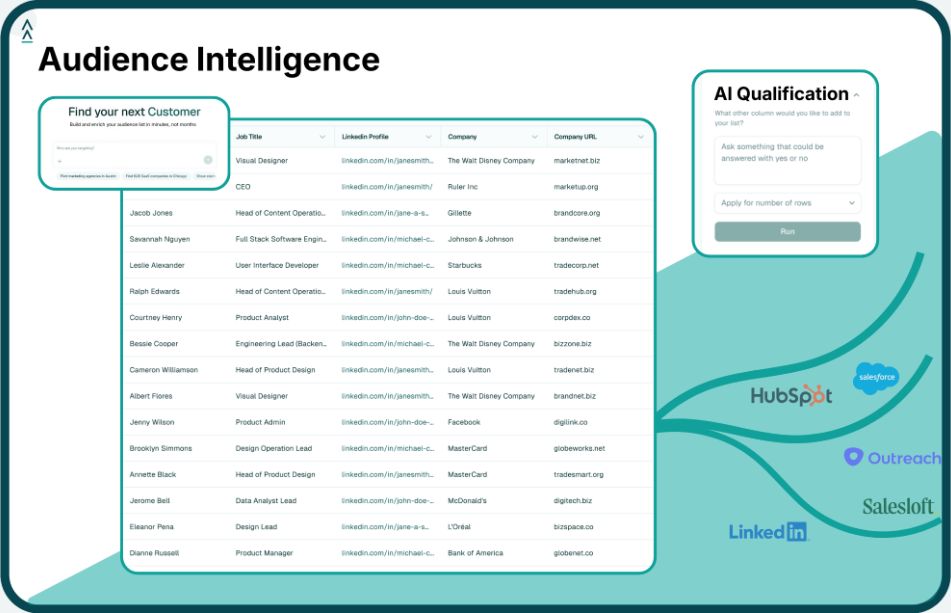
Tool and strategies modern teams need to help their companies grow.