.png)
.png)

Daniel Saks
Chief Executive Officer


If you are still stitching together three to five separate tools for contact data, enrichment, sequencing, and CRM syncing, you already know the problem. Your reps can easily spend $200-500 per user each month on a fragmented stack, and most of their outreach lands on prospects who have already made up their minds. Research shows that the vast majority of B2B buying groups have already ranked their preferred vendors before their first vendor contact, which means the best sales outreach tools in 2026 are not the ones that send the most emails, but the ones that reach the right person at the right moment.
The market is shifting just as quickly. Gartner predicts AI agents will significantly outnumber sellers in the coming years, and the Clari-Salesloft merger alongside Apollo's Pocus acquisition signal that consolidation is reshaping which platforms survive. Meanwhile, B2B contact data decays at roughly 30% per year, so the database you paid for six months ago is already a third obsolete. The best sales outreach tools on this list represent the strongest options across AI-native platforms, sequence automation, cold email scale, multi-channel personalization, and CRM-native outreach. Whether you are running a five-person SDR team or a 50-rep enterprise floor, there is a sales outreach tool here built for your workflow.
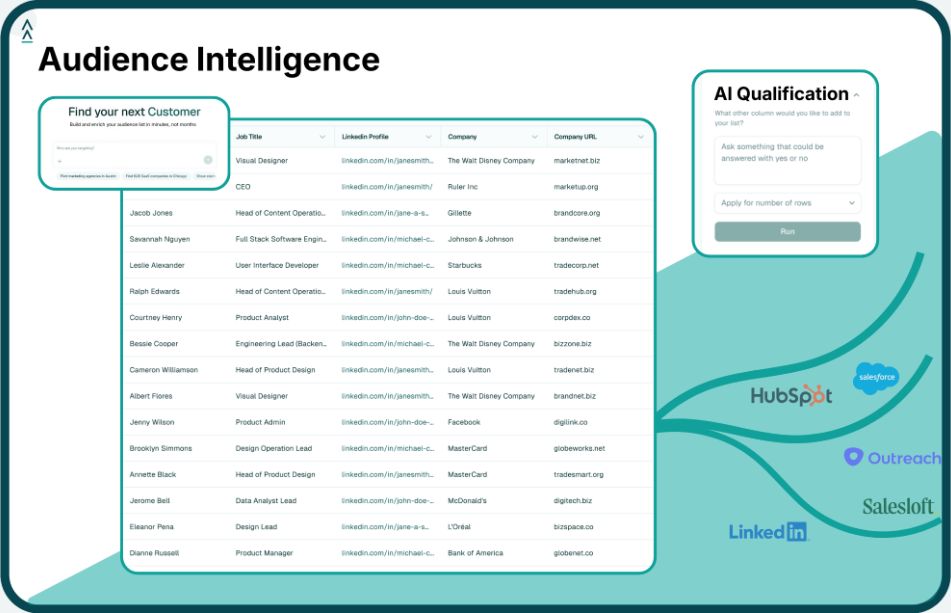
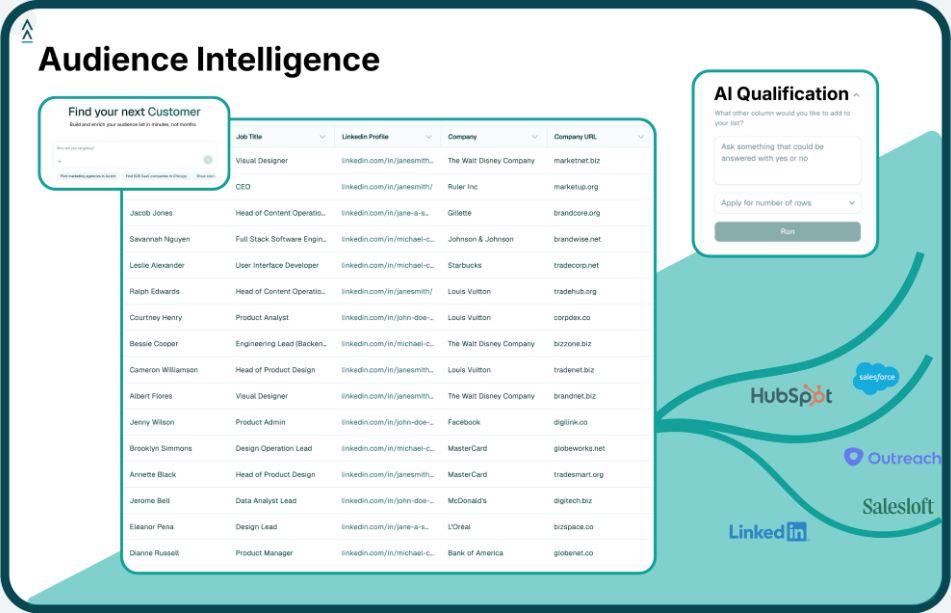
Landbase is an agentic AI platform purpose-built for go-to-market teams that want to move past the traditional stack of disconnected data, enrichment, and sequencing tools. Instead of requiring you to manually build prospect lists, enrich records, write personalized messages, and then load everything into a separate sequencer, Landbase's autonomous AI agents handle the entire workflow from signal-qualified prospecting through personalized multi-channel outreach.
The platform runs on three specialized AI agents, Research, Identity, and Predictive, that work together to identify which accounts are showing real buying signals, enrich contacts with 1,500+ data fields per record, and generate personalized messaging tailored to each prospect's context. That depth matters: most outreach tools give you 30-50 firmographic data points per contact. Landbase provides over 1,500 enrichment fields, which means its AI agents have substantially more context to qualify leads and personalize outreach. The platform's proprietary GTM-2 Omni model powers autonomous prospecting and outreach execution, so your team can describe their ideal customer profile in plain English and let the system find, qualify, and engage matching contacts from a database of 300M+ verified records.
What separates Landbase from the rest of this list is the signal-driven approach. Rather than batch-and-blast cadences that spray emails at static lists, Landbase uses real-time buying signals to determine not just who to reach, but when to reach them. The results back this up: P2 Telecom added $400K in MRR using Landbase's AI-qualified pipeline. Oyster saw 40%+ conversion improvement with signal-qualified outreach. QA Wolf reported a 50% improvement in lead quality. Named a Gartner Cool Vendor and backed by $42.5M in total funding including a $30M Series A, Landbase is built for teams that want to replace multiple GTM tools with a single AI-driven platform that handles prospecting, qualification, and outreach in one system.
Key features:
Best for: B2B sales teams that want an end-to-end AI-native platform combining contact data, signal-based qualification, and automated outreach, without managing a stack of separate tools.
Apollo.io is an all-in-one prospecting and engagement platform that has become one of the most widely adopted sales outreach tools for growing B2B teams. Its contact database, which Apollo's public materials currently place at roughly 210M to 230M+ contacts depending on the page, combined with a built-in email sequencer means teams can prospect and execute outreach without switching between separate data and engagement tools. The platform offers a free tier to get started, which makes it accessible for startups and solo SDRs who need to get outreach running quickly.
Apollo's built-in sequencer supports multi-step email campaigns with A/B testing and conditional logic. The platform recently acquired Pocus to add signal intelligence capabilities, signaling a move toward buying-signal-based selling. That said, Apollo's credit system can create unpredictable costs at scale, actual spending can climb well above the advertised $49/user/month starting price once credit overages and add-ons are factored in.
Key features:
Best for: Early-stage and mid-market GTM teams wanting an all-in-one prospecting and engagement platform at an accessible entry price.
Outreach is a pure sales engagement platform built for enterprise teams that need sophisticated multi-step sequence automation. Its strength is the cadence builder, which mixes calls, emails, and social touches with behavioral branching, letting reps create complex workflows that adapt based on how prospects interact with each touchpoint. Outreach integrates deeply with Salesforce and provides revenue analytics dashboards for tracking pipeline health.
Outreach does not include a contact database or enrichment layer. It is a sequence execution engine, which means you need a separate data provider feeding it. The platform does not publish pricing and requires annual contracts. Third-party estimates place entry pricing around $100-$120/user/month on annual terms, with implementation fees possible on top of that.
Key features:
Best for: Enterprise sales organizations already invested in Salesforce that need advanced sequence automation and revenue analytics.
Salesloft is a sales engagement platform that merged with Clari in December 2025 to create a combined entity with substantial annual recurring revenue. The merger brings together Salesloft's cadence execution with Clari's revenue intelligence and pipeline forecasting, positioning the combined platform as a "Predictive Revenue System." Salesloft publicly promotes dozens of AI agents for research, email writing, call scripts, and analytics, and its Salesforce integration is well-regarded on G2 for accuracy and reliability.
The Clari merger is still integrating, which means customers may face platform changes in the near term. Salesloft uses per-seat annual contracts with 12-month minimum commitments. Third-party pricing estimates suggest base pricing in the range of $125-180/user/month, with a 50-seat Premier deployment running $125,000-140,000/year. Add-ons for calling and chatbot features may cost an additional $300-400/user/year.
Key features:
Best for: Mid-to-enterprise teams wanting cadence execution plus revenue forecasting with strong CRM integration.
Saleshandy is a cold email outreach platform built for teams that prioritize sending volume and deliverability above all else. Its B2B Lead Finder provides access to 852M+ professional contacts and 42M+ company profiles, making it one of the larger databases among email-focused outreach tools. The platform includes an AI Sequence Copilot that helps build email campaigns, along with a built-in email warmup suite and unified inbox for managing replies.
Saleshandy is particularly popular with agencies because of its multi-client management features. Pricing starts at $36/month ($25/month billed yearly) for the Outreach Starter plan, scaling to $99/month ($69/month yearly) for Pro and $199/month ($139/month yearly) for Scale. That is significantly cheaper than enterprise engagement platforms. The trade-off is that Saleshandy is primarily an email tool. If your team needs multi-channel outreach across LinkedIn, phone, and SMS, you will need additional tools.
Key features:
Best for: Teams and agencies focused on cold email outreach at scale who want a large database and strong deliverability tooling at a budget-friendly price.
Lemlist is a multi-channel outreach platform that emphasizes deep personalization across email, LinkedIn, WhatsApp, and phone. Its standout feature is Liquid syntax personalization, which lets users create highly dynamic message templates that adapt to each prospect's data fields, going beyond basic first-name merge tags to conditionally adjust entire paragraphs based on industry, role, or company attributes. The platform includes a 600M+ contacts database and built-in email and phone finder.
Lemlist's Email Pro plan starts at $63/month per user, with the Multichannel Expert plan at $87/month per user. WhatsApp automation is available as a $20/user/month add-on on eligible plans, rather than bundled into every tier. Lemlist's strength is the personalization engine, but teams needing advanced analytics, revenue forecasting, or deep CRM integration beyond basic syncs may find the platform limited for those specific use cases.
Key features:
Best for: Teams that want personalized multi-channel outreach with built-in prospecting data and need to go beyond basic email sequences.
Reply.io is an AI-powered sales engagement platform that features Jason AI, an autonomous AI sales agent that handles prospecting, message writing, and follow-up replies. The platform provides access to 1B+ B2B professional contacts and supports multichannel sequences across email, SMS, WhatsApp, and LinkedIn. Reply.io's AI engine helps generate and optimize outreach messages, and its CRM integrations cover Salesforce, HubSpot, and Pipedrive.
Pricing starts at $49/user/month. Reply.io positions itself as an AI-first tool for smaller teams that want automation without enterprise complexity. Jason AI can generate contextual responses to prospect replies, which reduces the manual burden on SDRs managing high-volume campaigns.
Key features:
Best for: Small-to-midsize teams wanting an AI assistant to handle prospecting and multichannel follow-up without a steep learning curve.
Klenty is a multi-channel sales engagement platform that has invested heavily in AI capabilities, including SDRx for autonomous account intelligence, Agentic Cadences, AI Account Research, and Schedule IQ for AI-powered meeting scheduling. The platform supports cadences across email, LinkedIn, SMS, WhatsApp, and phone, making it one of the more channel-diverse options on this list. Klenty integrates natively with both Salesforce and HubSpot and includes AI lead scoring to help reps prioritize their outreach.
Pricing starts at $50/month. While Klenty does not offer a database on the scale of some competitors, current plans include AI List-Building, AI Data Enrichment, and AI Account and Prospect Research, giving teams a meaningful built-in data layer. Its strength is orchestrating complex multi-channel workflows for teams that need an execution layer enhanced by AI intelligence.
Key features:
Best for: Sales teams building complex multi-channel workflows that need AI-powered account intelligence and meeting scheduling.
Instantly.ai is an email-first outreach platform that has gained popularity for its focus on deliverability and volume. The platform allows unlimited email sending accounts, which gives teams flexibility to distribute send volume across multiple domains and maintain inbox placement. Its advanced email warmup tools and AI Copilot for campaign optimization make it particularly effective for teams running high-volume cold email campaigns.
Pricing starts at $30/month, making it one of the most affordable options on this list. Instantly.ai also offers intent-based prospecting with website visitor identification, adding a signal layer to its email-centric approach. The platform includes a native CRM, so teams focused purely on email outreach may not need a separate pipeline management tool.
Key features:
Best for: Teams prioritizing email deliverability, high send volume, and affordable entry pricing who want strong inbox placement.
Before comparing features or pricing, start with the question that determines whether any sales outreach tool actually works: how good is the contact data going into it?
B2B contact data decays at roughly 30% per year, people change jobs, companies restructure, emails go stale. The costs compound quickly. Bad data means bounced emails that damage your sender reputation, wasted rep hours on prospects who left the company months ago, and forecasts built on pipeline that does not actually exist.
This is why the best sales outreach tools in 2026 either include a large, frequently verified contact database or integrate deeply with a reliable data provider. Tools with built-in databases, Landbase (300M+ contacts with 1,500+ enrichment fields), Apollo.io (210M-230M+), Saleshandy (852M+), Reply.io (1B+), eliminate the need for a separate data subscription and reduce the integration points where records can fall out of sync. Sequence-only tools like Outreach and Salesloft are powerful execution engines, but they require you to solve the data quality problem separately before a single cadence step fires.
The takeaway: calculate your cost per meeting booked, not just your software cost per seat. If 30% of your outreach hits invalid contacts, you are effectively paying 30% more for every tool in your stack.
Choosing the best sales outreach tools for your team starts with your primary workflow gap. If your reps spend hours manually building lists and researching accounts before they can send a single message, you need a platform that handles prospecting and qualification, not just sequence execution. If your data and lists are solid but you need better multi-channel automation, a cadence-focused sales outreach tool will deliver more immediate value.
Consider total cost of ownership, not just the per-seat sticker price. A $49/user/month tool that requires a separate $100/user data provider plus a $30/user deliverability tool costs more than a unified platform. Factor in credit overages, add-on fees, and onboarding costs when comparing options.
Your outreach tool is only as useful as its connection to your CRM. Look for bidirectional sync that goes beyond surface-level logging, you need full activity tracking (emails sent, replies received, calls logged), custom field mapping, permission controls, and trigger-based automation that moves deals through stages automatically. A weak CRM integration can create manual data entry that can cost reps hours each week and makes pipeline reporting unreliable.
The biggest shift in 2026 is the move from rule-based sequences to agentic AI. Traditional outreach tools automate steps you define, send email on day 1, follow up on day 3, call on day 7. Agentic AI platforms go further by autonomously researching accounts, qualifying prospects based on real-time signals, generating personalized messaging, and adjusting outreach timing based on prospect behavior. Gartner predicts AI agents will significantly outnumber sellers in the coming years, which means teams adopting agentic outreach now will have a structural advantage over those still running manual cadences.
The sales outreach software market in 2026 is splitting into two camps: sequence execution tools that automate the act of sending, and AI-native platforms that automate the entire pipeline from prospecting through personalized engagement. Both have their place, but the gap between them is widening. Picking the best sales outreach tools requires understanding where that gap matters for your team.
The data makes the case clearly. Most SDR outreach effort produces no meaningful engagement, with reps averaging only a handful of quality conversations per day despite high activity volumes. The teams seeing the strongest ROI are the ones that prioritize precision targeting and smarter touchpoints over raw volume.
For most B2B teams evaluating their outreach stack today, the strongest path forward is a platform that eliminates the need to manage separate tools for data, enrichment, signals, and sequencing. Landbase does this by combining 300M+ verified contacts, autonomous AI agents, and real-time buying signals in a single system, so your team spends time closing deals instead of assembling workflows. The signal-driven approach to outreach consistently delivers higher conversion rates than volume-based cadences because it prioritizes reaching prospects who are actively showing buying intent.
Whether you go with an AI-native platform, an enterprise engagement tool, or a budget-friendly cold email solution, the key is matching the tool to where your team actually loses time. Map your current workflow from list building through reply handling, calculate your true per-rep cost including every tool in the stack, and choose the platform that eliminates the biggest friction point. The teams seeing the strongest results in 2026 are the ones that stopped optimizing individual steps and started automating the entire pipeline.
Sales outreach tools are software platforms that help B2B sales teams find, contact, and engage potential customers through email, phone, LinkedIn, and other channels. The best sales outreach tools range from simple email sequencers to full-stack platforms that combine contact databases, AI-powered personalization, multi-channel automation, and analytics. The core function is automating repetitive outreach tasks so reps can focus on conversations that convert.
Sales engagement platforms (like Outreach and Salesloft) focus on executing multi-step communication sequences, they automate the sending. Sales outreach tools is a broader category that includes both engagement platforms and all-in-one solutions that also handle contact discovery, data enrichment, and lead qualification. The distinction matters because engagement-only tools require a separate data provider, while end-to-end outreach platforms bundle everything together.
Traditional sequence tools automate the mechanics of sending emails and scheduling follow-ups on a fixed cadence. AI-powered outreach tools go further by automating research, qualification, and personalization, determining which prospects to contact and when, based on real-time signals rather than static lists. Gartner predicts AI agents will significantly outnumber sellers in the coming years, which suggests the shift toward AI-native outreach is accelerating, not slowing down.
Pricing varies widely. Cold email tools like Saleshandy start at $36/month ($25/month billed yearly) and Instantly.ai at $30/month. Mid-range platforms like Apollo.io and Reply.io start at $49/user/month, though credit-based pricing can push actual costs higher. Enterprise engagement platforms like Outreach and Salesloft do not publish official pricing; third-party estimates typically place them in the $100-180/user/month range on annual contracts, with onboarding fees possible. Unified AI platforms offer platform-based pricing that can be more cost-efficient than stacking separate tools.
Prioritize these capabilities based on your team's needs: (1) contact data quality and database size, (2) multi-channel support beyond just email, (3) AI features for personalization and qualification, (4) email deliverability and warmup tools, (5) CRM integration depth with your existing system, (6) intent signals or buying signal detection, (7) transparent and predictable pricing at your team's scale, and (8) analytics for measuring reply rates, conversion rates, and pipeline contribution.
For multi-channel outreach orchestrating email, LinkedIn, phone, SMS, and other channels from a single platform, the top options include Landbase (AI-driven multi-channel with signal-based targeting), Lemlist (personalized multi-channel with Liquid syntax), Klenty (complex multi-channel workflow automation), and Reply.io (AI-assisted multichannel sequences). Pure email tools like Saleshandy and Instantly.ai focus specifically on email volume and deliverability.
Effective outreach automation goes beyond scheduling emails on a timer. Start with accurate contact data, B2B contact data decays at roughly 30% per year, so stale lists waste automation budget. Layer in buying signals to prioritize prospects showing active intent. Use AI personalization to tailor messages to each prospect's context rather than relying on generic templates. Finally, orchestrate across multiple channels, multi-channel outreach data consistently shows higher response rates than single-channel email sequences alone.
At minimum, your sales outreach tool should offer bidirectional sync with your CRM (Salesforce, HubSpot, or Pipedrive) that includes full activity logging, custom field mapping, and automated deal stage updates. Surface-level integrations that only push contact records without tracking email opens, replies, and call outcomes create blind spots in your pipeline reporting. The best sales outreach tools also support trigger-based automation, for example, automatically enrolling a contact in a nurture sequence when their deal stage changes, or alerting a rep when a previously cold prospect re-engages.
Deliverability is the invisible factor that determines whether your outreach ever gets seen. The average cold email open rate in 2026 is approximately 27.7%, but that drops significantly if your emails land in spam. Key deliverability features to look for include email warmup tools that gradually build sender reputation, domain rotation across multiple sending accounts, SPF/DKIM/DMARC authentication support, and bounce detection that automatically removes invalid addresses. Tools like Instantly.ai and Saleshandy have made deliverability infrastructure a core selling point, while platforms like Landbase address the problem upstream by ensuring contact data is verified and enriched before outreach fires.
Tool and strategies modern teams need to help their companies grow.