.png)
.png)

Daniel Saks
Chief Executive Officer


.png)

Buying signals are the actionable clues that a B2B prospect is entering a buying cycle – hints that your next customer might be ready for a conversation. For go-to-market (GTM) teams in sales, RevOps, and marketing, recognizing these signals can be a game-changer. Why? Consider this: at any given time, only about 2–5% of your target market is actively looking to buy. The rest aren’t in-market yet. And when outreach isn’t timed to real buyer interest, it falls flat – over 70% of B2B buyers say they ignore cold outreach that feels generic or poorly timed.
When companies are hiring aggressively or making strategic new hires, it often signals upcoming changes – and potential purchase needs. Major leadership appointments are especially powerful buying signals. A new C-suite executive (think a new CTO or CMO) will often reset priorities and revisit vendor relationships. Early in their tenure, they’re looking to make an impact, which can mean exploring new tools that align with their vision. For example, a newly hired VP of Sales might be open to revamping the sales tech stack to hit ambitious growth targets.
Even beyond the C-suite, spikes in hiring within certain departments can telegraph where a company is investing. If a SaaS firm suddenly lists 20+ openings for engineers, they’re gearing up to build and innovate – possibly in need of DevOps tools, cloud services, or project management software. A wave of sales or marketing hires could indicate a focus on demand generation, suggesting openness to new CRM, enablement, or automation platforms. In essence, hiring momentum = growth mode, and growth mode often triggers buying activity. In fact, industry observations show an increasing share of B2B buyers only engage with sales after internal “buying signals” like key hires appear. The hiring itself creates pain points (onboarding, new workflows, bigger targets) that your solution might solve.
How to leverage hiring signals: Monitor press releases and LinkedIn for announcements of new executives or teams expanding. Some sales intelligence tools (like LinkedIn Sales Navigator or signal intelligence platforms) flag when target accounts add jobs or appoint roles that align with your product’s use cases. A well-timed outreach – say, congratulating a new CIO and noting how your solution can help them score a quick win in their first 90 days – can land with uncanny relevance. By focusing on companies already in motion, you’re no longer pushing a rope; you’re harnessing existing momentum.
New funding is one of the clearest buying signals in B2B sales. When a company raises a significant round of capital – whether a $5M Series A or a $50M Series C – two things usually happen. First, they now have budget to spend. Second, that funding typically comes with pressure to grow, fast. In other words, they have the means and the mandate to invest in new solutions.
The scale of this opportunity is huge. In 2024 alone, global venture capital investment reached nearly $314 billion – that’s thousands of companies entering “stronger budget cycles” virtually overnight. For GTM teams, a funding announcement is like a starting pistol: it’s the moment to reach out with a relevant, value-focused pitch. Timing is everything – which is why reps who pounce early often win the race. For instance, consider the difference between a generic pitch and one sent hours after a prospect announces a funding round. Common sense says the latter gets a warmer reception, and data backs it up: trigger-based outreach campaigns tied to events like funding can outperform generic cold outreach by huge margins (one study noted up to 497% higher engagement in certain use cases).
Why funding signals work: New funding usually precedes big initiatives. A company that just raised capital may plan to expand headcount (hinting at needs for HR and IT tools), enter new markets (geographic expansion needs), invest in scaling infrastructure, or outpace competitors. They’re also likely reevaluating vendors – with money to spend, “good enough” solutions may no longer cut it. This creates an opening for your product, if you can connect your value to their growth plans.
How to leverage funding signals: Set up alerts via platforms like Crunchbase, Owler, or Google News for funding news on target accounts or industries. When a funding event hits, personalize your outreach to acknowledge it – “Congrats on the Series B! Many companies in your shoes invest in automating X at this stage…here’s how we can help with that.” Being prompt matters: vendors that respond first often get the first shot at the deal, and roughly 35–50% of sales go to the supplier who engages a prospect first. Funding signals give you the jumpstart to be that first responder with a solution for their next phase of growth.
A prospect’s technology stack – the tools and platforms they use – is a living, breathing thing. When you see signs that a company has added, dropped, or replaced a technology in their stack, it’s a valuable buying signal. These technographic signals tell you about evolving needs or new “stack gaps” you might fill, as well as potential compatibility or competitive insights:
Technographic changes are frequent. The average company uses over 100 SaaS applications to run its business, and that number shifts as they grow or consolidate. Tech stacks are reviewed regularly; budgets shift to new priorities; older systems get upgraded. For GTM teams, watching these moves is critical. For example, if your product integrates with Slack and you see a target account just adopted Slack enterprise-wide, that’s a green light — the environment is now primed for your complementary solution. On the flip side, if they’re heavily using a competitor’s product, you might tailor your messaging around differentiation or integration benefits.
How to leverage technographic signals: Use tools and databases (like BuiltWith, G2 Stack, or other sales intelligence platforms) to track the technologies your prospects use. Many will flag “newly added technology” or “recently dropped” in their profiles. You can also follow engineering blogs or release notes from companies which sometimes mention new tools or vendors in use. When you approach a prospect, referencing their current tech environment shows instant credibility – e.g., “I noticed you’re using XYZ; our solution connects with that to eliminate [specific pain point].” This turns a cold outreach into a consultative conversation. It also helps you prioritize: focus on accounts whose tech maturity or recent changes align best with the problems you solve.
When a company expands geographically – whether opening a new office, entering a new regional market, or even relocating its headquarters – it’s more than just an announcement on a press release. It’s a buying signal that often indicates looming needs for support, services, and infrastructure in unfamiliar territory.
Think about a fast-growing software company opening its first European sales office, or a manufacturing firm expanding operations from the U.S. into Asia. These moves create immediate challenges: new regulatory environments, new customer segments, supply chain adjustments, hiring in new locales, and so on. To address these, companies frequently need new vendors or tools. For instance, a company expanding internationally might suddenly require multilingual customer support software, regional compliance consulting, local market research, or country-specific HR and payroll systems. An office opening in a new city could drive needs for local IT services, physical infrastructure, or new communication tools for distributed teams.
In short, expansion = opportunity for GTM teams. Companies in expansion mode are in growth mindset; they’re investing rather than cutting costs. They’re also more likely to switch things up – since entering a new market often means rethinking existing processes. As a sales or marketing pro, if you can tie your solution to smoothing their expansion, you’ll get attention. For example, “I saw you’re expanding to APAC – congrats! Typically, companies at this stage struggle with X; our platform has helped others entering new regions to solve exactly that, faster.”
How to leverage expansion signals: Keep an eye on news wires, the company’s own press releases, and local business journals for mentions of new offices, data centers, retail locations, or market entry announcements in your industry. Territorial sales reps should align these signals with their patch – if one of your target accounts is moving into your region, that’s a perfect icebreaker for a meeting. Additionally, tools that track facility and location data (even something like job postings that mention a new city) can tip you off to expansions. Timing your outreach around these events can dramatically increase relevance – you’re aligning with a strategic priority the moment it unfolds. In fact, reaching out in the wake of a major expansion or relocation can feel less like a cold call and more like well-timed advice, which is exactly the dynamic you want.
Not all buying signals are loud and public like a funding round or a press release. Some are subtle “digital body language” that indicate an account is warming up to a purchase. These intent signals come from buyer research and behavior. Think of them as the breadcrumb trail B2B buyers leave as they educate themselves long before they ever talk to sales.
Today’s B2B buyers are famously self-driven in research – studies show they spend 50% of their buying time seeking information from third-party sources (industry sites, reviews, forums, etc.). And 81% of sales reps say buyers are doing more pre-purchase research on their own than in the past. All this happens behind the scenes, but it generates data: content downloads, webinar attendances, website visits, whitepaper reads, comparisons on review sites, search queries for specific solution terms. These are intent signals that a savvy GTM team can use to gauge interest before a prospect raises their hand.
Examples of warming signals: an account spiking on intent data for “network security software” (suggesting they’re actively investigating solutions in that category), or a target company with multiple team members suddenly frequently visiting your pricing and case study pages. Maybe a prospect has been asking questions on social media about problems your product solves, or their CTO just published a blog about a challenge that aligns with your value prop. Each of these is a clue – a signal that, while there’s no explicit project yet, the pot is heating up.
How to leverage intent signals: Intent data providers (Bombora, ZoomInfo Intent, TechTarget, etc.) aggregate web-wide behavior to alert you when companies are surging on topics relevant to you. Your own marketing automation and web analytics can show which accounts are engaging with your content or website. The key is to separate real signals from noise. A single whitepaper download might not mean much, but multiple stakeholders from the same company showing interest in your category is a stronger signal of a buying committee mobilizing. Use these insights to prioritize who you reach out to and tailor your message: e.g., “I noticed your team has been exploring resources on [topic] – typically when we see that, it’s because companies are trying to solve [pain]. Are you finding that as well?” This catches them early in the journey, potentially before competitors, and positions you as a helpful advisor rather than a late-stage vendor.
One caution: intent signals alone can produce false positives (lots of “interest” that never converts). It’s here that layering signals together becomes crucial – which brings us to differentiating intent data from broader buying signals.
It’s important to clarify the difference between generic intent data and the broader concept of buying signals – and why the magic happens when you combine multiple signals. Intent data typically refers to behavioral indicators of interest, usually content consumption like web searches or downloads. On its own, intent data tells you who is researching a topic, but not necessarily why or how likely they are to act. That’s where other buying signals (the trigger events) come in.
Think of it this way: trigger events tell you why an account might care, and intent signals tell you whether that interest is turning into action. If a company just hired a new CFO or got a big funding round – that disruption provides a why, a potential motivation for change. But you still need to confirm if they’re acting on that potential, which is where intent and engagement signals help (are they actively looking into solutions?). On the flip side, if you see intent activity from an account but there’s no discernible business trigger, it could be just academic research or low-level tire-kicking. Without a trigger event, intent signals can be just noise; and without intent signals, a trigger event is just an interesting fact. The strongest approach is layering both: trigger events create the urgency, signals confirm the momentum.
Sales experts note that this layered “signal intelligence” is far more precise. One GTM advisor put it succinctly: the mistake teams make is assuming signals replace trigger events – they don’t. You need both pieces. This is why organizations that relied on intent data alone often found pipeline quality lacking – lots of leads that looked interested (visited a bunch of webpages, etc.) but never bought anything because there was no true catalyst. As Brian Carroll explained, this is also why pipeline can still break when marketing hands off intent leads without context: the account may show interest (signals) but lack real motivation unless there’s a business change driving it.
In practice, signal layering means, for example, not just jumping on an intent surge in isolation, but checking for complementary signals. Did that surge coincide with a new VP hire or a budget increase at the account? That combo is gold. Or if a prospect just announced an expansion (trigger) and then your web analytics shows them visiting your product comparison page (intent) – you have both the why and the action, indicating a high likelihood they’re entering a buying cycle now. Sales teams leveraging this layered approach can prioritize with much greater confidence.
The results speak for themselves. Companies that master signal layering see higher conversion rates and faster sales cycles. One SaaS provider found that targeting accounts where a specific trigger (CEOs talking about “innovation” publicly) was present, combined with tailored content, made those accounts 4× more likely to buy than those without that trigger. And broadly, sales outreach that’s informed by relevant signals (intent + triggers) consistently outperforms static, one-dimensional prospecting. Reps get more replies, more meetings, and ultimately more wins because they’re aligning sales effort to real buying readiness.
To truly appreciate buying signals, let’s connect them to four core GTM objectives: prioritizing who to go after, timing your engagement, qualifying the right prospects, and gaining an upper hand on competitors. Here’s how live signals make a difference in each area:
In summary, buying signals transform GTM efforts from volume-based guessing to precision targeting. They enable what every revenue team craves – doing more with less, by focusing on the right prospects at the right time with the right message.
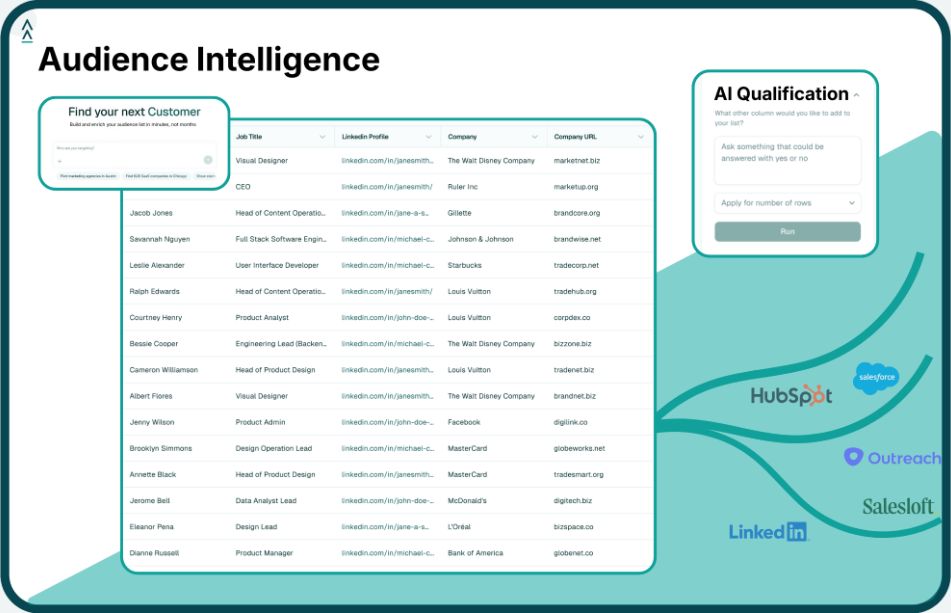
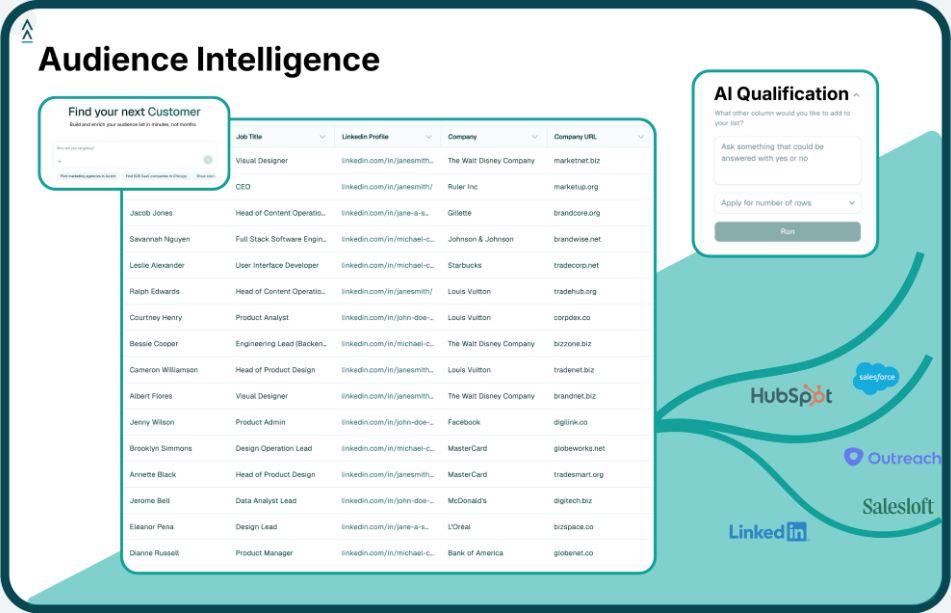
Timing and relevance are the name of the game in modern B2B sales. Buying signals give you both – and the faster you can act on them, the better your results. Landbase is at the forefront of this shift, serving as a category leader in identifying live buying signals and enabling natural-language GTM list building. In practice, that means Landbase surfaces over 1,500 real-time signals (from hiring and funding to intent surges and beyond) and lets you simply describe your ideal customer or scenario to instantly get a list of accounts matching those live criteria. It’s like having an AI-powered GTM assistant that builds your target list on the fly, reasoning across all the latest data so you don’t miss a beat.
Instead of juggling multiple tools or manually researching triggers, Landbase brings signal-driven intelligence into one platform. Imagine typing: “Companies in fintech that raised Series B in the last 6 months and are hiring for data science” – and getting a ready-to-engage list, complete with context on each account’s live signals. That’s the precision and speed Landbase delivers. GTM teams using Landbase can spot opportunities before competitors do, reach out with tailored relevance, and do it all in a fraction of the time it used to take. The result? More pipeline, higher conversion rates, and closed deals – all with less guesswork and grunt work.
Ready to turn live signals into GTM action? Don’t let your next best customer slip away unnoticed. Leverage the power of buying signals to know who’s ready to buy now – and let Landbase help you act on those insights with greater speed and accuracy than ever. It’s time to leave cold outreach behind and embrace a smarter, signal-driven go-to-market strategy.
Tool and strategies modern teams need to help their companies grow.