.png)
.png)
.png)

Daniel Saks
Chief Executive Officer


Finding the right contacts has never been harder — or more important. The gap between what vendors claim and what teams actually experience can be significant. That accuracy gap contributes to an estimated $3.1 trillion in losses due to bad data, a figure that encompasses wasted spend, lost opportunities, and operational inefficiency far beyond B2B contact discovery alone.
The problem is accelerating, too. Email decay rates hit 3.6% monthly in 2024 — nearly double the traditional baseline — driven by increased workforce mobility and rapid company restructuring. With annual data decay, teams that rely on static contact exports may be working with increasingly outdated records within months of their last refresh.
That is why choosing the best contact discovery tools matters more than picking the biggest database. The contact discovery software landscape in 2026 is shifting away from static search-and-export workflows toward platforms that layer enrichment, intent signals, and AI-driven qualification on top of raw contact data. The sales intelligence market is projected to reach $4.5 billion in 2026, underscoring the scale of investment in this space. The difference between a contact database and true contact intelligence is the difference between a spreadsheet of names and a prioritized list of people actually ready to buy.
This guide compares 12 b2b contact discovery platforms — the best contact finder tools available right now — across database coverage, enrichment depth, accuracy, AI capabilities, and real-world pricing. Whether you need a full end-to-end GTM platform or a lightweight email finder, you will find the right fit below.
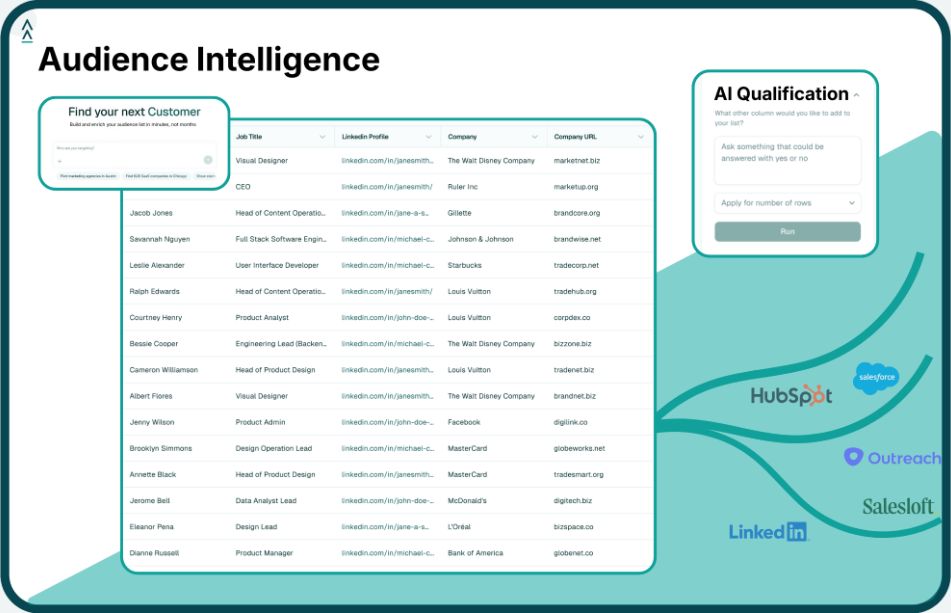
Landbase is the first agentic AI platform built specifically for go-to-market teams — and it is the strongest entry among the best contact discovery tools for teams that want to move beyond manual prospecting. Where most contact discovery software stops at finding an email address or phone number, Landbase handles the entire GTM workflow — from initial contact discovery through enrichment, qualification, and multi-channel outreach — in a single autonomous system. Its AI agents (Research, Identity, and Predictive) work in coordination to identify, enrich, and prioritize contacts without requiring manual search-and-export workflows.
The platform draws from a database of 300M+ verified contacts, but the real differentiator is enrichment depth. Landbase provides 1,500+ enrichment fields per contact — covering firmographics, technographics, intent signals, job change alerts, and buying behavior — compared to the 50-300 fields you get from most traditional databases. That depth means your team is not just finding contacts; you are finding signal-qualified leads who are actively showing buying intent.
Landbase's proprietary GTM-2 Omni model, trained on extensive GTM campaign data, powers the platform's ability to score and prioritize contacts based on real-time signals rather than static list criteria. The result is measurably higher conversion rates. Customers like P2 Telecom, Oyster, and QA Wolf have reported significant improvements in pipeline revenue, conversion rates, and lead quality — outcomes that reflect the difference between raw contact data and genuine audience intelligence.
In a market where contact data decays steadily over time, the advantage of an AI system that continuously re-verifies and re-scores contacts — rather than relying on a static export — compounds over time. Teams that exported a list in January are working with increasingly stale data by mid-year. Landbase's agentic approach keeps contact intelligence current without manual re-enrichment cycles.
Key capabilities:
Credibility: Gartner Cool Vendor recognition, $30M Series A funding, highly rated on G2.
Best for: B2B sales and marketing teams that want a single platform for contact discovery, enrichment, qualification, and conversion — without assembling a patchwork of tools.
ZoomInfo operates one of the largest B2B contact databases in the market, with 600M+ contact profiles and 135M+ company records. Each record includes 300+ data attributes, making it a go-to resource for enterprise teams that need broad coverage across industries and geographies. The platform includes intent data (via Streaming Intent), website visitor tracking, and conversation intelligence through its MarketingOS and TalentOS modules.
ZoomInfo's strength is breadth: if a contact exists in B2B, ZoomInfo likely has a record for them. However, that breadth comes with enterprise-level costs and annual contracts. Independent accuracy testing results vary — some reports place email accuracy at 75-85% for verified contacts, which is above the industry average but below the 95%+ figures that appear in vendor marketing.
Key features:
Pricing: ZoomInfo uses customized, seat-based pricing with annual contracts required. Pricing varies based on features, number of seats, and data access needs. Contact ZoomInfo directly for a quote, as published third-party estimates may not reflect current rates.
Best for: Enterprise sales organizations that need the broadest possible contact coverage and are prepared for annual contracts with significant budget commitments.
Apollo.io combines a 265M+ contact database with a built-in multi-step email sequencer, making it one of the more complete contact discovery platforms 2026 has to offer at its price point. The free tier gives new users access to the database and basic sequencing, which makes it a common starting point for early-stage teams testing their outbound motion.
Apollo has expanded its feature set significantly in recent years, adding topic-level buying intent signals and AI-generated email drafts. The all-in-one approach — database, sequencer, dialer, and basic analytics in a single tool — reduces tool sprawl for small teams. The trade-off is enrichment depth: Apollo provides standard firmographic and technographic data per contact, but lacks the 1,000+ field enrichment depth that dedicated enrichment platforms offer.
Key features:
Pricing: Free plan available. Paid tiers start at $49/user/month (Basic), with Professional and Organization tiers at higher per-user rates on annual billing. Credits expire each cycle, and phone number lookups cost more than email credits. Check Apollo's pricing page for current rates.
Best for: Early-stage and growing sales teams that need a database and sequencer in one tool at a startup-friendly price point.
Cognism focuses on compliance-first B2B data, with particular strength in European markets. Its Diamond Data feature provides human-verified mobile phone numbers that are 3x more likely to connect than standard data providers, making it a preferred choice for outbound calling teams targeting EMEA prospects. Cognism's database covers 400M+ profiles, with particular depth in European markets where other providers often have gaps.
For teams running phone-heavy outbound in Europe, Cognism addresses two problems simultaneously: GDPR compliance (built into data sourcing methodology) and connect rates (Diamond Data verification catches outdated numbers before they waste a rep's time). Cognism reports that teams using Diamond-verified numbers can connect with 87% of their list, a meaningful advantage for SDR teams whose productivity depends on reaching live humans rather than voicemails.
Key features:
Pricing: Quote-based with annual contracts required. Cognism offers tailored pricing based on team size, data access needs, and feature tier (Platinum or Diamond). Contact Cognism directly for current pricing, as published third-party estimates may not reflect current rates.
Best for: Sales teams running outbound calling campaigns in European markets where GDPR compliance and verified mobile numbers are essential.
Lusha is a focused contact finder built for speed. Its Chrome extension surfaces direct dial phone numbers and email addresses while browsing LinkedIn, making it one of the fastest best contact finder tools for individual lookups.
The tool is designed for reps who live in LinkedIn and need contact data without leaving their workflow. Lusha's simplicity is its advantage — there is no complex setup, no workflow builder, no enrichment pipeline to configure. You browse LinkedIn, click the extension, and get the contact. For SDRs doing targeted account-based prospecting at low-to-moderate volume, that speed matters more than enrichment depth.
Key features:
Pricing: Free plan with 70 credits/month. Paid plans start at competitive per-user rates on annual billing for Pro, Premium, and Scale tiers. Phone lookups consume multiple credits each. Unused monthly credits roll over and accumulate up to 2x the plan limit; annual credits reset at the end of the billing cycle. Check Lusha's website for current pricing.
Best for: Individual reps and small teams that need fast phone number discovery from LinkedIn profiles without a complex setup.
Clay takes a fundamentally different approach to b2b contact discovery by aggregating data from 50+ providers through waterfall enrichment workflows. Rather than relying on a single database, Clay queries multiple sources sequentially for each contact, often achieving meaningfully more data coverage than any single-source tool. It holds a 4.7/5 G2 rating with strong user reviews.
Clay's strength is flexibility. Revenue operations teams can build custom enrichment sequences — query Provider A first, fall back to Provider B if no match, then enrich with Provider C's technographic data — all within a spreadsheet-like interface. The trade-off is that Clay requires assembly. Unlike end-to-end platforms, you need to bring your own outreach tool, CRM connector, and in many cases your own data provider API keys. For teams with GTM engineering resources, that flexibility is a feature. For teams without, it is a bottleneck.
Key features:
Pricing: Plans overhauled in March 2026 with a dual credit system (Data Credits + Actions). Clay's pricing page currently shows Launch at $167/month and Growth at $446/month, though pricing on the page may vary between plan cards and FAQ text. Verify the live page at the time of purchase. Full contact + company + technographic enrichment costs approximately 75 credits per lead, with per-lead costs varying by plan tier.
Best for: Revenue operations and GTM engineering teams that want maximum enrichment coverage and are comfortable building custom data workflows.
Hunter.io is a focused email discovery and verification tool. Its domain search feature finds all email addresses associated with a company domain and surfaces contacts with job titles and filtering options, making it efficient for finding the right person at a target account. Hunter also includes built-in email verification and a basic cold email sequencer.
Hunter's domain search approach is particularly useful for account-based teams who know which companies they want to target but need to find the right contacts within those organizations. Decision-maker filtering helps surface senior contacts faster. For teams whose outreach is email-only and whose primary challenge is "I know the company, I need the person," Hunter does one thing well.
Key features:
Pricing: Free tier with 50 credits/month. Starter at $49/month ($34/month annual), Growth at $149/month ($104/month annual), and Scale at $299/month ($209/month annual). Annual billing saves roughly 30%.
Best for: Teams that primarily need verified email addresses and domain-level email discovery without additional data enrichment or phone numbers.
Seamless.AI positions itself as a real-time contact search engine rather than a static database. Instead of maintaining a fixed dataset, it searches and verifies contact data at the time of each query — a meaningful distinction when email decay rates are accelerating. The platform reports 1.3B+ verified contacts in its searchable index, and has built a large user community with thousands of reviews on G2.
The real-time approach means that in theory, every contact you pull from Seamless.AI has been verified at the moment of your search rather than weeks or months earlier. That freshness advantage matters most for teams in fast-moving industries (tech, startups) where job changes happen frequently. The caveat is that real-time verification quality depends on the underlying data sources, and accuracy reports from users are mixed — some report high-quality results while others note inconsistencies with phone numbers.
Key features:
Pricing: Free plan available with limited credits. Paid tiers (Basic, Pro, Enterprise) are available, but Seamless.AI's pricing structure has seen frequent changes and credit allotments vary across published sources. Contact Seamless.AI directly or check their live pricing page for the most current rates.
Best for: Teams that value real-time data verification over static database exports and want to test a search-engine-style approach to contact discovery.
RocketReach provides contact lookup capabilities across 700M+ profiles and 60M+ companies, with a strong LinkedIn integration that lets reps find email addresses and phone numbers directly from profiles. The platform supports verified email lookups across its large database, performing solidly in a category where accuracy claims often exceed real-world results.
Users frequently cite responsive customer service as a differentiator in G2 reviews (4.4/5, 1,200+ reviews).
Key features:
Pricing: Essentials at $69/month for 100 lookups, Pro at $119/month for 250 lookups, and Ultimate at $209/month for 500 lookups.
Best for: Teams that need reliable email lookups with broad profile coverage, particularly those integrating contact data via API.
UpLead differentiates on data accuracy with a pre-download verification system that checks every contact before it exports to your CRM. The platform claims 95%+ data accuracy, positioning it as a reliable option for teams that have been burned by poor-quality data from other providers. The database covers 180M+ B2B contacts across 200+ countries.
In a market where independent accuracy testing suggests the average falls well below vendor claims, UpLead's pre-download verification acts as a quality gate. Instead of exporting 1,000 contacts and discovering 300+ bounce after you have already loaded them into your sequencer, UpLead flags unverifiable contacts before they enter your workflow. For teams focused on deliverability and sender reputation protection, that pre-export filter is the core value proposition.
Key features:
Pricing: Free 7-day trial. Essentials, Plus, and Professional tiers available with increasing credit allotments, enrichment features, and API access. Check UpLead's website for current pricing.
Best for: Growing teams that prioritize data accuracy over database size and want pre-verified contacts on a mid-range budget.
SalesIntel takes a human-verification approach to B2B contact data, with a research team that re-verifies contacts every 90 days. The platform covers 100M+ B2B contacts with particular strength in U.S. decision-maker data. SalesIntel's 90-day re-verification cycle directly addresses the data decay problem — given that a significant percentage of professionals change jobs annually, quarterly human review catches stale records that automated verification might miss.
The platform also includes Bombora intent data integration, which layers buying signals on top of verified contact records. For teams running account-based programs, the combination of human-verified accuracy and account-level intent signals narrows the gap between "contacts in your CRM" and "contacts worth calling today."
Key features:
Pricing: Quote-based. SalesIntel uses custom pricing based on team size, data volume, and feature requirements. Contact SalesIntel directly for current rates.
Best for: Mid-market sales teams focused on U.S. accounts that need human-verified accuracy and are willing to pay a premium over automated-only verification.
LeadIQ is built specifically for the SDR workflow — capturing contacts from LinkedIn Sales Navigator and pushing them directly into CRM and sequencing tools with a single click. Rather than competing on database size, LeadIQ focuses on prospecting velocity: how quickly a rep can go from identifying a prospect on LinkedIn to having them in an active outreach sequence.
The platform's AI features generate personalized first lines for outreach emails based on the prospect's recent activity, job changes, and company news. LeadIQ also tracks sales triggers — job changes, funding rounds, promotions — that signal when a prospect might be more receptive to outreach. For SDR teams that already use LinkedIn Sales Navigator as their primary prospecting surface, LeadIQ adds the contact capture and enrichment layer that Navigator lacks natively.
Key features:
Pricing: Free plan available (1 user, 50 credits). Pro plan at $200/month, with Enterprise pricing available by quote.
Best for: SDR teams that prospect primarily through LinkedIn Sales Navigator and need fast contact capture with AI-assisted outreach personalization.
One of the most important — and underreported — factors in choosing contact discovery software is the gap between stated accuracy and real-world performance. Vendors routinely claim 90-95% data accuracy, but the reality is more nuanced.
Independent analyses suggest most providers fall well short of their claimed accuracy rates when accounting for all record types (email, phone, title, company). That does not mean every provider delivers poor results — it means the "accuracy" metric varies wildly depending on what you are measuring:
The practical implication: if your team's primary outreach channel is email, prioritize providers with high email deliverability rates and real-time verification. If you rely on cold calling, look for human-verified phone numbers (Cognism's Diamond Data, SalesIntel's research team) rather than programmatically sourced direct dials. And regardless of channel, plan for ongoing data maintenance — even the best provider's data degrades steadily over time.
Your choice comes down to four factors: scope, budget, workflow integration, and data freshness requirements.
By team size and budget:
By primary use case:
The bigger question for 2026 is whether you need contact discovery software alone or full contact intelligence. Stacking a separate data provider, enrichment tool, sequencer, and CRM connector often costs more than a consolidated platform — and every handoff between tools is a place where data degrades.
The contact discovery platforms 2026 landscape is broad, and the right tool depends on your team's size, budget, and how much of the GTM workflow you want to consolidate. Each of the best contact discovery tools in this list serves a legitimate use case.
That said, the broader trend is unmistakable: the market is moving from static contact databases toward contact intelligence — platforms that unify data, enrichment, signals, and automation in a single system. With the sales intelligence market continuing to grow rapidly, the shift from manual search-and-export to AI-driven contact intelligence is no longer a future prediction — it is the current trajectory.
Landbase represents this shift most fully. With 300M+ contacts, 1,500+ enrichment fields, signal-qualified lead prioritization, and multi-channel outreach built in, it replaces the multi-tool stack with a single end-to-end GTM platform. For teams ready to move beyond contact databases and into contact intelligence, Landbase is the strongest choice available today.
The best tool depends on your needs. For teams that want AI-powered contact discovery with enrichment and outreach in one platform, Landbase offers the deepest capability set. For maximum database breadth, ZoomInfo is a leading option with 600M+ contacts. For budget-conscious teams, Apollo.io provides a free tier with 265M+ contacts and built-in sequencing. For GDPR-compliant European data, Cognism is the category leader.
Vendor claims typically range from 90-95% accuracy, but independent analyses suggest most providers fall well short of those figures. The gap varies by data type — email deliverability tends to be stronger than phone number accuracy. Tools with real-time verification (like UpLead's pre-download checks) or human verification (like SalesIntel's 90-day cycles) generally deliver higher accuracy than static databases.
B2B contact data decays steadily, with a significant portion of your database going stale every year. Teams that rely on static exports without regular re-verification are working with increasingly outdated records — making continuous data maintenance or platforms with built-in re-verification essential for outbound success.
A contact database provides static records — names, emails, phone numbers, titles — that you search and export. Contact intelligence adds enrichment layers (technographics, intent signals, firmographic updates, job change alerts) and uses AI to prioritize which contacts are most likely to convert. The shift from database to intelligence is one of the defining trends in B2B data for 2026, with platforms like Landbase offering 1,500+ enrichment fields and autonomous AI scoring versus the 50-300 fields typical of traditional databases.
Yes. Some teams use a waterfall approach, querying multiple providers sequentially to maximize coverage. Clay automates this process across 50+ providers, often achieving meaningfully more data coverage than any single source. However, stacking tools adds complexity and cost. Platforms that consolidate data, enrichment, and outreach in one system — like Landbase — reduce the need for multi-provider stacking.
Most tools in this list integrate with Salesforce, including ZoomInfo, Apollo.io, Cognism, Lusha, SalesIntel, LeadIQ, and Landbase. The depth of integration varies — some offer native bi-directional syncing while others require third-party connectors. ZoomInfo and Landbase offer the most comprehensive Salesforce integrations for enterprise workflows. LeadIQ and SalesIntel also provide strong native Salesforce connectors for mid-market teams.
Free tiers from Apollo.io (database access + basic sequencing), Hunter.io (50 credits/month), Lusha (70 credits/month), and LeadIQ (limited captures) are useful for testing and low-volume prospecting. For teams doing serious outbound at scale, free plans can hit credit limits quickly. They are a good starting point to evaluate a platform's data quality and interface before committing to a paid plan.
Budgets vary widely by team size. Solo reps and startups can get started for $0-$100/month using free tiers and entry-level plans. Growing teams of 3-10 reps often spend in the range of $300-$1,500/month across their prospecting stack, depending on tools and usage. Mid-market teams may invest $1,500-$5,000/month for verified data and compliance features. Enterprise organizations with 50+ sales reps commonly invest $25,000-$60,000+/year on platforms like ZoomInfo, or consolidate with platforms like Landbase that replace multiple point solutions.
Tool and strategies modern teams need to help their companies grow.