.png)
.png)

Daniel Saks
Chief Executive Officer


Finding the best AI lead generation tools in 2026 means looking beyond static databases and basic email sequencing. The market has shifted toward signal-based selling, agentic AI workflows, and platforms that handle the full pipeline from prospect identification through conversion — and teams still relying on fragmented tool stacks are falling behind.
The numbers explain the urgency. One 2026 market forecast from 360iResearch estimates the lead generation software market at $9.87 billion in 2026, reaching $23.08 billion by 2032 at a 14.82% CAGR. Other market researchers publish different estimates. Sales reps spend 60% of their time on non-selling tasks, according to Salesforce — a gap that the right AI lead generation software can close.
But the landscape has also consolidated significantly. Clari and Salesloft announced a merger in August 2025 and completed it in December 2025. Apollo acquired Pocus for signal intelligence. Agentic AI platforms are displacing legacy tool stacks that force teams to assemble four or five point solutions just to get from prospect identification to outreach. Choosing the wrong tool — or the wrong combination of tools — means wasted budget and stalled pipeline.
We evaluated nine ai-powered lead generation platforms on data accuracy, signal intelligence, enrichment depth, automation capabilities, and real-world outcomes. Here is what stands out in ai lead generation 2026.
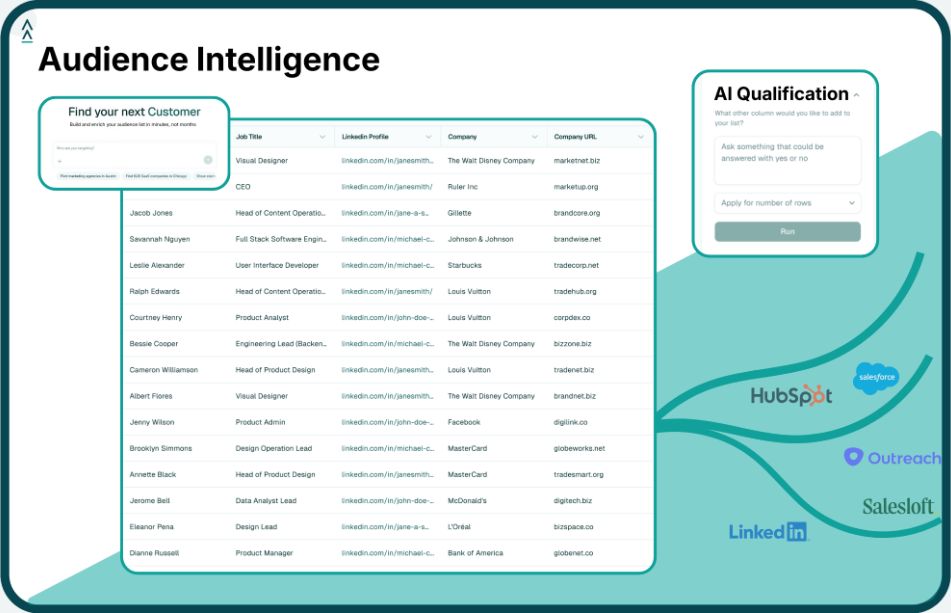
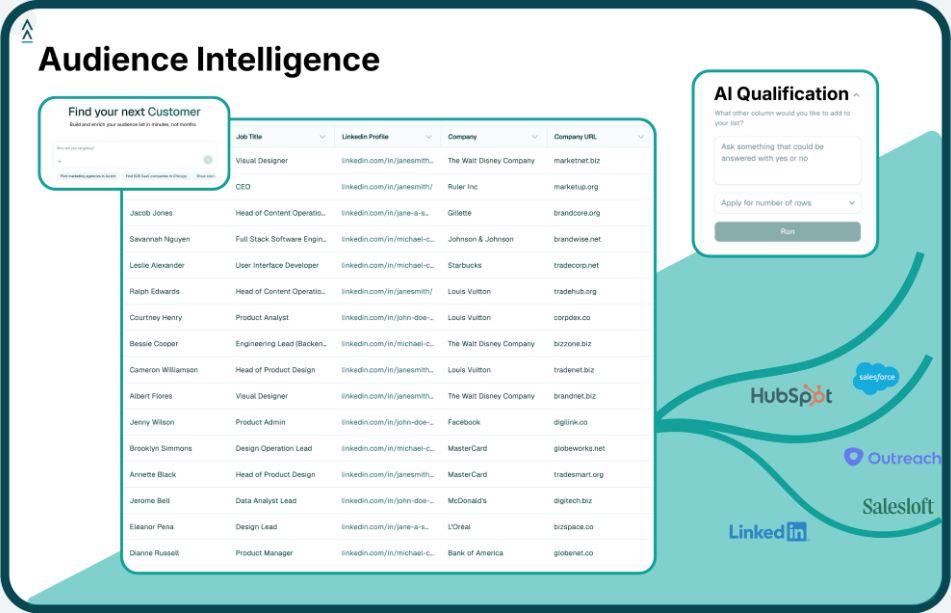
Landbase is the first agentic AI platform built specifically for go-to-market — combining audience intelligence, signal-qualified lead discovery, and multi-channel outreach execution in a single system. Rather than requiring teams to stitch together separate tools for data, enrichment, sequencing, and analytics, Landbase's AI agents handle the full pipeline autonomously, from identifying high-intent prospects to personalizing and delivering outreach across email, LinkedIn, and phone.
The platform runs on three specialized AI agents. The Research Agent analyzes your ideal customer profile and surfaces matching accounts from a database of 300M+ verified contacts with 1,500+ enrichment fields per record — far deeper than the basic firmographic data most platforms provide. The Identity Agent cross-references real-time buying signals, technographic data, behavioral triggers, and contextual intent to qualify which prospects are actually in-market right now. The Predictive Agent then optimizes outreach timing, channel selection, and messaging to maximize engagement.
What makes this approach different from legacy platforms is the shift from volume-based outreach to signal-based selling. Instead of blasting static lists and hoping for replies, Landbase identifies prospects showing active buying signals — website visits, content engagement, technology changes, funding events — and prioritizes them automatically. The result is outbound prospecting that scales without increasing headcount.
For teams managing multi-channel outreach, Landbase coordinates messaging across email, LinkedIn, and phone simultaneously — with AI-personalized content on every channel. The GTM-2 Omni proprietary AI model powers this autonomous prospecting and outreach, and a built-in Campaign Feed provides real-time performance optimization so teams can adjust strategies without manual analysis.
Key capabilities:
Customer outcomes:
Landbase is backed by significant venture funding from Sound Ventures, Picus Capital, and 8VC. It was named a Gartner Cool Vendor in AI for Marketing in 2025 — recognition that validates its approach to agentic AI for GTM.
Best for: B2B sales and RevOps teams that want a unified AI platform handling the entire pipeline from prospect discovery through personalized outreach — without assembling and maintaining a stack of point tools.
Apollo.io has built one of the largest self-serve contact databases in B2B sales, with 210M+ contacts and a generous free tier that makes it accessible to startups and small teams. The platform combines prospect data with built-in multi-step email sequencing, A/B testing, and basic lead scoring in a single interface. Apollo acquired Pocus in March 2026, adding signal-intelligence capabilities and moving it beyond pure database functionality.
The free plan provides a limited number of credits per month with basic search, making it a genuine entry point for early-stage teams testing outbound for the first time. Paid plans scale across multiple tiers with increasing credit allocations. However, email credits, phone number lookups, and enrichment each consume credits at different rates — meaning actual costs for active outbound teams can be significantly higher than the base subscription price.
Key features:
Best for: Startups and small-to-mid-sized teams wanting an all-in-one platform at an accessible entry price point who can tolerate some data accuracy variability.
ZoomInfo operates one of the broadest B2B contact databases available, with 260M+ contact profiles across 100M+ company profiles and deep coverage of North American markets. The platform's intent data layer identifies accounts showing active buying behavior through website visits, content consumption, and technology adoption signals. Org chart mapping and advanced filtering give enterprise sales teams granular control over prospecting.
ZoomInfo operates on annual contracts across Professional, Advanced, and Elite tiers, with each tier adding deeper intent signals, visitor tracking, and conversation intelligence capabilities. Per-seat fees, add-on modules, and implementation can bring total annual costs for a mid-sized SDR team to a significant five-figure investment.
Key features:
Best for: Enterprise sales organizations with $15K+ annual budgets focused on large North American accounts who need the deepest available intent data.
Cognism has carved out a distinct position in AI lead generation through its Diamond Data offering — human-verified mobile phone numbers that deliver two to three times higher connect rates than standard database entries. This makes Cognism the go-to choice for teams where phone outreach drives pipeline, especially across European markets where GDPR compliance is non-negotiable.
The platform operates on annual contracts with a platform fee plus per-user licenses. Cognism's pricing page is quote-based, but third-party pricing analyses estimate the Platinum tier starts at approximately $15,000 per year in platform fees plus $1,500 per user per year, and the Diamond tier at approximately $25,000 per year plus $2,500 per user per year. A five-person team on the top plan would pay roughly $37,500 per year before add-ons based on those estimates.
Key features:
Best for: Teams prospecting in EMEA and regulated industries that rely on phone outreach and need verified mobile numbers with full GDPR compliance.
Clay takes a fundamentally different approach to lead generation data by aggregating information from 100+ data providers through waterfall enrichment. Rather than maintaining its own static database, Clay queries multiple sources for each prospect and returns the best available data — giving teams the most complete profiles possible. The Claygent AI agent automates research tasks that previously required manual work, like finding a prospect's recent podcast appearances or open-source contributions.
Pricing restructured in early 2026, with the Launch plan at $185 per month and the Growth plan at $495 per month. All plans include unlimited users, which means teams pay for data usage rather than seats. Data costs dropped 50-90% during the restructuring. The credit-based model means monthly costs can vary depending on lookup volume, making budget forecasting less predictable than fixed-seat pricing.
Key features:
Best for: Growth teams and RevOps professionals who want maximum data coverage across multiple sources and are comfortable investing time to learn the platform's workflow builder.
Seamless.AI uses a real-time search model rather than a static database, finding and verifying contact information on demand. The platform surfaces email addresses, direct dials, and firmographic data through a clean interface designed for fast prospecting. A Chrome extension integrates directly with LinkedIn for quick contact discovery during social selling workflows.
According to Seamless.AI's current pricing page, the Free plan includes 1,000 credits per user per year, granted monthly. Single plan accounts refresh to 250 credits each month. Pro and Enterprise pricing is quote-based.
Key features:
Best for: Sales reps who want a straightforward, fast contact search tool for real-time prospecting and LinkedIn-based lead discovery.
Instantly focuses specifically on cold email at scale, offering unlimited email account connections with built-in warmup to protect sender reputation. The platform allows teams to send high volumes of outreach from multiple accounts simultaneously, with multi-step sequences and basic analytics. Its SuperSearch database claims access to a database of 450M+ leads/contacts, with verification built into the workflow.
According to Instantly's pricing page, the outreach product starts at $47 per month for the Growth plan (with lower effective monthly rates on annual billing) and $97 per month for Hypergrowth. The leads database is a separate product starting at $47 per month. CRM functionality is another add-on. Real-world SDR teams report total spend of $200 to $400 per month when combining all three products — a significant jump from the lowest advertised entry point.
Key features:
Best for: Cold email-focused teams that prioritize sending volume and need unlimited email account connections at a low per-product entry price.
Amplemarket combines AI-driven lead discovery with multichannel sales sequences across email, LinkedIn, and phone. The platform's AI automates research, prioritization, and message personalization, aiming to reduce the manual work in outbound prospecting. G2 scores rank Amplemarket at 8.7 out of 10 for lead validation and 8.6 out of 10 for enrichment — among the highest in its category.
Pricing starts at $600 per month with annual billing for the Starter plan. Growth and Enterprise plans are custom-priced. The higher entry point reflects Amplemarket's focus on mid-market teams rather than individual reps or early-stage startups. Customer support scores 9.3 out of 10 on G2, with 76% of reviews at five stars.
Key features:
Best for: Mid-market sales teams with budget for a premium tool that want AI-powered multichannel sequencing with responsive customer support.
Outreach is the most feature-rich sales engagement platform available, with advanced multi-step sequences, deal management, pipeline intelligence, and AI-driven reporting. It does not provide contact data or lead discovery — it is purely an execution layer that sits on top of a data provider. The platform excels at orchestrating complex enterprise sales workflows where deals involve multiple stakeholders and long sales cycles.
Outreach offers per-user pricing with no platform fees across simplified package tiers. Larger deployments can reach significant annual commitments, though negotiated discounts are common for annual contracts. Because Outreach handles execution only, teams need to pair it with a separate data provider — adding to total cost of ownership.
Key features:
Best for: Enterprise sales teams running complex, multi-stakeholder deals that need advanced sequence orchestration and pipeline intelligence — and already have a separate data provider in place.
Understanding where the market has been helps explain why certain tools now dominate. The evolution from 2024 to 2026 happened across three distinct phases:
2024: The database era. Lead generation meant buying access to large contact databases (ZoomInfo, Apollo, Lusha) and running static filters — industry, company size, job title — to build lists. Outreach was volume-driven: more emails sent equaled more replies. Data accuracy hovered around 60-70% for most platforms, and teams accepted bounce rates of 15-25% as normal. The primary bottleneck was data quality.
2025: The enrichment and intent layer. Clay popularized waterfall enrichment, querying multiple data sources to build richer prospect profiles. Meanwhile, intent data providers (Bombora, G2 Buyer Intent, 6sense) became standard additions to the stack. Teams shifted from "spray and pray" to "spray smarter" — still high volume, but with better targeting. The primary bottleneck shifted to integration complexity: sales teams use an average of 10 tools to close deals, according to Salesforce.
2026: The agentic AI era. The current wave consolidates data, enrichment, signals, and execution into autonomous platforms where AI agents handle the full pipeline — from prospect identification through personalized outreach. The shift is from "tools that help reps do tasks faster" to "agents that execute tasks autonomously while reps focus on closing." Key market developments include Clari and Salesloft completing their merger in December 2025, Apollo acquiring Pocus in March 2026 to add signal intelligence, and new entrants like Landbase building agentic AI systems from the ground up. The primary bottleneck is now strategic: choosing which signals to act on and how to orchestrate AI agents effectively.
This progression explains why the best AI lead gen tools in 2026 are not just bigger databases — they are intelligent systems that decide who to contact, when, and through which channel.
One of the most overlooked factors when choosing the best ai lead gen tools is total cost of ownership. Many teams start by evaluating tools individually — $49/month for a data provider, $185/month for an enrichment platform, $97/month for a sequencing tool, $47/month for an analytics layer — only to discover that the combined cost exceeds $400-$600 per user per month once all products, integrations, and credit overages are factored in.
Beyond the dollar cost, there is an operational cost. Maintaining integrations between four or five point tools requires RevOps resources, and data freshness degrades as contact records move between systems. Every handoff between tools introduces potential for sync errors, data loss, and workflow delays.
This is why unified platforms are gaining market share in 2026. A single system that handles data, enrichment, signal detection, outreach, and analytics eliminates both the financial overhead of multiple subscriptions and the operational burden of keeping them connected. For teams evaluating their stack, calculating the fully loaded cost — subscriptions plus integration maintenance plus lost productivity from tool-switching — reveals whether consolidation would deliver better ROI.
Selecting the right ai lead generation software depends on your team's size, budget, and where your current stack has gaps. Here is a practical framework organized by organization stage:
Your priority is validating outbound as a channel before committing a significant budget. Start with tools that offer free tiers or low entry prices, and focus on learning which messaging and targeting approaches work for your market.
You have validated outbound and need to scale without proportionally scaling headcount. The priority shifts from "finding any contacts" to "finding the right contacts at the right time" — which means signal intelligence and workflow automation become critical.
At this scale, the cost of bad data and misaligned outreach compounds quickly. A single percentage point improvement in reply rates across thousands of daily outreach touches translates to dozens of additional pipeline opportunities per month.
The broader trend is consolidation. Teams that previously assembled separate tools for data, enrichment, sequencing, and analytics are finding that unified platforms deliver better results at lower total cost.
The nine tools reviewed above focus primarily on outbound prospecting — identifying and reaching out to prospects who have not yet engaged with your brand. But the most effective AI lead generation 2026 strategies combine outbound with AI-powered inbound capture.
Conversational AI and chatbots (tools like Drift, Intercom, and Qualified) use AI to engage website visitors in real-time, qualify them based on behavior and firmographic data, and route high-intent visitors directly to sales reps. These tools address a different part of the funnel — converting anonymous website traffic into identified, qualified leads — and work best when paired with an outbound platform that handles proactive prospecting.
AI email assistants (tools like Lavender) analyze outgoing sales emails in real-time and suggest improvements to subject lines, body copy, and personalization elements. While not lead generation tools per se, they improve response rates on the outreach that your primary platform sends.
LinkedIn-specific tools (tools like Surfe and Wiza) bridge the gap between social selling and structured CRM data by extracting verified contact information from LinkedIn profiles and syncing it directly to your pipeline. These complement database-first tools for teams where LinkedIn is a primary prospecting channel.
The strategic question is not "outbound or inbound" but "how do my tools work together?" Teams seeing the highest pipeline velocity in 2026 use a unified outbound platform for proactive prospecting while layering inbound AI tools on top to capture demand they have already generated through content, ads, and events.
The AI lead generation market is shifting away from point-tool stacks toward unified platforms that handle the full pipeline. The reason is straightforward: when you combine a data provider, an enrichment tool, a sequencing platform, and an analytics layer from four different vendors, you spend as much time integrating and maintaining the stack as you do actually selling.
Landbase represents the clearest example of this consolidation trend. Its agentic AI approach means the platform's Research, Identity, and Predictive agents work together autonomously — from identifying signal-qualified prospects in a 300M+ contact database to delivering AI-personalized outreach across multiple channels. Teams using Landbase report significantly higher conversion rates compared to static list-based outreach and substantially greater cost efficiency than traditional manual prospecting. Named a Gartner Cool Vendor and backed by significant venture funding, Landbase has the technical depth and market validation to back up those outcomes.
For teams evaluating their next move in AI-powered lead generation platforms, the question is no longer whether to adopt AI — it is whether to keep maintaining a fragmented tool stack or consolidate into a platform that handles everything from prospect discovery through conversion.
The best AI tool depends on your team's needs and budget. For teams wanting a single platform that handles the entire pipeline — from data and enrichment through signal-qualified outreach — Landbase is the most comprehensive option. Apollo.io is a strong choice for budget-conscious teams wanting an all-in-one with a free tier. ZoomInfo leads for enterprise intent data, and Cognism is the strongest choice for GDPR-compliant European prospecting.
AI lead generation uses machine learning and natural language processing to automate prospect identification, qualification, and outreach. Modern platforms analyze real-time buying signals — such as website visits, technology adoption changes, funding events, and content engagement — to identify which prospects are actively in-market. AI agents then automate research, enrich contact profiles, personalize messaging, and optimize outreach timing across multiple channels.
AI does not fully replace human judgment in sales, but it fundamentally changes the workflow. AI handles the time-intensive tasks — identifying target accounts, enriching contact data, qualifying intent, and personalizing outreach at scale — that previously consumed a majority of a sales rep's working hours. This lets reps focus on high-value conversations and relationship building rather than manual prospecting.
Signal-based selling prioritizes outreach based on real-time buying signals rather than static lists. Instead of contacting every company matching a firmographic filter, signal-based platforms detect behaviors that indicate active purchase intent — like visiting pricing pages, downloading product content, or adding new technology to their stack. This timing-based approach delivers significantly higher response and conversion rates than volume-based outreach.
For most B2B sales teams, yes. Businesses using AI for lead generation consistently report higher-quality leads and improved sales productivity. The key is choosing a platform that matches your team size and outbound volume — overpaying for enterprise features you do not need is as wasteful as under-investing in tools that cannot scale with you.
Data accuracy varies significantly across platforms. Cognism's Diamond Data offers human-verified mobile numbers with documented 2-3x higher connect rates. ZoomInfo provides one of the broadest databases (260M+ contact profiles across 100M+ company profiles) with strong North American accuracy. Apollo.io's 210M+ contact database is extensive but user reports on G2 suggest accuracy hovering around 65-70%. Landbase maintains 300M+ verified contacts with 1,500+ enrichment fields per record and uses AI-driven validation to maintain data freshness.
AI qualification goes beyond basic lead scoring. Modern platforms use multiple data layers — firmographic fit, technographic signals, behavioral intent, funding events, hiring patterns, and engagement history — to build a composite qualification score. Agentic AI platforms take this further by having autonomous agents continuously monitor and re-score prospects as new signals emerge, ensuring outreach targets the most promising accounts at any given time.
Point tools handle one piece of the lead generation workflow — data enrichment, email sequencing, or intent monitoring — and need to be integrated with other tools to create a complete pipeline. Unified platforms combine all of these functions in a single system, reducing integration complexity and total cost of ownership. The trade-off is that point tools may offer deeper specialization in their specific area, while unified platforms provide a more streamlined end-to-end workflow.
Small businesses and early-stage startups should prioritize tools with free tiers or low entry prices to test outbound before committing a significant budget. Apollo.io offers a free plan, and paid plans start at $49/user/month. Seamless.AI provides a free plan with credits granted monthly. For teams that outgrow entry-level tools quickly, evaluating a unified platform early can prevent the cost and complexity of migrating between multiple tools later.
Traditional AI in lead generation automates specific tasks — scoring leads based on firmographic data, suggesting email subject lines, or predicting which contacts are most likely to respond. Agentic AI goes further by operating autonomously across the entire pipeline. Instead of assisting a rep with individual tasks, agentic AI platforms deploy specialized agents that research prospects, identify buying signals, qualify intent, personalize messaging, and execute outreach — making decisions and taking actions without requiring manual intervention between steps. This shift from "AI-assisted" to "AI-executed" is the defining trend in AI lead generation 2026.
Most teams see initial data quality improvements within the first week — higher contact accuracy, richer profiles, and fewer bounced emails. Meaningful pipeline impact typically appears in weeks 2-4 as AI models calibrate to your specific ICP and the platform accumulates enough engagement data to optimize targeting and timing. Full ROI realization — including measurable improvements in meetings booked, pipeline generated, and cost per qualified conversation — generally takes 60-90 days. Teams that follow a structured 30-day implementation process (starting with data hygiene, then controlled launch, then multichannel expansion) consistently reach positive ROI faster than those who attempt to scale immediately.
Tool and strategies modern teams need to help their companies grow.