Daniel Saks
Chief Executive Officer
.png)
.png)
.png)


The productivity technology landscape has undergone a seismic shift in 2024-2025, with AI-powered tools transforming how enterprises work across every function. From software development to legal research and clinical documentation, these platforms are eliminating manual work and accelerating business outcomes. For go-to-market teams navigating this new era, understanding which productivity platforms lead in AI-powered audience discovery and qualification is just as critical as choosing foundational infrastructure. Agentic AI platforms like Landbase's GTM-2 Omni now sit alongside these productivity leaders, helping revenue teams find and engage their ideal customers with natural-language precision.
Anysphere's Cursor platform is an AI-powered coding assistant that enables developers to generate, edit, and understand code through natural language prompts. The "vibe coding" platform integrates directly into developers' IDEs, providing contextual code suggestions, debugging assistance, and automated refactoring.
Cursor represents the forefront of developer productivity, addressing the critical shortage of software engineers by amplifying individual developer output. Its success demonstrates how AI can transform technical workflows while maintaining developer control and creativity. The platform's viral adoption among engineering teams shows that productivity tools that integrate seamlessly into existing workflows achieve faster adoption than disruptive alternatives.
Databricks provides a unified data platform that combines data warehousing, data engineering, and AI/ML capabilities in a single lakehouse architecture. The platform enables enterprises to store, process, and analyze massive datasets while building and deploying AI applications at scale.
Databricks has become the foundational data layer for enterprise AI adoption, solving the critical challenge of unifying data silos while enabling secure AI development. Its lakehouse architecture eliminates the traditional separation between data warehouses and data lakes, allowing organizations to run analytics and AI on the same data platform.
OpenAI develops frontier foundation AI models including GPT-4 and the o1 series that power applications across industries. Its ChatGPT platform serves both individual users and enterprises through ChatGPT Enterprise, while its API platform enables developers to integrate AI capabilities into their own applications.
OpenAI's foundation models have become the default starting point for AI application development across industries. By providing accessible APIs and user-friendly interfaces, the company has democratized AI capabilities that were previously limited to organizations with specialized AI expertise.
Anthropic develops the Claude family of AI foundation models with a strong emphasis on enterprise reliability, safety, and interpretability. The company focuses on creating AI systems that are more controllable and predictable than general-purpose models.
Anthropic's success demonstrates that enterprises prioritize reliability and safety over raw capability when adopting AI for mission-critical applications. The company's focus on constitutional AI and interpretability addresses key enterprise concerns about AI trustworthiness and compliance.
Glean provides AI-powered enterprise search that indexes information across all company applications and data sources, creating a unified search experience for employees. The platform integrates with over 100 enterprise applications including Slack, Gmail, Google Drive, and internal databases.
Glean addresses the critical enterprise productivity problem of information fragmentation, where valuable knowledge is scattered across dozens of disconnected applications. By creating a unified search layer across the enterprise tech stack, the platform eliminates time wasted searching for information and reduces knowledge silos.
Harvey provides AI-powered tools specifically designed for legal professionals, enabling lawyers to conduct research, analyze contracts, draft documents, and manage complex legal workflows more efficiently. The platform is built on foundation models customized for legal work and integrates with existing legal research databases.
Harvey is transforming one of the largest professional services sectors by automating routine legal work and augmenting lawyer expertise. The legal industry has historically been slow to adopt technology, but Harvey's success shows that AI tools designed specifically for legal workflows can achieve rapid adoption among elite firms.
Abridge provides an AI-powered clinical documentation platform that records, transcribes, and summarizes medical conversations between physicians and patients in real-time. The system integrates with major EHR systems like Epic and Cerner, automatically generating clinical notes that can be edited and signed by physicians.
Abridge addresses one of healthcare's most pressing challenges: physician burnout caused by excessive administrative work. By automating clinical documentation, the platform allows doctors to focus more on patient care and less on paperwork. This not only improves physician satisfaction but also enhances patient experience through more engaged doctor-patient interactions.
Scale AI provides enterprise-grade data infrastructure for training and validating AI models, offering data labeling, annotation, and validation services at scale. The platform supports computer vision, natural language processing, and multimodal AI training with high-quality, human-validated datasets.
Scale AI addresses the fundamental challenge of AI development: the need for high-quality training data. Without accurate, well-labeled data, even the most advanced AI models cannot perform effectively. By providing enterprise-grade data infrastructure, Scale AI enables organizations to develop more accurate and reliable AI applications.
Sierra provides AI agents for customer service automation, enabling enterprises to handle customer inquiries through natural conversational AI. The platform integrates with existing customer service platforms and can handle complex, multi-turn conversations while maintaining brand voice.
Sierra represents the convergence of AI agents and customer service productivity, addressing one of the largest operational costs for enterprises. The customer service market is massive, and AI automation has the potential to dramatically improve both customer experience and operational efficiency.
Together AI provides a cloud platform supporting over 200 open-source AI models, enabling developers to train, fine-tune, and deploy AI models at scale. The platform features proprietary FlashAttention technology for high-performance inference and supports both commercial and research use cases.
Together AI represents an important alternative approach to AI infrastructure, focusing on open-source models rather than proprietary systems. This democratization of AI capabilities allows organizations to avoid vendor lock-in while maintaining control over their AI systems.
Cognition AI developed Devin, the world's first autonomous AI software engineer that can complete entire software development tasks end-to-end. The platform can plan, write, test, and deploy code autonomously while learning and improving from experience.
Cognition AI represents the cutting edge of autonomous AI agents for productivity, moving beyond assistance to full autonomy. While current coding assistants augment human developers, Devin can complete entire development tasks independently. This represents a paradigm shift in how software is built and has implications for addressing the global shortage of software engineers.
Hippocratic AI develops large language models specialized for healthcare applications, creating patient-facing AI agents for care coordination, appointment scheduling, and basic medical guidance. The platform is purpose-built for the healthcare environment with strong safety and compliance controls.
Hippocratic AI addresses critical healthcare workforce shortages through AI agents that can handle routine patient interactions. The healthcare industry faces severe staffing challenges, and AI automation offers a way to maintain quality care while reducing burden on human staff.
These 12 fastest-growing productivity companies demonstrate a clear trend: the shift from manual workflows to AI-powered automation across every industry and function. What's particularly notable is how natural language is becoming the standard interface for productivity tools, from coding assistants that understand plain English prompts to enterprise search platforms that answer questions rather than requiring complex queries.
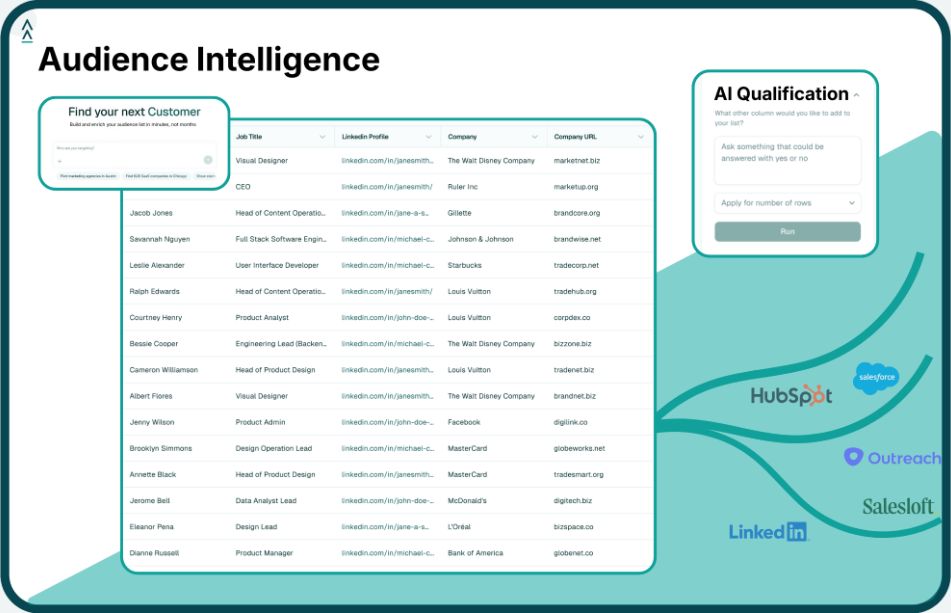
This evolution is creating new opportunities for go-to-market teams to leverage similar AI capabilities. Just as developers use Cursor to describe what they want to build, sales and marketing teams can use platforms like VibeGTM to find their ideal customers through natural language prompts. The 300M+ contacts and 24M+ companies in Landbase's database, combined with 1,500+ unique signals across firmographic, technographic, intent, and behavioral data, enable revenue teams to build targeted audiences in seconds rather than days.
The success of these productivity platforms shows that the future belongs to tools that eliminate friction rather than add complexity. Whether it's autonomous coding agents, AI legal assistants, or clinical documentation systems, the winning formula combines deep domain expertise with intuitive interfaces that amplify human capabilities rather than replacing them.
This list highlights the fastest-growing productivity technology companies based on:
Agentic AI refers to AI systems that can act autonomously to achieve specific goals, rather than just responding to prompts. These systems can plan, execute, and adapt their actions based on feedback and changing circumstances. In productivity contexts, agentic AI enhances output by handling complex, multi-step tasks that previously required human coordination. For example, Cognition AI's Devin can complete entire software development projects autonomously, while platforms like Landbase's GTM-2 Omni can discover, qualify, and export target audiences based on natural language prompts.
Fast-growing productivity tech companies secure funding by demonstrating exceptional metrics that show both market demand and execution capability. The companies on this list typically show rapid revenue growth, strong user adoption, or clear market leadership in high-value categories. Investors are particularly attracted to productivity tools that solve real business problems with measurable ROI. Companies that can demonstrate product-market fit through revenue traction and customer growth have the strongest position when raising capital.
Essential productivity tools for modern businesses fall into several categories: developer productivity (like Cursor and Cognition AI), enterprise knowledge management (like Glean), industry-specific automation (like Harvey for legal and Abridge for healthcare), and foundation AI models (like Anthropic and OpenAI). What makes these tools essential is their ability to eliminate manual work, reduce time-to-value, and amplify human expertise. The most successful tools integrate seamlessly into existing workflows rather than requiring complete process overhauls.
Landbase's GTM-2 Omni model benefits sales and marketing teams by transforming audience discovery from a manual, technical process into a natural conversation. Teams can type prompts like "CFOs at enterprise SaaS companies that raised funding in the last 30 days" and receive AI-qualified exports ready for immediate activation. The model leverages extensive contact and company databases with comprehensive signals to ensure precision targeting. This eliminates days of manual research and enables teams to focus on high-value selling activities.
Key metrics to evaluate productivity tech startups include revenue growth rate, user adoption metrics, market share in specific categories, and funding velocity. These metrics demonstrate both market demand and execution capability. Additionally, customer retention rates, time-to-value for users, and expansion revenue from existing customers provide insight into product-market fit. The strongest productivity startups show consistent growth across multiple metrics while maintaining high customer satisfaction scores.
Yes, some advanced productivity platforms offer free tiers to drive adoption. For example, Landbase offers a free, no-login audience builder that allows users to export AI-qualified contacts per session. This product-led growth approach enables teams to experience the platform's value before committing to paid plans. Other platforms like OpenAI offer free tiers of ChatGPT with premium features available through subscription. These free options democratize access to advanced AI capabilities and allow organizations to test solutions before making larger investments.
Tool and strategies modern teams need to help their companies grow.