Daniel Saks
Chief Executive Officer
.png)
.png)
.png)


The eCommerce technology sector has seen investment shifts, with global funding reaching approximately $7.3 billion in 2025, with several companies achieving unicorn status and beyond. From live video shopping to autonomous checkout, these innovations are transforming how billions shop online. AI, automation, and creator-driven commerce are reshaping retail's future, with companies solving critical pain points—from last-mile delivery to customer data activation— attracting massive investment and achieving rapid scale. For go-to-market teams in the eCommerce space, knowing which platforms lead in AI-powered audience discovery and qualification is just as important as choosing the right operational infrastructure. Agentic AI platforms like Landbase now sit alongside these eCommerce leaders, transforming how teams find and engage their ideal customers through natural-language targeting and real-time intent signals.
Whatnot operates a real-time live video shopping platform that combines social engagement with instant purchasing capability. The platform focuses on collectibles, fashion, and consumer goods, enabling authentic, interactive experiences between sellers and buyers.
Whatnot validates the "retailtainment" model in Western markets, proving live shopping (dominant in Asia) can succeed globally. The platform's $6 billion+ GMV demonstrates massive consumer adoption and transaction volume.
ShopMy connects premium brands with trusted curators (influencers and tastemakers) through an integrated marketing platform that emphasizes authentic discovery over algorithmic recommendations. The platform enables brands to work with a network of 100,000+ creators to drive sales through authentic product recommendations.
ShopMy is a rare profitable unicorn with a $1.5 billion valuation and profitability since 2024. The platform's $1 billion+ annual sales demonstrates massive scale through curator-driven discovery.
Zepto operates India's leading quick-commerce grocery delivery platform, promising 10-minute delivery through a network of 250 dark stores strategically located in metropolitan areas. The company specializes in ultra-fast fulfillment of grocery and essential items.
Zepto achieved a $7 billion valuation as of 2025, establishing unicorn status in quick-commerce. The company's 250+ dark stores demonstrate operational scale in emerging markets, pioneering ultra-fast delivery in India's fastest-growing cities.
Hightouch provides an AI-powered customer data platform (CDP) with composable architecture that enables 1:1 personalized experiences at scale. The platform focuses on reverse ETL and real-time automated customer data activation across marketing channels.
Hightouch achieved a $1.2 billion valuation, validating market demand for composable CDP solutions. The platform addresses retail's shift from mass marketing to micro-personalization, providing flexibility versus monolithic traditional CDPs.
Standard AI develops computer vision AI that automatically detects products as customers shop, enabling autonomous checkout without traditional scanning or lines. The platform offers retrofit capability that can be installed in existing stores.
Standard AI achieved $1 billion valuation, becoming the world's first autonomous checkout unicorn. The platform democratizes Amazon Go-style checkout for mainstream retailers while solving critical retail labor shortage problems.
Talon.One provides an enterprise loyalty and promotions platform that uses AI-driven optimization to balance customer acquisition with profitability. The platform enables personalized, scalable promotions and loyalty programs for global brands.
Talon.One's $135 million Series B funding (July 2025) demonstrates strong investor confidence. With 270+ global enterprise brands including H&M, Adidas, Sephora, and Nordstrom, the platform solves the critical challenge of rising CAC versus LTV.
Boulevard provides an AI-driven client experience platform for service retail businesses including salons, spas, and medspas. The platform streamlines scheduling, messaging, marketing, and payments through precision AI-powered scheduling.
Boulevard's $80 million Series D funding indicates a proven business model and scalability. The platform brings enterprise-grade AI and automation to small service businesses, addressing an underserved appointment-based retail sector.
Meesho operates a social commerce platform that facilitates trade between suppliers, resellers, and customers, enabling individuals to become micro-entrepreneurs by reselling products through social networks. The platform focuses on tier 2/3 cities in India.
Meesho's $6.2 billion GMV run rate, which demonstrates significant market traction as one of India's fastest-growing e-commerce platforms. The social commerce model enables micro-entrepreneurship and financial inclusion in underserved markets.
Swap provides a unified eCommerce operations platform that consolidates inventory, logistics, returns, and cross-border management in a single interface. The platform uses AI-powered demand forecasting with smart restocking recommendations.
Swap's $40 million Series B validates strong product-market fit. The platform addresses operational complexity choking DTC brands by replacing 10-15 different tools with one unified solution, enabling rapid geographic expansion.
Rokt leverages AI and machine learning to present relevant offers on retailers' websites at the post-transaction moment, increasing revenue without disrupting customer experience. The platform optimizes offer presentations based on real-time customer behavior and purchase context.
Rokt works with enterprise brands including Live Nation, Hulu, Macy's, Kohl's, Uber, Albertsons, and HelloFresh. The platform's AI-driven personalization at the transaction moment captures the highest-intent touchpoint for revenue optimization.
These 10 fastest-growing eCommerce tech companies represent the cutting edge of retail innovation, each solving critical challenges in their respective domains. From Whatnot's validation of live commerce in Western markets to Standard AI's democratization of autonomous checkout, these platforms are reshaping how consumers discover, evaluate, and purchase products.
The common thread across all these companies is their strategic use of AI and data to create competitive advantages. Whether it's Hightouch enabling micro-personalization through composable CDP architecture, or Talon.One using AI to optimize loyalty programs while protecting margins, artificial intelligence has become the foundational technology driving eCommerce innovation.
For businesses looking to compete in this rapidly evolving landscape, understanding these platforms is essential. But equally important is having the right go-to-market strategy to reach the decision-makers at these high-growth companies. This is where AI-powered audience discovery platforms become critical.
This list highlights the fastest-growing eCommerce technology companies and startups based on rigorous criteria:
The companies featured in this list represent prime targets for B2B service providers, technology partners, and investors. However, reaching the right decision-makers at these fast-moving organizations requires sophisticated audience intelligence and targeting capabilities.
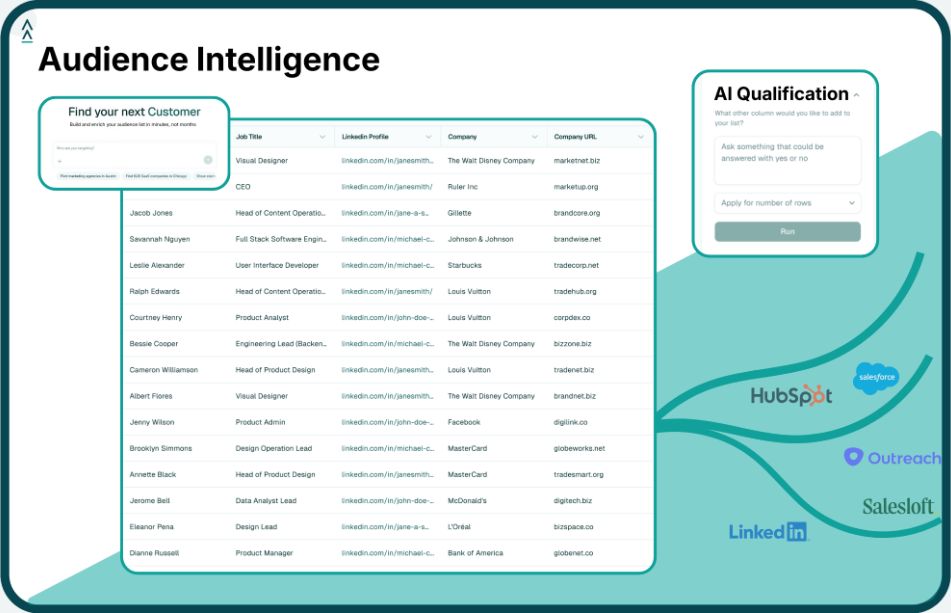
This is where platforms like Landbase's agentic AI become essential. Instead of manually researching and compiling lists of relevant contacts, go-to-market teams can use natural-language prompts to instantly generate AI-qualified audiences. For example, a prompt like "Product leaders at AI/ML startups hiring their first RevOps leader" would return precisely targeted contacts ready for outreach.
Landbase's VibeGTM interface leverages 1,500+ unique signals across firmographic, technographic, intent, hiring, and funding data to build highly qualified prospect lists. With access to 300M+ contacts and 24M+ companies, the platform enables teams to:
For companies looking to engage with the fastest-growing eCommerce tech companies, AI-powered audience discovery isn't just convenient—it's a competitive necessity.
A fastest-growing eCommerce tech company demonstrates rapid scaling through significant funding rounds ($30M+ in 2024-2025), strong market traction, and innovative technology solving critical industry challenges. These companies typically achieve unicorn status ($1B+ valuation) or show clear paths to massive scale. Examples include Whatnot's $11.5 billion valuation and ShopMy's $1.5 billion valuation with profitability. Growth velocity, capital efficiency, and market impact are key indicators.
AI platforms like Landbase's GTM-2 Omni accelerate growth by enabling precise audience targeting and qualification through natural-language prompts. Instead of wasting resources on cold outreach, eCommerce startups can instantly identify high-intent prospects based on real-time signals like funding rounds, hiring activity, and tech stack changes. This precision targeting reduces customer acquisition costs while increasing conversion rates. The efficiency allows startups to scale without massive sales teams, directing resources toward product development and customer success.
eCommerce tech companies typically progress through Series A ($10-30M), Series B ($30-100M), and Series C+ ($100M+) funding rounds as they demonstrate product-market fit and scaling potential. The companies featured here have raised substantial later-stage funding: Whatnot's $225 million Series F, Hightouch's $80 million Series C, and Talon.One's $135 million Series B. These funding stages validate business models and provide capital for aggressive market expansion. Later rounds typically indicate proven revenue models and path to profitability.
Key leaders include Grant LaFontaine (Whatnot CEO), Harry Rein (ShopMy CEO), Aadit Palicha (Zepto CEO), Kashish Gupta (Hightouch Co-CEOs), and Angie Westbrock (Standard AI CEO). These founders combine deep eCommerce expertise with technical innovation, often having previous experience in retail, technology, or consumer platforms. Their leadership has enabled rapid scale and significant valuations in competitive markets.
eCommerce businesses can leverage AI-powered audience discovery platforms like Landbase to find and qualify ideal customers using natural-language targeting. By accessing 1,500+ unique signals across firmographic, technographic, intent, hiring, and funding data, teams can build highly targeted prospect lists in seconds. This approach enables precise targeting based on real-time market signals, ensuring outreach is relevant and timely. The efficiency dramatically reduces time-to-market and improves conversion rates compared to traditional manual research.
Primary challenges include increasing competition, rising customer acquisition costs, and operational complexity as companies scale globally. Opportunities lie in AI-driven personalization, autonomous retail technologies, live and social commerce expansion, and unified operations platforms consolidating fragmented tool stacks. Companies solving these challenges—like those featured in this list—will continue attracting significant investment and achieving rapid growth. The shift from mass marketing to micro-personalization represents the biggest opportunity for well-positioned platforms.
Tool and strategies modern teams need to help their companies grow.