Daniel Saks
Chief Executive Officer
.png)
.png)
.png)


The DevOps market is projected to reach $25.5 billion by 2028, driven by AI integration, security automation, and the relentless demand for faster software delivery. For go-to-market teams targeting these high-growth DevOps companies, understanding their funding patterns, leadership, and market positioning is crucial. Platforms like Landbase empower B2B sales and marketing teams to identify and qualify prospects at these fast-growing companies using natural-language prompts to search for companies based on funding, size, and industry.
Cursor provides an AI-native code editor that integrates intelligent code completion and generation directly into the development environment. The platform offers contextual understanding of entire codebases for intelligent suggestions and real-time collaboration features for team coding. Developers use Cursor to accelerate coding workflows with AI assistance that understands project context.
Databricks provides a unified platform for data engineering, data science, analytics, and machine learning, built on an open-source foundation. The company has strategically pivoted to AI agents and full-scale AI building tools, offering Lakehouse (Postgres-based database for AI agents) and Agent Bricks (AI agent platform). Enterprises use Databricks to build lakehouse architectures that power large-scale analytics and AI applications.
Functionize provides an AI-powered testing and QA platform that generates self-healing test scripts from natural language descriptions. The platform offers automated test data creation and management, plus API and performance testing across global VMs. Product managers and less technical team members can create and maintain tests without deep QA engineering expertise.
Zed provides a collaborative AI-native code editor built from the ground up in Rust for performance and reliability. The platform features persistent, contextual conversations tied to code with character-level permalinks and real-time collaboration for humans and AI agents using CRDTs. Zed's architecture is specifically designed for AI collaboration, not bolted onto existing editors.
Trunk.io provides a CI reliability platform that uses AI-powered flaky test detection and quarantine across any language, test runner, or CI provider. The platform offers automated test failure analysis and duplicate detection, plus intelligent merge queues with anti-flake protection. Teams maintain continuous delivery velocity while reducing developer time wasted on test maintenance.
NeuBird provides a GenAI-powered SRE platform featuring Hawkeye AI teammate for ITOps engineers. The platform interprets IT telemetry from observability tools, provides automated issue identification and analysis from incident management tools, and delivers actionable resolutions to ITOps teams. NeuBird transforms raw observability data into actionable insights.
Phoebe provides an AI-powered software reliability platform featuring swarms of AI agents that monitor logs, traces, commits, and metrics. The platform offers read-only, vendor-agnostic incident diagnosis and code/config fix generation, plus predictive problem detection before downtime occurs. Phoebe acts as a "software immune system" with proactive protection versus reactive monitoring.
AllSpice provides a Git-powered collaboration platform for electrical engineering teams, bringing software DevOps practices to hardware engineering. The platform offers a shared workspace for catching design errors early in hardware development and version control for hardware from idea to production. Hardware teams can collaborate with the same sophistication as software developers.
SRE.ai provides an AI-native DevOps agent platform that integrates with AWS, Salesforce, and ServiceNow. The platform features a chat-like interface for managing testing, releases, monitoring, and security, plus automated workflow execution across enterprise DevOps toolchains. AI agents navigate complex toolchains through natural language.
Blacksmith Software provides a high-performance CI cloud for GitHub that claims half the cost of competitors and twice as fast performance through bare metal hardware architecture. The platform uses high-performance consumer gaming CPUs for superior single-core performance, directly addressing CI/CD cost pain points.
Pipeshift provides a Platform-as-a-Service for orchestrating AI workloads across any infrastructure (cloud or on-premises). The platform supports training and deploying open-source AI models and vector databases, plus scales AI apps, copilots, and agents with full security and governance. Pipeshift bridges traditional DevOps and AI/ML workload requirements.
Dagger provides a CI/CD workflow engine that turns semi-automated flows into robust containerized workflows. The platform offers Dagger Cloud for unified view across pre-push and post-push pipelines, plus holistic visibility across all CI/CD pipelines. Dagger builds on the Docker legacy to create more modular, portable CI/CD pipelines.
For sales and marketing teams targeting these fast-growing DevOps companies, traditional lead generation approaches fall short. These companies move quickly, with frequent funding rounds, leadership changes, and tech stack updates that create narrow windows of opportunity. This is where Landbase's agentic AI platform transforms go-to-market strategy.
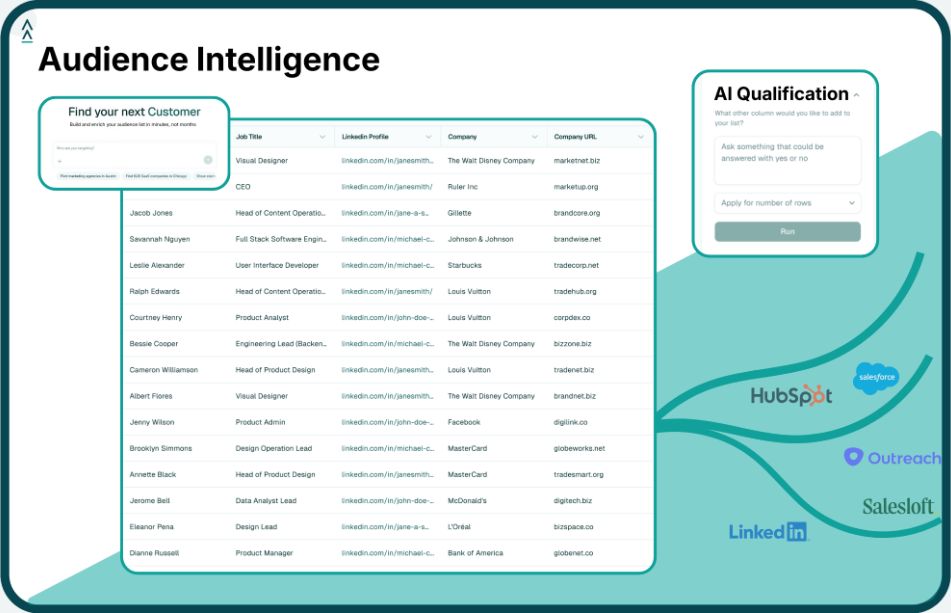
Using natural-language prompts, teams can build targeted lists like:
Landbase's database includes over 300 million contacts and 24 million companies with numerous unique signals spanning firmographic, technographic, intent, hiring, and funding data. The platform's GTM-2 Omni AI model interprets these plain-English queries and delivers AI-qualified audiences ready for immediate activation in existing sales and marketing tools.
For DevOps vendors looking to penetrate this high-growth market, the ability to identify companies at the exact moment they're most receptive to new solutions – whether due to recent funding, tech stack changes, or hiring activity – becomes a critical competitive advantage.
The rapid growth is driven by AI integration, security automation demands, and the need for faster software delivery in competitive markets. Companies like Cursor achieved 1,000% YoY growth by embedding AI directly into developer workflows, while Functionize ran over 1 billion tests demonstrating the scale of automated testing adoption. The market is projected to reach $25.5 billion by 2028, reflecting the strategic importance of DevOps tools in modern software development.
Recent funding rounds validate market opportunities and enable rapid innovation. Databricks' ~$1 billion raise at a $100 billion valuation signals enterprise confidence in AI platforms, while Zed's $32 million from Sequoia enables ground-up rethinking of code editors. These investments allow startups to attract top talent, accelerate product development, and compete with established players through specialized AI-powered solutions.
Key signals include recent funding rounds, tech stack changes, hiring activity for engineering leadership roles, and AI integration announcements. Platforms like Landbase track numerous unique signals including recently funded tech startups, rapid sales department growth, and specific technology adoption. These signals help identify companies at inflection points when they're most receptive to new DevOps solutions.
B2B sales teams should leverage natural-language targeting platforms like Landbase's VibeGTM interface to build precise prospect lists based on real-time signals. Instead of manual database queries, teams can use natural language to instantly generate AI-qualified audiences based on funding, tech stack, and hiring patterns. This approach dramatically reduces research time while increasing targeting precision for high-growth DevOps companies.
AI is fundamentally reshaping DevOps through agentic systems that automate complex workflows, predict reliability issues, and enhance developer productivity. Companies like Phoebe's "software immune system" and SRE.ai's AI agents demonstrate the shift from reactive tools to proactive, autonomous systems. This trend toward agentic AI will continue to accelerate as DevOps teams seek to manage increasing complexity while maintaining velocity.
Tool and strategies modern teams need to help their companies grow.