Daniel Saks
Chief Executive Officer
.png)
.png)
.png)


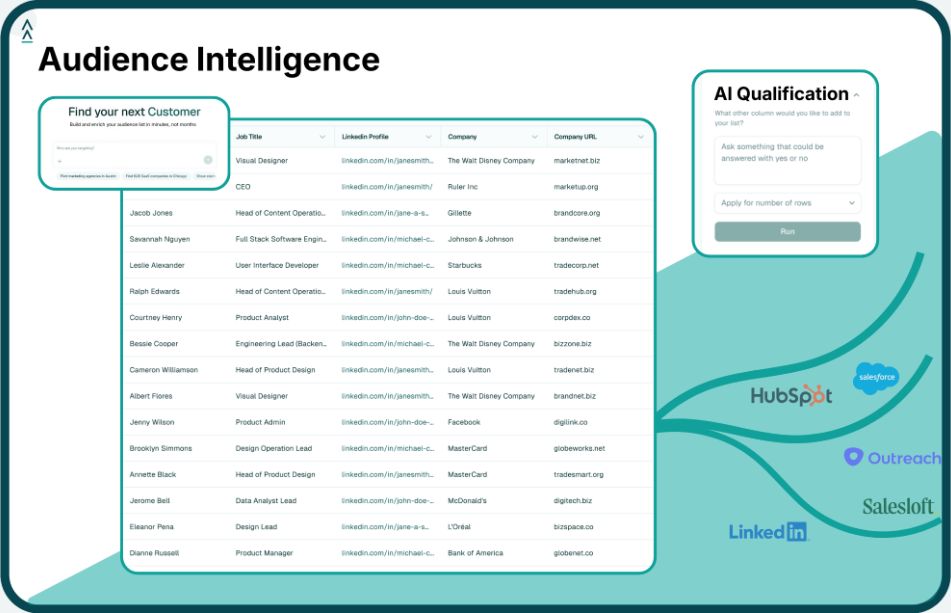
The data analytics landscape is undergoing explosive transformation, with companies raising billions in capital to power the next generation of AI-driven insights. The market is projected to reach $345.30 billion by 2030, growing at a CAGR of 33.21%. From prediction markets commanding billion-dollar valuations to AI assistants that query data in natural language, these companies are redefining how organizations extract insights from information. For go-to-market teams, the ability to harness real-time data signals and intent tracking is just as crucial as traditional analytics platforms. This is where agentic AI platforms like Landbase are transforming the game—enabling teams to find and qualify their next customer in seconds using natural-language prompts against 1,500+ unique signals.
Kalshi operates a CFTC-regulated prediction market platform that allows users to trade on the outcomes of real-world events. Their analytics engine processes vast amounts of market data to provide insights into public sentiment, probability forecasting, and event outcome predictions.
Databricks provides a unified platform combining data engineering, data warehousing, machine learning, and AI. Their lakehouse architecture merges data lakes and data warehouses, enabling organizations to manage all their data, analytics, and AI workloads in one place.
Polymarket operates a decentralized information markets platform where users trade on real-world event outcomes. Their analytics infrastructure processes blockchain-based trading data to generate probabilistic forecasts and sentiment analysis.
Cloudflare provides network infrastructure and analytics services, processing over 20% of all internet traffic globally. Their analytics platform delivers real-time insights on web performance, security threats, bot traffic, and user behavior patterns.
Snowflake provides a cloud data platform that enables organizations to store, analyze, and share data at massive scale. Their architecture separates storage and computation, allowing customers to scale independently.
Alembic provides an AI-powered analytics platform focused on business decision intelligence. Their approach to automated analytics and predictive modeling for enterprise decision-making has garnered significant investor confidence.
Numeric provides an AI-powered financial analytics and accounting automation platform. They help finance teams streamline month-end close processes, automate reconciliations, and generate real-time financial insights using machine learning algorithms.
WisdomAI provides an AI data-analytics assistant that helps organizations query, analyze, and derive insights from their data using natural language. The platform acts as an intelligent layer between users and their data infrastructure.
MoEngage provides an insights-led customer engagement platform that combines analytics, AI-powered personalization, and multi-channel campaign management. Their platform analyzes customer behavior across touchpoints to enable hyper-personalized marketing at scale.
Reducto provides an AI-powered platform that extracts structured data from unstructured documents. Their technology enables organizations to analyze PDF files, scanned documents, images, and other unstructured content by converting them into queryable, analyzable data.
The data analytics market is experiencing unprecedented growth, driven by the convergence of AI, cloud infrastructure, and real-time data processing. According to industry analysis, 77% of organizations list analytics as the principal lever for operational efficiency, underscoring its shift from support function to strategic core. The integration of AI and machine learning is delivering an estimated $4.4 trillion productivity upside across industries.
Within this rapidly evolving landscape, the ability to access and act on real-time signals has become critical for go-to-market success. Traditional data providers with static databases are being replaced by platforms that offer dynamic, AI-qualified audiences based on current market activity. This is where solutions like Landbase's AI-qualified audiences excel—combining 300M+ contacts with 1,500+ unique signals including real-time intent tracking, funding events, hiring activity, and technology stack changes.
This list highlights companies that demonstrate genuine growth velocity based on objective criteria:
We analyzed 296 venture-backed companies using proprietary scoring across these dimensions, prioritizing companies with recent funding rounds and demonstrated growth trajectories over absolute company size.
While these 15 companies represent the cutting edge of data analytics, there's an emerging category that's particularly relevant for B2B sales and marketing teams: agentic AI for go-to-market. Traditional analytics platforms focus on historical data and descriptive reporting, but modern GTM requires predictive and prescriptive capabilities.
Platforms like Landbase's GTM-2 Omni represent this new paradigm, where AI agents coordinate targeting, qualification, and list building based on real-time signals. Instead of manually querying databases with complex filters, teams can use natural language to describe their ideal customer profile: "CFOs at enterprise SaaS companies that raised funding in the last 30 days."
This approach leverages real-time intent tracking, website visitor intelligence, and market trigger events to deliver AI-qualified audiences ready for immediate activation. The result is a dramatic reduction in time-to-value—from days of manual research to seconds of AI-powered discovery.
For organizations competing in the fast-moving analytics market, the ability to identify and engage high-value prospects at the right moment is just as important as having the best product. Agentic AI platforms are becoming the essential layer that connects sophisticated analytics capabilities with actionable go-to-market execution.
A fast-growing data analytics company demonstrates significant growth velocity through recent funding rounds (typically $50M+ in 2024-2025), user/traffic growth exceeding industry averages, and market expansion into new verticals or geographies. Unlike established leaders measured by total revenue, fast-growing companies are evaluated on their acceleration rate and investor confidence. This confidence is evidenced by funding velocity and valuation increases that signal market validation of their approach.
Agentic AI transforms go-to-market strategies by enabling natural-language targeting that eliminates complex database queries. Instead of manual list building, teams describe their ideal customer profile in plain English, and AI agents coordinate across 1,500+ signals to build and qualify audiences instantly. This approach reduces time-to-value from days to seconds and ensures teams are always working with current market data. The result is more efficient prospecting and higher-quality pipeline generation for sales teams.
Recent funding serves as both validation and fuel for data analytics startups. Large funding rounds ($50M+) demonstrate investor confidence in product-market fit and growth potential, while providing capital to scale infrastructure and expand into new markets. The concentration of billion-dollar rounds in 2025 indicates that institutional investors view data analytics as critical infrastructure. This capital enables startups to accelerate product development, hire top talent, and compete effectively against established players.
Industries with complex data environments and rapid market changes benefit most from advanced business intelligence. Financial services require real-time risk assessment and regulatory compliance insights to maintain competitive advantage. Healthcare needs to navigate complex buying processes while maintaining strict data privacy standards. Cybersecurity companies must demonstrate a deep understanding of prospect risk profiles to close deals effectively. SaaS companies compete in crowded markets requiring precise targeting based on technology stack changes and churn signals.
Leading data analytics companies prioritize data privacy through certifications like SOC II and GDPR compliance, transparent data sourcing practices, and robust security protocols. They implement strict access controls, data encryption, and regular security audits to protect customer information. For B2B data providers specifically, they focus on publicly available business information rather than personal consumer data, reducing regulatory complexity. This approach maintains data utility for go-to-market teams while ensuring compliance with evolving privacy regulations.
Tool and strategies modern teams need to help their companies grow.