Daniel Saks
Chief Executive Officer
.png)
.png)
.png)


The customer experience automation market is experiencing explosive growth, projected to reach $26.11 billion by 2034. This surge is driven by the fact that 93% of consumers now recognize the value of AI in customer service, creating unprecedented demand for intelligent, autonomous customer experience platforms. For go-to-market teams, understanding these CX automation leaders is crucial—not just for customer retention, but for identifying the right prospects who are actively investing in customer experience transformation. Platforms like Landbase's agentic AI complement this ecosystem by helping B2B companies discover and qualify prospects who are implementing these advanced CX solutions, enabling targeted outreach to organizations prioritizing customer experience innovation.
Cognigy provides an enterprise-grade orchestration layer combining Conversational and Generative AI to deliver autonomous customer service. Their pre-trained AI Agents resolve high-volume customer requests with minimal human intervention, while their Agent Copilot assists human agents with real-time contextual support.
Cognigy demonstrates that enterprise-grade AI automation can deliver measurable results at scale, with customers achieving 70%+ automation rates while maintaining service quality. As Raluca Ragab from Eurazeo Growth noted, "Cognigy's enterprise-grade orchestration layer for AI Agents works alongside human agents to deliver a highly effective, personalized service on any channel."
Sierra builds outcome-driven AI agents that deliver personalized, empathetic customer experiences aligned to brand voice across all channels. Their Agent OS platform enables companies to build once and deploy everywhere, with recent additions including voice support for phone calls.
Sierra represents the fastest proof point that agentic AI can deliver mission-critical customer experience at enterprise scale. As CEO Bret Taylor explains, "Our thesis is really simple. We think that conversational AI will become the dominant form factor that people use to interact with brands."
Verint provides a comprehensive AI-powered open platform with a team of AI-powered bots under their Da Vinci AI system. Their suite includes Agent Copilot, self-service capabilities, advanced analytics, and workforce engagement tools.
Verint's 2025 research reveals critical insights about customer behavior, including that 78% of consumers would consider switching after a single poor experience (up from 67% in 2024).
Parloa delivers an enterprise-grade contact center platform powered by AI with a voice-first approach. Their platform supports both voice and messaging channels with built-in automated translation and intelligent routing capabilities.
Parloa addresses the critical gap in voice automation, recognizing that many customer service interactions still happen over the phone. Their voice-first approach provides a more natural and comprehensive customer experience compared to chat-only solutions.
Poly AI specializes in conversational voice platforms that deliver effortless customer experience at scale across 10 languages. Their platform handles account management, authentication, billing, payments, booking, and reservations through natural voice interactions.
Poly AI demonstrates the growing importance of voice automation in customer experience, with their 10-language support enabling global enterprises to deliver consistent service across regions. Their specialized voice focus eliminates human translation bottlenecks for multinational organizations.
Nextiva provides a unified CX platform that combines native CX and automation tools from the ground up. Their connected platform integrates voice, surveys, automation, and analytics into a single solution.
Nextiva addresses the critical barrier of AI complexity, with CEO Tomas Gorny stating, "AI is the great equalizer, if we use it properly." This philosophy makes advanced CX automation accessible to organizations without extensive technical resources.
Ada provides autonomous customer service agents that resolve customer requests without human intervention across digital channels and voice. Their platform focuses on containment—resolving issues without redirection.
Ada represents a shift from deflection-focused chatbots to true resolution-oriented AI. As CEO Mike Murchison explains, "Our vision has always been to resolve every customer service conversation." This agent-first philosophy ensures customers get complete solutions rather than being passed between channels.
Cresta delivers real-time agent assist intelligence that improves human agent performance in the moment. Their platform blends human intuition with AI guidance through an orchestration layer that learns from every interaction.
Cresta demonstrates that the future of CX isn't about replacing humans but enhancing their capabilities. CEO Ping Wu explains, "We're excited about transforming contact centers with AI." This hybrid approach maintains the human touch while leveraging AI for real-time intelligence.
Yellow.ai builds customer service automation on a multi-LLM architecture, enabling cross-channel chat and voice automation. Their platform is continuously trained on 16+ billion conversations annually.
Yellow.ai's multi-LLM architecture provides resilience and flexibility that single-model platforms cannot match. Their focus on reducing operating costs while boosting efficiency makes them particularly attractive to cost-conscious enterprises.
Rezo AI provides unified, hyper-personalized interactions through voice AI agents and chatbots built on an omnichannel architecture. Their platform includes centralized data repositories for context-aware interactions.
Rezo AI addresses the global enterprise need for multilingual support, with their 15+ language capabilities enabling consistent customer experience across regions. Their agentic AI approach bridges the gap between enterprises and customers through autonomous, context-aware interactions.
Five9 provides an intelligent CX platform powered by their Genius AI Architecture, recently enhanced with Agentic CX featuring AI Agents. Their platform includes enhanced AI trust and governance with granular guardrails.
Five9's focus on enterprise-ready AI with governance and observability addresses critical adoption barriers for large organizations. Their flexible approach allows companies to implement AI at their own pace, from basic automation to fully autonomous agents.
Salesforce Service Cloud provides customer service capabilities within their Customer 360 platform, featuring AI-powered sentiment analysis through Customer Experience Intelligence (CXI). Their platform integrates seamlessly with the broader Salesforce ecosystem.
Salesforce's integration of CX within their Customer 360 platform ensures that customer service data flows seamlessly across sales, marketing, and service functions. Their acquisition of Convergence.ai demonstrates commitment to enhancing AI capabilities within their established ecosystem.
For B2B go-to-market teams, the rapid adoption of CX automation platforms represents a significant opportunity. Companies investing in these advanced solutions are often experiencing growth, digital transformation, or competitive pressure—making them ideal prospects for complementary B2B solutions.
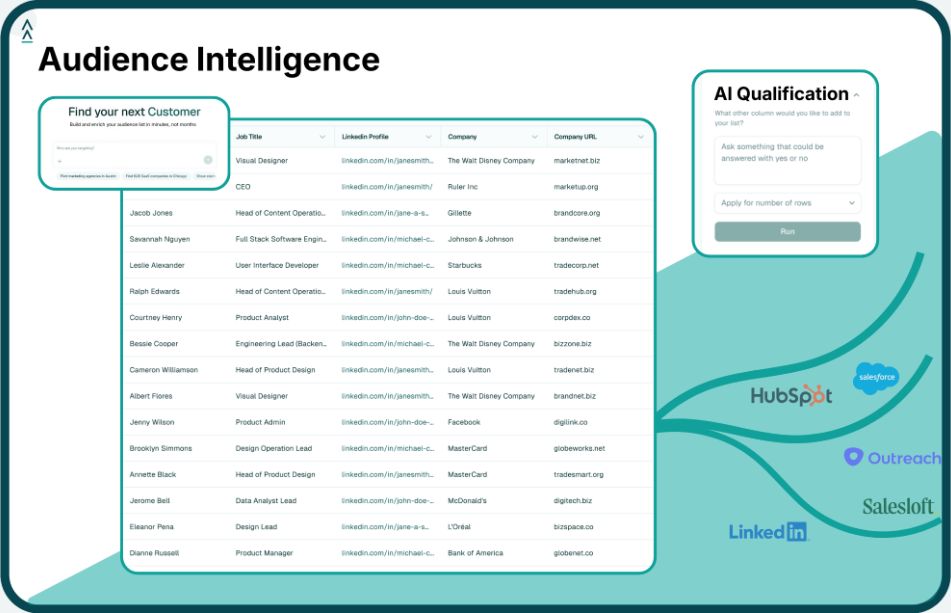
Platforms like Landbase's VibeGTM interface enable sales and marketing teams to discover these high-value prospects using natural-language prompts like "Companies using Cognigy or Sierra for customer service automation" or "Enterprises that recently implemented AI-powered contact center solutions." By leveraging 1,500+ unique signals including technology stack detection, funding events, and hiring activity, GTM teams can build AI-qualified audiences of organizations actively investing in CX innovation.
This approach allows B2B companies to:
Customer Experience Management (CXM) software focuses specifically on managing and optimizing customer interactions across all touchpoints, with emphasis on service, support, and relationship management. Digital Experience Platforms (DXP) are broader content and experience management systems that handle website content, mobile experiences, and digital commerce. CXM platforms like those listed above specialize in conversational AI, contact center automation, and service orchestration, while DXPs focus on content delivery and user experience management. The key distinction is that CXM prioritizes ongoing customer relationships while DXP emphasizes content-driven digital experiences.
Agentic AI transforms CX automation by enabling autonomous agents that can reason, decide, and take action independently rather than just following predefined scripts. This allows for more natural, context-aware interactions that can handle complex customer requests without human intervention. Platforms like Cognigy and Sierra demonstrate 70%+ automation rates while maintaining service quality, showing that agentic AI can deliver both efficiency and customer satisfaction. The technology learns from each interaction and continuously improves performance over time.
Investors in CX automation startups typically look for enterprise customer adoption (especially Fortune 100 companies), significant funding rounds ($50M+), rapid ARR growth, and strategic partnerships with established technology companies. The 86% of consumers who value AI in customer service creates a strong market tailwind, but investors want proof of enterprise validation through customer logos, retention rates, and expansion revenue. Additional signals include technology differentiation, proven founder expertise, and scalable business models that can support multi-channel deployment across global enterprises.
While platforms like Verint and Cognigy focus on enterprise customers, many CX automation solutions including Nextiva and Ada serve businesses of all sizes. Nextiva specifically focuses on making AI accessible to SMBs, with CEO Tomas Gorny stating that "AI is the great equalizer." However, smaller businesses should carefully evaluate pricing models, implementation complexity, and feature requirements to ensure the platform aligns with their scale and budget. Many vendors offer tiered pricing and simplified implementations designed specifically for SMB needs.
B2B companies can identify prospects investing in CX automation by monitoring technology stack changes, funding announcements, hiring activity for customer experience roles, and conference attendance. Platforms like Landbase enable discovery of these high-value prospects through natural-language targeting, allowing GTM teams to build AI-qualified audiences of companies actively implementing advanced customer experience solutions. Additionally, tracking job postings for CX-related roles, partnership announcements with CX vendors, and earnings calls mentioning customer experience investments can reveal organizations prioritizing CX transformation.
Tool and strategies modern teams need to help their companies grow.