January 7, 2026

10 Fastest Growing API Integration Platforms Companies and Startups

Discover the 10 fastest-growing API integration platforms driving the market's explosive growth from $15.63B to $78.28B by 2032, featuring Kong's $175M Series E, Workato's $5.7B valuation, and AI-powered integration solutions.
  • Button with overlapping square icons and text 'Copy link'.
Table of Contents

Major Takeaways

How fast is the API integration platform market growing?
The market is projected to expand from $15.63 billion in 2025 to $78.28 billion by 2032, growing at a 25.9% compound annual growth rate as businesses urgently need to connect increasingly complex SaaS ecosystems.
Which API integration platforms have achieved unicorn status?
Postman reached a $6 billion valuation, Workato stands at $5.7 billion, and Kong achieved a $2 billion valuation, demonstrating the strategic importance of API infrastructure in modern enterprise operations.
Why is AI integration becoming essential for API platforms?
Leading platforms like Kong, Workato, and MuleSoft have embedded agentic AI capabilities to enable self-healing workflows and intelligent API orchestration, making AI integration table stakes for handling the surge in API calls driven by AI and LLM adoption.

The API integration platform market is experiencing explosive growth, projected to expand from $15.63 billion in 2025 to $78.28 billion by 2032, with a compound annual growth rate of 25.9%. This surge reflects businesses' urgent need to connect disparate systems in an increasingly complex SaaS landscape. As companies deploy more specialized tools, seamless data flow becomes critical for operational efficiency and customer experience. For go-to-market teams specifically, the ability to integrate audience intelligence platforms like Landbase's agentic AI with existing CRM and outreach tools can dramatically accelerate pipeline generation and improve targeting precision.

Key Takeaways

  • Market experiencing explosive growth – The API integration platform market is projected to grow from $15.63 billion in 2025 to $78.28 billion by 2032 at a 25.9% CAGR as businesses connect increasingly complex SaaS ecosystems.
  • AI integration is now table stakes – Leading platforms like Kong, Workato, and MuleSoft have embedded agentic AI capabilities to enable self-healing workflows and intelligent API orchestration for the AI era.
  • Recent funding validates market confidence – Kong secured $175M Series E in November 2024, while Workato raised $200M Series E at a $5.7B valuation, demonstrating strong investor and customer validation.
  • Enterprise vs. SMB segmentation is clear – Platforms like MuleSoft and Boomi focus on complex enterprise needs with strong security and governance, while Zapier and Activepieces serve SMBs with accessible, cost-effective solutions.
  • Unicorn status achieved by multiple players – Postman ($6B valuation as of June 2020), Workato ($5.7B valuation), and Kong ($2B valuation) have all achieved unicorn status, reflecting the strategic importance of API infrastructure.
  • Developer experience remains paramount – Platforms like Postman have grown their user base to 35M+ by focusing on the entire API lifecycle from design to testing.
  • API integration enables GTM efficiency – Seamless integration between audience discovery platforms and outreach tools allows sales and marketing teams to activate high-quality prospect lists without manual data handling.

1. Kong — API Gateway & Service Mesh Platform

What They Do:

Kong provides a unified API platform that manages both internal and external APIs through its Konnect platform and AI Gateway. The company offers an open-source foundation with Kong Gateway while delivering enterprise-grade capabilities for managing the surge in API calls driven by AI and LLM adoption. Enterprises use Kong to consolidate disparate API systems and enable what CEO Augusto Marietti calls "the software assembly line" of the AI era.

Why They're Important:

  • Unified platform manages both internal and external APIs across hybrid environments
  • AI Gateway specifically designed for managing AI/LLM API calls
  • Open-source foundation provides flexibility while enterprise features ensure security and scale

Key Stats / Metrics:

Leadership:

  • CEO: Augusto Marietti
  • Founded: 2009

Recent Funding:

  • Most Recent Round: $175M Series E (November 2024)
  • Lead Investors: Tiger Global (led), Balderton (co-led)
  • Other Investors: Andreessen Horowitz, Index Ventures, Sapphire Ventures
  • Valuation: $2B

2. Workato — Enterprise Automation & Integration Platform

What They Do:

Workato delivers an enterprise automation and integration platform with 1,200+ native connectors and AI-powered automation agents through its Workato One platform. The company serves enterprise customers with enterprise-grade low-code automation capabilities, including PCI DSS 4.0-level security and embedded environments for partner white-labeling.

Why They're Important:

  • Workato One unifies AI-native building blocks (Agent Studio, Agent Trust, AgentX Apps)
  • Real-time ROI analytics through Workato Insights helps partners demonstrate value
  • Strong enterprise adoption with proven track record in complex automation scenarios

Key Stats / Metrics:

Leadership:

  • CEO: Vijay Tella
  • Founded: 2013

Recent Funding:

3. MuleSoft (Salesforce) — Enterprise iPaaS & API Management Platform

What They Do:

MuleSoft, now part of Salesforce, provides an enterprise iPaaS and API management platform positioned as Salesforce's "agentic AI spine." The platform features Anypoint Code Builder with Einstein generative flows, Model Context Protocol (MCP) support for agentic AI, and MuleSoft for Flow that enables point-and-click automation for non-developers. Enterprises rely on MuleSoft for end-to-end API lifecycle management with built-in AI governance.

Why They're Important:

  • Deep integration with Salesforce ecosystem provides 360-degree customer data
  • Positioned as Salesforce's "agentic AI spine" with Model Context Protocol support
  • Hybrid deployment model makes it essential for large-scale, API-first strategies

Key Stats / Metrics:

  • Multiple years as Gartner iPaaS Leader
  • Part of Salesforce ecosystem serving 150,000+ customers
  • Enterprise-grade reliability and scale

Leadership:

  • CEO: Marc Benioff
  • Founded: 2006

Recent Funding:

  • Acquisition: Acquired by Salesforce for $6.5B (2018)
  • Valuation: Part of Salesforce (market cap over $300B)

4. Boomi — Enterprise Integration Platform (iPaaS)

What They Do:

Boomi offers an enterprise integration platform (iPaaS) with agentic AI innovations for self-healing flows, full API management embedding with anomaly detection, and composable architecture for multi-cloud flexibility. The platform unifies API, data, and workflow management in a single console, serving complex global enterprises with extensive partner networks including SAP, Oracle, and AWS.

Why They're Important:

  • Gartner iPaaS Leader recognition demonstrates sustained excellence
  • AI accelerates error handling with self-healing capabilities
  • Composable architecture ideal for complex global roll-outs requiring multi-cloud flexibility

Key Stats / Metrics:

  • Consistent Gartner iPaaS Leader recognition
  • May 2025 platform upgrades include anomaly detection dashboards
  • 20,000+ customers globally

Leadership:

  • CEO: Steve Lucas
  • Founded: 2000

Recent Funding:

  • Most Recent Round: $4M Series A

5. Postman — API Development & Collaboration Platform

What They Do:

Postman provides a collaborative API lifecycle platform that simplifies the entire API workflow from design to testing. The platform has grown its user base from 25M to 35M+ and serves as critical infrastructure for developer teams across the software industry. Postman's focus on collaboration addresses fundamental developer workflow needs in API management.

Why They're Important:

  • 35M+ user base demonstrates massive developer adoption
  • Simplifies entire API lifecycle from design to testing
  • Widely adopted across software industry for API management

Key Stats / Metrics:

  • $6B valuation (as of June 2020)
  • $433M total funding
  • 35M+ users
  • 251-1,000 employees

Leadership:

  • CEO: Abhinav Asthana
  • Founded: 2012

Recent Funding:

  • Last Funding Round: Series D
  • Top Investors: Bond, Nexus Venture Partners, Battery Ventures, Coatue, Insight Partners
  • Total Funding: $433M
  • Valuation: $6B (June 2020)

6. Zapier — No-Code Automation Platform

What They Do:

Zapier delivers a no-code automation platform with 7,000+ apps and AI-enhanced workflows featuring dynamic branching and AI-powered data parsing and enrichment. The platform serves as the go-to choice for SMBs and product-led teams, evolving beyond simple "zaps" to sophisticated automation capabilities while maintaining flat pricing for predictable TCO.

Why They're Important:

  • 7,000+ apps provide extensive integration coverage
  • AI-enhanced capabilities show continued innovation despite mature market position
  • Flat pricing keeps TCO predictable for smaller teams

Key Stats / Metrics:

  • 7,000+ apps
  • New AI connectors for contextual message routing (2025)
  • 700+ employees
  • Millions of users worldwide

Leadership:

  • CEO: Wade Foster
  • Founded: 2011

Recent Funding:

  • Most Recent Round: $140M Series B (2021)
  • Valuation: $5B 

7. Microsoft Power Automate — Enterprise Low-Code Automation

What They Do:

Microsoft Power Automate provides enterprise low-code automation with deep Microsoft ecosystem integration, multi-cloud orchestration capabilities, and AI-generated flows via Copilot. The platform enables businesses to automate processes across Microsoft 365, Dynamics 365, and hundreds of third-party applications through a visual, no-code interface that's accessible to business users while maintaining enterprise-grade security.

Why They're Important:

  • Deep integration with Microsoft ecosystem provides seamless automation across Office 365 and Azure
  • Multi-cloud orchestration capabilities support complex enterprise environments
  • AI-generated flows via Copilot make automation accessible to non-technical users

Key Stats / Metrics:

  • Part of Microsoft Power Platform suite serving millions of organizations
  • Deep integration with Microsoft 365 (270M+ users)
  • Enterprise-grade security and compliance

Leadership:

  • CEO: Satya Nadella
  • Founded: 2016 (as Microsoft Flow)

Recent Funding:

  • Parent Company: Microsoft Corporation
  • Valuation: Part of Microsoft (market cap over $3 trillion)

8. Activepieces — Open-Source API Integration Platform

What They Do:

Activepieces offers an open-source API integration platform with a visual workflow builder, self-hosting capabilities, and SOC 2 compliance. The platform provides an affordable alternative to enterprise iPaaS solutions while maintaining developer-friendly features and security standards. Activepieces appeals to organizations that want integration capabilities without vendor lock-in or high licensing costs.

Why They're Important:

  • Open-source foundation provides transparency and flexibility
  • Self-hosting capabilities address security and compliance requirements
  • SOC 2 compliant for enterprise security requirements

Key Stats / Metrics:

  • 41,000+ users engaged with the platform/community
  • $500K total funding raised
  • 151+ contributors to the open-source project

Leadership:

  • CEO: Mohammed Abu Musa
  • Founded: 2021

Recent Funding:

  • Most Recent Round: $500K Seed

9. Tray.io — Low-Code iPaaS for Complex Automation

What They Do:

Tray.io provides a low-code iPaaS platform focused on complex, data-heavy automation for mid-to-large enterprises. The platform offers flexible API integrations and sophisticated workflow capabilities that go beyond simple point-to-point connections. Tray.io enables businesses to build custom integrations that handle complex data transformations, conditional logic, and multi-step processes across their SaaS stack.

Why They're Important:

  • Focus on complex, data-heavy automation differentiates from simpler no-code platforms
  • Mid-to-large enterprise focus addresses sophisticated integration requirements
  • Flexible API integrations support custom business logic and data transformations

Key Stats / Metrics:

  • Low-code platform with enterprise-grade capabilities
  • Focus on mid-to-large enterprise market segment
  • 250+ employees

Leadership:

  • CEO: Rich Waldron
  • Founded: 2012

Recent Funding:

  • Most Recent Round: $40M Series C (2021)

10. SnapLogic — Cloud-Native Integration Platform

What They Do:

SnapLogic delivers a cloud-native integration platform featuring SnapGPT (generative AI), metadata-aware capabilities, API orchestration, and AgentCreator for building AI agents. The platform enables organizations to connect applications, data, and things through a unified interface that leverages AI to accelerate integration development and maintenance. SnapLogic's focus on metadata awareness helps organizations understand and govern their data flows across complex environments.

Why They're Important:

  • SnapGPT generative AI integration accelerates integration development
  • Metadata-aware capabilities provide data governance and visibility
  • AgentCreator enables building AI agents for autonomous integration tasks

Key Stats / Metrics:

  • $364M annual revenue
  • $381M total funding raised
  • 1,000+ enterprise customers

Leadership:

  • CEO: Gaurav Dhillon
  • Founded: 2006

Recent Funding:

  • Most Recent Round: $165M Series G (December 2022)
  • Valuation: $1B

Market Overview: Why API Integration Matters for Modern Business

API integration has become the connective tissue of modern business operations, enabling organizations to leverage best-of-breed SaaS applications while maintaining data consistency and workflow continuity. Rather than being locked into monolithic enterprise suites, companies can now assemble specialized tools that address specific business needs. This composable architecture approach requires robust integration capabilities to ensure seamless data flow and process automation.

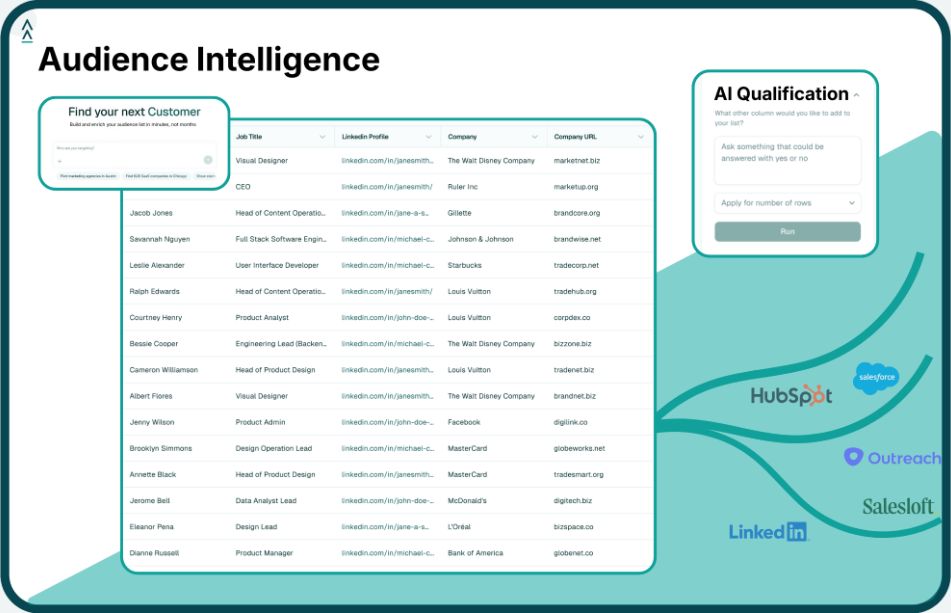
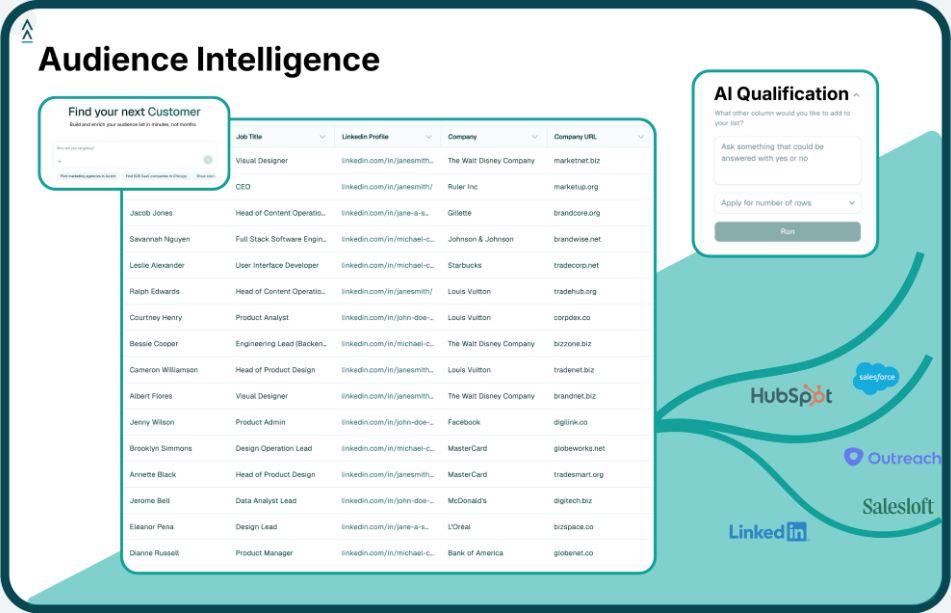
For go-to-market teams specifically, the ability to integrate audience intelligence data with outreach platforms is critical for efficient pipeline generation. Platforms like Landbase's VibeGTM leverage natural-language targeting to build AI-qualified prospect lists that can be activated across existing tools. This eliminates the manual data handling that traditionally slows down sales and marketing operations.

How We Chose These API Integration Platforms

This list highlights platforms that demonstrate strong growth momentum and market relevance based on:

  • Recent funding activity – Prioritizing companies with 2024-2025 funding rounds like Kong's $175M Series E
  • Growth metrics – Including platforms with strong growth trajectories and market presence
  • Market validation – Featuring Gartner-recognized leaders like Boomi and MuleSoft
  • Innovation focus – Highlighting platforms with AI-native capabilities like MuleSoft's Agentforce
  • Market coverage – Including platforms that serve different segments from SMB (Zapier) to enterprise (MuleSoft)
  • Developer adoption – Featuring platforms with strong user bases like Postman's 35M+ users

API Integration and Go-to-Market Efficiency

The fastest-growing API integration platforms are enabling a new era of operational efficiency, particularly for go-to-market teams. By connecting audience intelligence platforms with CRM, email, and LinkedIn outreach tools, sales and marketing teams can eliminate manual data handling and focus on high-value activities.

Landbase's platform exemplifies this approach by providing AI-qualified audience lists that can be exported and activated in existing tools. With access to 300M+ contacts and 24M+ companies, Landbase uses natural-language prompts to build targeted lists based on 1,500+ unique signals including firmographic, technographic, intent, hiring, and funding data.

This integration capability is particularly valuable because:

  • Eliminates data silos – Connects audience intelligence with activation channels
  • Accelerates time-to-value – Reduces list building from days to seconds
  • Improves targeting precision – Leverages real-time signals like funding rounds and hiring activity
  • Reduces operational overhead – Eliminates manual data handling and enrichment
  • Enables multi-channel activation – Supports seamless activation across email, LinkedIn, and other channels

As the API integration market continues its explosive growth, platforms that enable seamless data flow between intelligence and activation will become increasingly critical for go-to-market success.

Frequently Asked Questions

What is an API integration platform and why is it important for businesses today?

An API integration platform connects different software applications and services, enabling them to share data and functionality seamlessly. These platforms are critical for modern businesses because they eliminate data silos, automate manual processes, and enable organizations to leverage best-of-breed SaaS applications without being locked into monolithic suites. The market is growing at 25.9% CAGR, reflecting their strategic importance. They enable businesses to build composable architectures that adapt quickly to changing needs while maintaining operational efficiency.

How does Landbase's GTM-2 Omni AI model enhance go-to-market strategies?

Landbase's GTM-2 Omni AI enhances go-to-market strategies by interpreting natural-language prompts to build and qualify audience lists instantly. The model is trained on billions of GTM data points from 50M+ B2B campaigns and uses 1,500+ unique signals to evaluate audience fit and timing. This enables sales and marketing teams to find their next customer in seconds rather than spending days on manual research and list building. The AI-powered approach dramatically improves targeting precision while reducing operational overhead.

Who are the key leaders behind Landbase and what is their background?

Landbase is led by experienced founders and executives including Daniel Saks, co-founder and CEO who previously co-founded unicorn company AppDirect, and Hua Gao, co-founder and Chief Data Scientist who holds a Stanford Ph.D. and previously co-founded EverString (acquired by ZoomInfo). The leadership team brings deep expertise in SaaS, AI, and go-to-market strategies from companies like AppDirect, EverString, ZoomInfo, and Bain & Company. Their combined experience spans decades of building and scaling successful B2B technology companies.

What kind of funding have leading API integration platforms like Landbase recently received?

Leading API integration platforms have secured significant funding recently, demonstrating strong investor confidence in the category. Kong raised $175M Series E in November 2024 at a $2B valuation, while Workato achieved a $5.7B valuation after its Series E round. Postman reached a $6B valuation with $433M total funding. These significant funding rounds validate the critical role API integration platforms play in modern enterprise infrastructure.

Which industries can benefit most from advanced API integration and audience discovery tools?

Industries with complex buying processes and specialized requirements benefit most from advanced API integration and audience discovery tools. These include cybersecurity, financial services, healthcare, IT services, and B2B SaaS. These sectors require hyper-relevant targeting that accounts for specific risk profiles, compliance needs, and buying processes, which AI-powered platforms can address more effectively than traditional approaches.

What are the primary benefits of using an AI-powered audience discovery platform?

AI-powered audience discovery platforms like Landbase provide several key benefits: they build lists in seconds using natural language instead of complex filters, leverage 1,500+ unique signals for precise targeting, export up to 10,000 contacts instantly, and deliver AI-qualified audiences ready for immediate activation. This dramatically reduces time-to-value for go-to-market teams while improving targeting precision and engagement rates. The combination of speed, accuracy, and ease-of-use enables sales and marketing teams to focus on high-value activities rather than manual research and data handling.

  • Button with overlapping square icons and text 'Copy link'.

Stop managing tools. 
Start driving results.

See Agentic GTM in action.
Get started
Our blog

Lastest blog posts

Tool and strategies modern teams need to help their companies grow.

Discover how recruiting tech companies leverage AI-powered lead generation with real-time hiring signals, natural-language targeting, and instant audience discovery to identify prospects with genuine buying intent and achieve higher conversion rates.

Daniel Saks
Chief Executive Officer

Discover how HR tech companies leverage AI-powered lead generation, intent data, and multi-stakeholder targeting to achieve 35% higher conversion rates and build predictable B2B pipelines in competitive markets.

Daniel Saks
Chief Executive Officer

Discover how EdTech companies leverage AI-powered lead generation with multi-stakeholder targeting, educational signals, and curriculum-aligned campaigns to navigate complex buying committees and achieve predictable revenue growth.

Daniel Saks
Chief Executive Officer

Stop managing tools.
Start driving results.

See Agentic GTM in action.