Daniel Saks
Chief Executive Officer


.png)

Recruiting technology companies face a unique paradox: they help other businesses find talent, yet often struggle to identify their own ideal customers efficiently. The recruiting tech market has become increasingly competitive, with 85% of tech companies prioritizing lead generation as a core growth strategy. For recruiting startups and established platforms alike, the challenge isn't just finding companies that hire—it's identifying organizations actively seeking external recruiting solutions with the right timing, budget, and pain points.
The key to successful B2B lead generation in recruiting tech lies in understanding real-time hiring signals rather than relying on static demographic data. Today's most effective approach leverages AI-powered audience discovery platforms that can interpret natural-language prompts like "HR Directors at healthcare companies with 100-500 employees actively hiring" and instantly generate qualified prospect lists ready for outreach.
AI-driven audience discovery has transformed how recruiting tech companies build pipelines, moving beyond manual LinkedIn searches and outdated contact databases toward intelligent qualification based on real-time market signals. This shift from volume-based to signal-based targeting enables recruiting tech companies to focus their limited resources on prospects with genuine buying intent, dramatically improving conversion rates and sales efficiency.
The recruiting technology market operates within a distinct framework defined by cyclical hiring needs, competitive differentiation challenges, and rapidly evolving buyer requirements. Unlike other B2B software categories, recruiting tech companies must demonstrate immediate ROI through successful placements or time-to-hire improvements, creating higher barriers to entry and more complex sales cycles.
Modern recruiting buyers have become increasingly sophisticated, often evaluating multiple solutions simultaneously while demanding proof of domain expertise and industry-specific capabilities. The average recruiting technology purchase now involves multiple stakeholders including HR leaders, talent acquisition specialists, finance teams evaluating ROI, and sometimes even candidates providing feedback on user experience.
The solution lies in moving beyond simple demographic targeting toward strategic audience building based on real-time hiring signals and organizational changes. Companies that can identify prospects showing genuine buying intent—through recent funding, rapid team expansion, or new leadership hires—achieve significantly higher engagement rates than those relying on broad industry targeting.
For enterprise recruiting platforms, the focus should be on quality over quantity, identifying accounts that match ideal customer profiles with precision. Startups, meanwhile, need speed and flexibility to test different market segments while conserving limited resources. Both require tools that can adapt to their specific go-to-market motions and scale with their growth.
The traditional approach of manual prospecting or purchasing static contact lists has given way to sophisticated AI-powered platforms that combine vast data sets with intelligent qualification. Modern lead generation tools for recruiting tech companies must integrate multiple data sources, including firmographic, technographic, intent, and crucially, hiring signals, to identify prospects with genuine purchase intent.
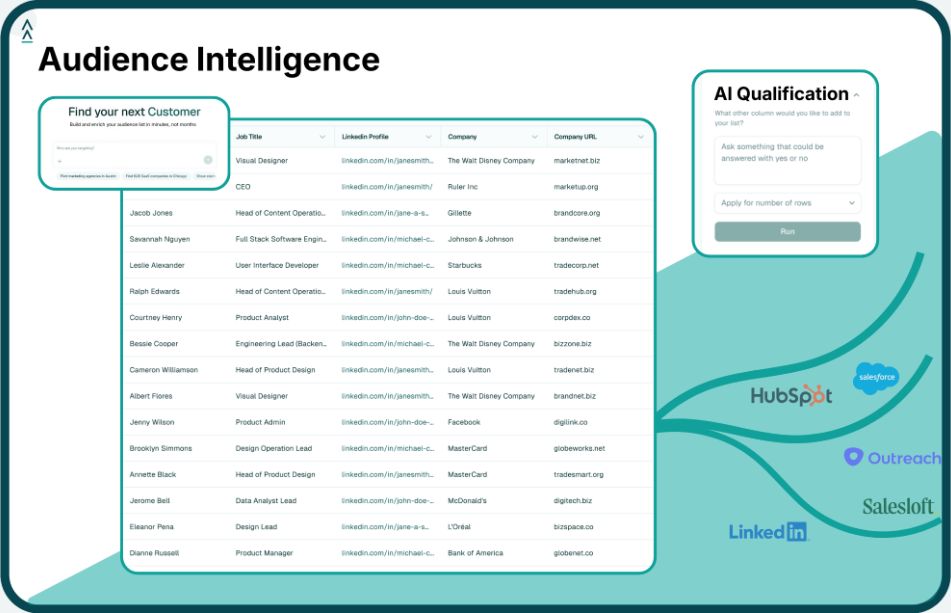
GTM-2 Omni, Landbase's agentic AI model, represents the cutting edge of this evolution, moving beyond simple data aggregation to autonomous audience discovery and qualification. These systems can interpret natural-language prompts like "VPs of Engineering at AI startups with recent funding" and instantly generate AI-qualified prospect lists ready for outreach.
The shift toward AI-driven platforms addresses a critical market need, with many recruiting companies preferring specialized expertise over building in-house capabilities. However, the most successful companies maintain control over their targeting strategy while leveraging external platforms for execution efficiency.
Free access to advanced lead generation capabilities has become increasingly important, especially for recruiting startups and growth-stage companies. Platforms offering no-login, instant audience generation allow teams to test targeting hypotheses quickly without lengthy procurement processes or significant upfront investment.
High-quality lead generation for recruiting technology requires moving beyond basic company demographics to focus on behavioral and contextual signals that indicate genuine buying intent. The most effective approach combines firmographic data (company size, industry, location) with real-time hiring signals (job postings, funding announcements, organizational changes) to identify prospects actively seeking recruiting solutions.
Successful recruiting tech companies understand that not all hiring companies need external recruiting services. The key is identifying organizations experiencing specific pain points that align with their solution—whether that's difficulty filling specialized technical roles, rapid scaling needs, or compliance requirements for regulated industries.
Data verification becomes critical at this stage, with platforms offering built-in email validation achieving 83.1% deliverability.
The ability to export qualified contacts directly into existing CRM and outreach tools ensures seamless workflow integration. Companies implementing these data-driven approaches report 78% improvement in lead-to-appointment conversion rates compared to traditional demographic targeting methods.
Small recruiting technology companies and solo founders face unique constraints that demand cost-effective, efficient lead generation approaches. With limited budgets for expensive data licenses or dedicated sales development representatives, these companies must maximize ROI from every outreach attempt while maintaining the ability to test different market segments quickly.
The most effective strategy for small recruiting tech businesses emphasizes speed, precision, and minimal financial commitment. Free tiers and trial access to advanced lead generation platforms enable these companies to maintain consistent pipeline development without significant upfront investment, while natural-language targeting eliminates the technical barriers that often prevent non-technical founders from building precise audience lists.
The ability to generate qualified prospect lists instantly using natural-language prompts is particularly valuable for small businesses. Instead of spending weeks building complex filter combinations or purchasing expensive data licenses, founders can immediately test different targeting hypotheses and adjust based on response rates.
Free audience building capabilities become crucial for small recruiting tech companies operating with minimal budgets. Platforms offering no-login access and instant exports of up to 10,000 contacts enable consistent pipeline development without significant financial commitment, allowing small teams to compete effectively with larger competitors.
Recruiting startups operate under intense pressure to prove product-market fit quickly while conserving limited resources. Their lead generation strategies must emphasize speed, cost-effectiveness, and rapid iteration based on real-world feedback. Founder-led sales often characterize the early stages, where the founding team personally handles outreach and relationship building to gain deep customer insights.
The key to successful startup lead generation lies in rapid experimentation and immediate feedback loops. Startups should test different messaging, targeting criteria, and outreach channels quickly, measuring results and doubling down on what works while abandoning approaches that don't generate engagement. This agile approach allows recruiting startups to refine their ideal customer profile based on actual market response rather than theoretical assumptions.
The ability to generate qualified prospect lists instantly becomes particularly valuable for recruiting startups. Instead of spending valuable time on manual research, founders can focus on high-value activities like product development, customer conversations, and strategic partnerships. This efficiency gain can be the difference between sustainable growth and resource exhaustion in the critical early stages.
While many recruiting tech companies start with founder-led sales, partnering with specialized B2B lead generation agencies can accelerate growth and provide access to expertise that would be expensive to build in-house. These agencies bring deep domain knowledge, proven methodologies, and established processes that can significantly improve lead quality and conversion rates.
The most effective agency partnerships combine strategic consulting with tactical execution, helping recruiting tech companies refine their ideal customer profile, develop targeted messaging, and optimize outreach strategies based on industry-specific insights. Agencies with experience in the recruiting technology space understand the unique buying cycles, stakeholder dynamics, and competitive landscape that define this market.
However, successful agency partnerships require clear communication, shared definitions of lead quality, and regular performance reviews. The best agencies act as true extensions of the client's sales and marketing teams, providing strategic insights and tactical execution that drive measurable business results.
Companies implementing agency-driven lead generation strategies report significant improvements in pipeline velocity and conversion rates, with some achieving 78% improvement in lead-to-appointment conversion through better targeting and messaging alignment.
While lead generation focuses on identifying immediate sales opportunities, effective business development in recruiting tech requires a broader strategic perspective. Successful recruiting technology companies think beyond individual transactions to build strategic partnerships, expand into new markets, and develop channel sales relationships that create sustainable competitive advantages.
Business development in recruiting tech involves identifying complementary technology partners, establishing reseller relationships, and creating ecosystem integrations that enhance product value. It also includes strategic market expansion, whether geographic (entering new regions) or vertical (expanding into new industries with specialized recruiting needs).
The most successful recruiting tech companies integrate lead generation with broader business development strategies, using initial customer success as a foundation for strategic growth initiatives. This approach creates a virtuous cycle where strong lead generation fuels customer acquisition, which in turn provides the reference cases and market validation needed for strategic partnerships and expansion.
Business development professionals in recruiting tech need deep market understanding, relationship-building skills, and the ability to identify strategic opportunities that align with company capabilities and market needs. They must also understand how to leverage data-driven insights to identify promising partnership opportunities and expansion markets.
A comprehensive business development strategy for recruiting technology companies integrates lead generation with broader market positioning, competitive differentiation, and strategic growth initiatives. The foundation of any effective strategy is a clear understanding of the ideal customer profile, supported by data-driven insights about market trends, competitive dynamics, and buying behavior.
Successful business development strategies start with thorough market research and segmentation, identifying the most promising customer segments based on both demographic characteristics and behavioral signals. This research should inform not just targeting criteria but also product positioning, pricing strategies, and go-to-market approaches.
The integration of AI-powered audience intelligence becomes particularly valuable at the strategic level, providing insights about market trends, competitive positioning, and emerging opportunities. Platforms offering growth signals and insights enable recruiting tech companies to make informed decisions about market expansion, product development, and resource allocation.
Effective business development strategies also include clear metrics and accountability frameworks, with regular performance reviews and course corrections based on actual results. The most successful companies maintain a balance between strategic vision and tactical execution, ensuring that day-to-day lead generation activities support broader business objectives.
Landbase stands out in the B2B lead generation landscape by combining agentic AI with instant, natural-language audience discovery specifically designed for recruiting technology companies. The platform addresses the unique challenges faced by both established recruiting platforms and startups through its frictionless approach to finding qualified prospects showing real-time hiring signals.
The core innovation lies in GTM-2 Omni, Landbase's agentic AI model trained on billions of data points and sales interactions. This allows users to simply type plain-English prompts like "HR Directors at healthcare companies with 100-500 employees actively hiring" and instantly receive AI-qualified exports of up to 10,000 contacts ready for activation in existing tools.
Recruiting technology companies benefit from Landbase's precision targeting capabilities, enabling them to focus on high-value accounts showing real-time buying signals rather than wasting resources on companies with stable headcount. The platform's ability to identify organizations undergoing specific hiring triggers—like new funding, rapid team expansion, or leadership changes—dramatically improves conversion rates compared to traditional demographic targeting.
The platform's integration with existing tools like Gmail, Outlook, and LinkedIn ensures seamless workflow adoption, while the continuous learning from user feedback improves AI performance over time. For recruiting tech companies navigating competitive markets and complex buyer journeys, Landbase provides the precision, speed, and intelligence needed to find and qualify the right customers at the right time.
AI helps recruiting tech companies by identifying real-time hiring signals that indicate genuine buying intent, rather than relying on static demographic data. AI-powered platforms can analyze 1,500+ unique signals including job postings, funding announcements, headcount growth, and organizational changes to pinpoint companies actively seeking recruiting solutions. Modern AI systems can interpret natural-language prompts and instantly generate qualified prospect lists, dramatically reducing the time required for manual research.
The most effective lead generation channels for B2B recruiting startups combine targeted email outreach with LinkedIn engagement, both informed by real-time hiring signals. Startups should focus on personalized outreach to companies showing specific buying indicators like recent funding, rapid hiring, or new HR leadership. The key is using AI-powered audience discovery to identify these signals efficiently, then delivering personalized messaging that demonstrates domain expertise and addresses specific pain points.
A strong business development strategy is critical for scaling recruiting software companies beyond initial product-market fit. While lead generation focuses on immediate sales opportunities, business development creates sustainable competitive advantages through strategic partnerships, market expansion, and ecosystem development. Successful recruiting tech companies integrate lead generation with broader business development strategies, using initial customer success as a foundation for strategic growth initiatives. This approach creates predictable revenue growth through multiple channels rather than relying solely on direct sales.
Recruiting tech companies should prioritize real-time hiring signals over static demographic data. The most valuable signals include recent funding announcements (indicating increased hiring budgets), rapid job posting velocity (showing urgent hiring needs), new HR leadership hires (suggesting potential vendor changes), and organizational restructuring (creating new hiring requirements). Companies showing multiple signals simultaneously—such as recent funding combined with rapid hiring—are 3-5x more likely to invest in external recruiting solutions than those showing demographic alignment alone. These behavioral signals provide much stronger indicators of buying intent than traditional firmographic data like company size or industry.
A B2B lead generation agency can be a good investment for new recruiting tech ventures once they have validated product-market fit and established clear ideal customer profiles. In the earliest stages, founder-led sales with instant audience generation tools like Landbase's free tier provide the most cost-effective approach for testing hypotheses and building initial pipelines. However, once a venture has proven its value proposition and needs to scale outreach efficiently, specialized agencies with recruiting technology expertise can accelerate growth while providing access to premium data sources and proven methodologies that would be expensive to build in-house. The key is ensuring alignment on lead quality definitions and maintaining regular performance reviews to ensure ROI.
Tool and strategies modern teams need to help their companies grow.