Daniel Saks
Chief Executive Officer
.png)
.png)
.png)


Legal tech companies face a unique paradox in B2B lead generation: they serve an industry deeply rooted in tradition while offering solutions that promise digital transformation. With law firms and legal departments often operating with conservative technology adoption cycles, identifying prospects who are genuinely ready to embrace innovation requires more than basic demographic targeting. The challenge is particularly acute for startups needing to prove product-market fit quickly while navigating complex buying committees that can include partners, IT directors, legal operations professionals, and compliance officers.
Successful legal tech lead generation hinges on identifying organizations showing concrete signals of change readiness—whether through hiring for legal operations roles, investing in regulatory compliance solutions, or expanding into new practice areas that demand technological support. Modern approaches leverage advanced data signals and AI-powered qualification to move beyond simple firmographics toward identifying legal organizations actively demonstrating buying intent through their operational decisions and strategic investments.
Audience discovery platforms are transforming how legal tech companies identify prospects who aren't just demographically aligned with their ideal customer profile, but are actively navigating digital transformation challenges that align with specific solutions. The ability to target based on real-time signals like "personal injury law firms in Miami actively researching data privacy solutions" or "corporate legal departments at financial services firms implementing new contract management systems" creates unprecedented precision in legal tech prospecting.
The legal industry's technology adoption follows distinct patterns that require specialized understanding for effective B2B lead generation. Unlike other B2B sectors where technology decisions might rest primarily with IT departments, legal tech purchasing involves a complex web of stakeholders with different priorities and concerns. Partners at law firms worry about client service implications and competitive differentiation, while in-house counsel at corporations focus on risk mitigation and regulatory compliance.
Legal tech companies must define their Ideal Customer Profile (ICP) with granular precision, considering factors like:
The traditional approach of targeting broadly by firm size or practice area is insufficient in today's competitive legal tech landscape. Successful companies identify specific pain points within their target segments—such as document automation needs for high-volume litigation firms, compliance monitoring requirements for financial services legal departments, or matter management challenges for growing corporate legal teams.
Natural-language targeting capabilities become particularly valuable for legal tech companies, enabling them to describe complex ICPs that combine multiple criteria. For example, "employment law firms with 25-100 attorneys that recently hired legal operations professionals" represents a much more qualified audience than simply "employment law firms." This precision targeting ensures that outreach efforts focus on organizations that not only fit the demographic profile but are actively investing in the infrastructure necessary to support new technology adoption.
AI-powered lead discovery represents a paradigm shift for legal tech companies, moving from static demographic filtering to dynamic audience identification based on real-time behavioral and operational signals. Traditional database approaches that rely solely on firmographic data like firm size, practice areas, and geographic location miss critical indicators of buying readiness that are visible through more sophisticated signal analysis.
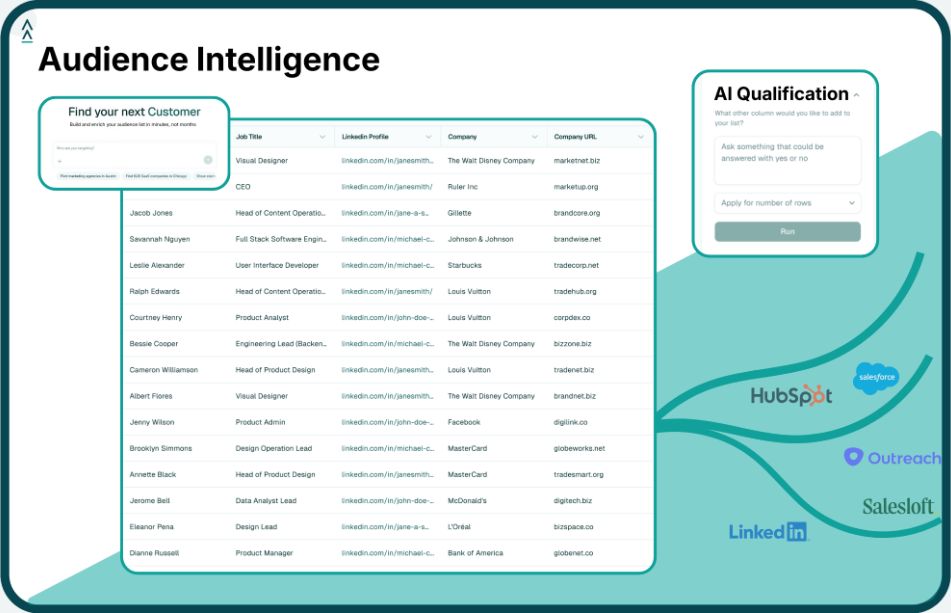
Agentic AI systems like GTM-2 Omni interpret natural-language queries to build and qualify legal tech audiences instantly, leveraging 1,500+ unique signals for precision targeting. This includes signals such as:
The key advantage of AI-powered qualification lies in its ability to evaluate both fit and timing simultaneously. While traditional approaches might identify firms that match demographic criteria, AI systems can determine which of those firms are actively showing buying intent through their operational decisions. This distinction is critical in the legal sector, where technology adoption cycles can be lengthy and prospects may not be ready to engage even if they fit the ideal customer profile.
Semantic search capabilities enable legal tech companies to describe their target audiences in plain English rather than constructing complex Boolean queries or navigating multiple filter menus. This democratizes sophisticated audience discovery, making it accessible to non-technical marketing and sales professionals while maintaining the precision of advanced targeting criteria. The result is faster hypothesis testing, more efficient resource allocation, and higher-quality lead generation that focuses on prospects with genuine purchase intent.
Legal tech startups operate under unique constraints that demand specialized lead generation strategies. With limited resources, urgent need to prove product-market fit, and the challenge of selling innovation to a traditionally conservative industry, startups must emphasize speed, cost-effectiveness, and rapid iteration based on real-world feedback.
Founder-led sales often characterize successful legal tech startups, where founders personally handle initial outreach and relationship building. This approach allows for deep customer understanding and rapid product iteration based on direct feedback from legal professionals. However, founders need tools that enable efficient prospect identification without consuming excessive time on manual research.
Key startup lead generation priorities include:
The ability to generate qualified prospect lists instantly using natural-language prompts is particularly valuable for legal tech startups. Instead of spending weeks building complex filter combinations or purchasing expensive legal industry databases, founders can immediately test different targeting hypotheses—such as "boutique IP law firms actively hiring" versus "corporate legal departments at fintech companies implementing compliance solutions"—and adjust based on response rates.
Free access to advanced lead generation capabilities becomes crucial for startups operating with minimal budgets. Platforms offering no-login access and instant exports enable startups to maintain consistent pipeline development without significant financial commitment, allowing them to focus resources on product development and customer success rather than expensive data acquisition.
Legal tech lead generation requires data sources that go beyond basic attorney directories and firm demographics. The most effective contact lists combine firmographic, technographic, and behavioral signals to identify legal organizations showing genuine readiness for technology adoption.
Landbase provides access to 300M+ contacts and 1,500+ unique signals, including specialized categories relevant for legal tech such as "Healthcare Orgs Researching Cloud Security" or "Financial Service Orgs Researching Cloud Security." These signals are particularly valuable for legal tech companies serving regulated industries where compliance and data security are primary concerns.
Critical data points for legal tech contact lists include:
Data accuracy and compliance are particularly important in the legal industry, where professionals expect high standards of data quality and privacy adherence. SOC II and GDPR compliant data sources ensure that contact information is ethically sourced and regularly validated, reducing bounce rates and maintaining sender reputation for email outreach campaigns.
The integration of multiple signal types enables much more sophisticated targeting than traditional legal directories. For example, identifying "C-level executives at personal injury law firms that recently expanded into new regions" provides a much higher probability of engagement than simply targeting "personal injury law firm partners." The expansion signal indicates both growth capacity and potential operational challenges that might create demand for legal technology solutions.
Legal tech marketing requires a nuanced approach that addresses the unique concerns and decision-making processes within legal organizations. Unlike other B2B sectors where ROI arguments might dominate, legal tech marketing must balance efficiency gains with risk mitigation, client service enhancement, and competitive differentiation.
Effective legal tech marketing strategies include:
Content marketing becomes particularly important in the legal tech space, where prospects often conduct extensive research before engaging with vendors. The complexity of legal technology purchasing decisions means that marketing content must address multiple stakeholder concerns—from partners worried about client service implications to IT directors focused on security and integration requirements.
Landbase can provide qualified audiences to fuel targeted legal tech marketing campaigns, ensuring that content reaches organizations most likely to benefit from specific solutions. This targeted approach improves marketing efficiency by focusing resources on prospects showing genuine interest and readiness for legal technology adoption.
SEO for legal tech requires specialized keyword research that reflects how legal professionals actually search for solutions. Terms like "legal operations technology," "compliance automation for law firms," or "document management for corporate legal departments" reflect the specific language used by legal buyers and should inform content strategy and campaign targeting.
The decision-making structure within legal organizations presents unique challenges for B2B lead generation. Unlike other B2B sectors where purchasing authority might rest with a single department, legal technology decisions often involve multiple stakeholders with different priorities and influence levels.
Key decision makers in legal organizations include:
Effective legal tech lead generation requires multi-threaded outreach strategies that address the specific concerns of each stakeholder group. Partners respond to messages about competitive advantage and client service enhancement, while legal operations professionals focus on implementation complexity and ROI metrics. IT directors need detailed security and compliance information, while practice group leaders want to understand specific functionality benefits.
The ability to target specific roles within legal organizations becomes critical for effective outreach. Landbase allows targeting specific roles like 'C-Level or Founders Roles' and 'Director/C-Level Management' within legal firms and companies, enabling more precise messaging that resonates with each stakeholder's priorities and concerns.
Understanding the buying committee dynamics within target organizations enables more effective sales strategies that build consensus across multiple stakeholders. This approach recognizes that legal technology purchasing decisions are rarely made in isolation and require coordinated messaging that addresses the diverse perspectives within legal organizations.
The real value of AI-qualified leads emerges when they're seamlessly integrated into existing sales workflows and activation tools. Legal tech companies must ensure that their lead generation efforts translate into actionable sales activities that drive pipeline development and revenue growth.
Best practices for integrating AI-qualified leads include:
The context behind lead qualification becomes particularly important in legal tech sales, where understanding the specific triggers that indicate buying readiness enables more relevant conversations. Sales teams should understand not just demographic information about prospects, but the specific operational signals—such as new hiring, regulatory changes, or technology stack gaps—that indicate genuine purchase intent.
Sales efficiency improves dramatically when teams can focus on high-quality prospects rather than spending time on manual research and qualification. The ability to generate AI-qualified audiences on demand enables consistent pipeline development while freeing sales professionals to focus on relationship building and closing deals rather than prospecting activities.
Legal tech companies must track metrics that align with their specific business objectives and the unique characteristics of their target markets. Traditional lead generation metrics like MQL volume may not provide meaningful insights into legal tech sales performance, where quality often matters more than quantity.
Essential KPIs for legal tech lead generation include:
The Landbase platform provides growth signals, Trust Score, and TAM insights to monitor and optimize legal tech lead generation performance. These metrics help companies understand not just how many leads they're generating, but how well those leads align with their ideal customer profile and conversion potential.
The complexity of legal technology purchasing decisions requires sophisticated attribution models that track engagement across multiple touchpoints and stakeholders. Multi-touch attribution provides more accurate ROI measurement than last-touch models, recognizing that legal tech buying decisions often involve extensive research and multiple interactions before purchase decisions are made.
Continuous optimization requires regular feedback loops between sales and marketing teams, with shared definitions of lead quality and unified metrics that track performance across the entire customer journey. A/B testing different messaging approaches, targeting criteria, and outreach channels enables systematic improvement of lead generation effectiveness over time.
The legal tech industry stands at the beginning of a transformation driven by agentic AI systems that can autonomously discover, qualify, and nurture prospects based on real-time market signals and buying intent indicators. Unlike traditional AI that simply responds to queries, agentic AI actively works to achieve specific objectives—like finding qualified legal tech prospects—by orchestrating multiple AI agents to gather, analyze, and act on market intelligence.
GTM-2 Omni represents the cutting edge of agentic AI for GTM automation, offering predictive capabilities for legal tech lead generation that go beyond simple demographic matching to evaluate both fit and timing through analysis of 1,500+ unique signals. These systems continuously learn from user feedback and campaign performance, improving their targeting precision and qualification accuracy over time.
Emerging trends in legal tech lead generation include:
The shift toward agentic AI systems addresses the unique challenges of legal tech lead generation, where traditional volume-based approaches fail to account for the conservative technology adoption patterns and complex buying committees characteristic of the legal industry. By focusing on precision targeting based on real-time operational signals rather than static demographic data, these systems enable legal tech companies to find and engage with prospects who are genuinely ready for technology adoption.
Continuous learning capabilities ensure that agentic AI systems improve their performance over time, adapting to changing market conditions, regulatory requirements, and competitive dynamics within the legal technology landscape. This adaptive intelligence becomes particularly valuable in the legal sector, where technology adoption patterns can shift rapidly in response to regulatory changes, competitive pressures, and client demands.
Landbase stands out in the legal tech B2B lead generation landscape by combining agentic AI with instant, natural-language audience discovery specifically designed for companies serving the legal industry. The platform addresses the unique challenges faced by both established legal tech companies and startups through its frictionless approach to finding qualified prospects who are actively demonstrating buying intent.
The core innovation lies in GTM-2 Omni, Landbase's agentic AI model trained on 50M+ campaigns and sales interactions. This allows users to simply type plain-English prompts like "personal injury law firms in Miami, FL actively researching data privacy solutions" or "Heads of HR at professional services firms responding to recent layoffs" and instantly receive AI-qualified exports of up to 300M+ contacts ready for activation in existing tools.
What makes Landbase particularly valuable for legal tech companies:
Established legal tech companies benefit from Landbase's precision targeting capabilities, enabling them to focus on high-value accounts showing real-time buying signals through operational changes and strategic investments. Startups appreciate the speed and cost-effectiveness, with founder-led sales teams able to generate a consistent pipeline without building complex in-house systems or purchasing expensive legal industry databases.
The platform's integration with existing tools like Gmail, Outlook, and LinkedIn ensures seamless workflow adoption, while the continuous learning from user feedback improves AI performance over time. For legal tech companies navigating the unique challenges of selling innovation to a traditionally conservative industry, Landbase provides the precision, speed, and intelligence needed to find and qualify the right customers at the right time.
Agentic AI in legal tech lead generation refers to autonomous AI systems that can interpret natural-language prompts, coordinate multiple data sources, and execute complex audience discovery tasks without human intervention. Unlike traditional AI that simply responds to queries, agentic AI actively works to achieve specific objectives—like finding qualified legal prospects—by orchestrating multiple AI agents to gather, analyze, and qualify data. These systems leverage 1,500+ unique signals including firmographic, technographic, intent, and behavioral indicators specific to the legal industry. This enables users to describe their ideal audience in plain English and receive instantly qualified prospect lists ready for outreach.
Legal tech startups can identify their ICPs by focusing on specific operational signals rather than just demographic criteria. Look for law firms or legal departments showing concrete indicators of change readiness—such as hiring legal operations professionals, expanding into new practice areas, implementing new compliance requirements, or investing in complementary technology solutions. Use natural-language targeting to describe complex ICPs that combine multiple criteria, like "employment law firms with 25-100 attorneys that recently hired legal operations professionals." This approach ensures you're targeting organizations that not only fit your demographic profile but are actively demonstrating readiness for legal technology adoption.
The most crucial data points go beyond basic firmographics to include real-time operational signals like hiring activity for legal operations roles, regulatory compliance requirements by industry, technology stack changes indicating openness to innovation, firm expansion or practice area growth, and funding events that increase technology budgets. These signals indicate genuine buying intent rather than just demographic alignment. Platforms with access to 1,500+ unique signals can evaluate both fit (does this legal organization match our ideal customer profile?) and timing (are they actively showing buying intent through operational decisions?).
Landbase integrates with Salesforce and HubSpot, and users can easily export up to 10,000 contacts per session in standard formats for immediate import into existing tools. This export-and-activate approach ensures that qualified audiences can be leveraged in current workflows without requiring complex technical setup or disrupting established processes. The key is to maintain context about why prospects were qualified—referencing specific signals like hiring activity or compliance needs in your outreach messaging.
Common challenges include the conservative technology adoption patterns in the legal industry, complex multi-stakeholder buying committees, and difficulty identifying organizations showing genuine buying intent. These can be overcome by focusing on operational signals rather than just demographics, using AI-powered qualification to evaluate both fit and timing, and implementing multi-threaded outreach strategies that address different stakeholder concerns. Natural-language targeting enables precise audience identification without technical barriers, while instant audience generation allows for rapid hypothesis testing and optimization.
Yes, Landbase can help target legal firms based on specific technology interests and operational signals. Using natural-language prompts, you can target firms showing indicators of readiness for specific legal technology solutions—such as "law firms with active M&A practices researching contract automation tools" or "corporate legal departments at healthcare organizations implementing new e-discovery solutions." The platform's 1,500+ unique signals include technology stack data, hiring patterns, regulatory requirements, and growth indicators that can identify firms most likely to benefit from and adopt specific legal technology solutions.
Tool and strategies modern teams need to help their companies grow.