Daniel Saks
Chief Executive Officer


.png)

Most EdTech companies understand that lead generation isn't just about collecting contacts—it's about navigating one of the most complex B2B buying environments in any industry. With EdTech purchasing decisions involving multiple stakeholders and extended sales cycles, consistent pipeline development becomes mission-critical for sustainable growth.
The challenge differs dramatically between established EdTech companies with institutional relationships and startups needing to prove educational impact quickly. Today's most effective B2B lead generation leverages advanced data signals, AI-powered qualification, and strategic targeting rather than volume-based approaches. AI-powered audience discovery platforms are transforming how companies identify educational institutions and decision-makers who are not just demographically aligned with their ideal customer profile, but actively showing buying intent through hiring signals, funding events, and curriculum alignment needs.
The science behind successful EdTech lead generation has evolved significantly. Companies implementing product-led growth strategies combined with account-based marketing are seeing improved ramp times compared to traditional approaches. For EdTech companies navigating complex educational ecosystems, understanding these modern frameworks can mean the difference between predictable revenue growth and constant pipeline uncertainty.
B2B lead generation for EdTech companies operates within a unique framework defined by educational procurement calendars, multi-stakeholder decision-making, and the need to demonstrate measurable learning outcomes. Unlike traditional B2B sales, EdTech purchases must satisfy both pedagogical requirements and administrative constraints, creating a complex evaluation process that involves multiple departments and approval levels.
The modern EdTech buyer's journey involves coordinating across diverse stakeholders, each with different priorities and concerns. Curriculum directors focus on instructional outcomes and standards alignment, IT administrators prioritize security and implementation complexity, superintendents weigh budget impact against strategic goals, and teachers evaluate usability and classroom integration. This multi-threaded buying process demands coordinated outreach strategies that address diverse perspectives within target institutions.
The solution lies in moving beyond simple contact collection toward strategic audience building based on real-time educational signals and behavioral indicators. Successful EdTech companies map entire institutional accounts rather than targeting individual contacts, creating personalized content and outreach for each stakeholder role within the buying committee.
For established EdTech companies, the focus should be on precision targeting of institutions that match ideal customer profiles with specific curriculum needs and budget capacity. Startups, meanwhile, need speed and flexibility to test hypotheses quickly while conserving limited resources. Both require tools that can adapt to their specific go-to-market motions and scale with their growth.
The traditional approach of purchasing educational contact databases or running broad LinkedIn campaigns has given way to sophisticated, AI-powered platforms that combine vast data sets with intelligent qualification. Modern lead generation tools must integrate multiple data sources, including firmographic, technographic, intent, and behavioral signals, to identify educational institutions with genuine purchase intent.
Agentic AI represents the cutting edge of this evolution, moving beyond simple data aggregation to autonomous audience discovery and qualification. These systems can interpret natural-language prompts like "Curriculum directors at K-12 districts in California adopting new math standards" and instantly generate AI-qualified prospect lists ready for outreach.
The shift toward AI-driven platforms addresses a critical market need, with companies preferring specialized expertise over building in-house capabilities. However, the most successful companies maintain control over their targeting strategy while leveraging external platforms for execution efficiency.
Free access to advanced lead generation capabilities has become increasingly important, especially for startups and growth-stage companies. Platforms offering no-login, instant audience generation allow teams to test targeting hypotheses quickly without lengthy procurement processes or significant upfront investment.
The most sophisticated B2B lead generation strategies leverage multiple data signals to identify educational institutions with genuine purchase intent. Beyond basic firmographic data like district size and location, modern platforms track real-time indicators of buying readiness including hiring activity for curriculum roles, funding announcements, technology stack changes, and curriculum standards adoption.
These advanced signals enable much more precise targeting than traditional demographic approaches. For example, identifying "IT Directors at university systems adopting new LMS platforms in the last quarter" provides a much higher probability of engagement than simply targeting "IT Directors at universities." The technology adoption creates immediate need and urgency.
The integration of these signals into AI-powered qualification systems enables unprecedented precision in audience targeting. Platforms with access to 1,500+ unique signals can evaluate both fit (does this institution match our ideal customer profile?) and timing (are they actively showing buying intent?).
Look-alike modeling further enhances targeting precision by identifying institutions that share characteristics with existing successful customers. This approach leverages historical conversion data to find new prospects with similar profiles, increasing the likelihood of successful engagement.
Real-time intent tracking becomes particularly valuable for EdTech sales, where timing can be as important as fit. Identifying institutions that are actively researching solutions, visiting competitor websites, or engaging with relevant content allows for perfectly timed outreach that capitalizes on existing interest.
EdTech startups operate under different constraints than established companies, with limited resources, urgent need to prove educational impact, and pressure to generate initial revenue quickly. Their lead generation strategies must emphasize speed, cost-effectiveness, and rapid iteration based on real-world feedback.
Founder-led sales often characterize the early stages of EdTech startups, where the founding team personally handles outreach and relationship building. This approach allows for deep customer understanding and rapid product iteration based on direct feedback. However, founders need tools that enable efficient prospect identification without consuming excessive time on manual research.
The ability to generate qualified prospect lists instantly using natural-language prompts is particularly valuable for startups. Instead of spending weeks building complex filter combinations or purchasing expensive data licenses, founders can immediately test different targeting hypotheses and adjust based on response rates.
Rapid experimentation is the hallmark of successful startup lead generation. Teams should test different messaging, targeting criteria, and outreach channels quickly, measuring results and doubling down on what works while abandoning approaches that don't generate engagement.
Successful EdTech lead generation requires understanding the specific roles and responsibilities within educational institutions. Unlike traditional B2B companies where purchasing authority might be concentrated in a single department, educational buying committees span multiple functional areas with distinct priorities and evaluation criteria.
Effective targeting begins with mapping the complete buying committee and understanding each stakeholder's influence on the final decision. Curriculum directors evaluate pedagogical fit and learning outcomes, IT administrators assess security and integration requirements, superintendents consider budget impact and strategic alignment, and teachers provide input on usability and classroom effectiveness.
The most effective outreach strategies create parallel nurture tracks for each stakeholder role, addressing their specific concerns and providing relevant content that speaks to their priorities. This multi-threaded approach ensures that all decision-makers receive appropriate information to support their evaluation process.
Regional and standards-focused campaigns drive significantly higher conversion rates, with campaigns aligned with specific state curriculum frameworks seeing higher engagement than generic national campaigns. Geographic localization combined with standards alignment creates immediate relevance for decision-makers who must justify purchases based on curriculum fit.
Educational content marketing dramatically outperforms direct sales tactics in the EdTech space, with 87% of B2B marketers prioritizing audience relevance in lead generation efforts. Content that addresses specific educational challenges—such as implementation guides, curriculum alignment resources, ROI calculators, and peer success stories.
Virtual events have become particularly effective, offering significantly higher engagement rates than email campaigns while providing opportunities to demonstrate product value and gather behavioral data. Effective virtual events include pre-event nurture sequences, live interactive elements, and structured post-event follow-up that moves attendees through awareness to trial activation.
LinkedIn dominates as the most effective channel for EdTech B2B lead generation, with LinkedIn recognized as highly effective for reaching educational decision-makers. The platform's professional context and targeting capabilities align perfectly with the multi-stakeholder nature of educational purchasing decisions.
The integration of AI-driven audience intelligence enables more precise content targeting and personalization. By identifying institutions showing specific behavioral signals—such as website visits to pricing pages, engagement with curriculum content, or attendance at relevant conferences—companies can deliver the right content to the right stakeholders at the right time.
The complexity of EdTech lead generation creates significant time and resource demands for sales and marketing teams. Manual prospect research, complex filter building, and multi-stakeholder outreach coordination consume valuable time that could be spent on high-value relationship building and strategic planning.
AI-powered platforms that automate audience discovery and qualification can dramatically improve efficiency, allowing teams to focus on what they do best—building relationships and demonstrating educational value. The ability to generate AI-qualified prospect lists instantly using natural-language prompts eliminates hours of manual research and complex database navigation.
Email marketing remains surprisingly effective in EdTech B2B, delivering strong return on investment, far outperforming newer channels when properly segmented and personalized. The key is educational value rather than promotional messaging, with content that addresses specific institutional challenges and opportunities.
The combination of automation and human touch creates the most effective EdTech sales and marketing approach. AI handles the repetitive, time-consuming tasks of audience discovery and initial qualification, while human teams focus on high-value conversations, relationship building, and demonstrating educational impact.
Effective EdTech lead generation requires clear metrics and continuous optimization based on performance data. The shift from simple lead counts toward more sophisticated qualification frameworks demands equally sophisticated measurement approaches that track performance across the entire customer journey.
Key Performance Indicators (KPIs) should align with educational outcomes and revenue objectives rather than just activity metrics. While lead volume might indicate marketing activity, conversion rates, sales cycle length, and educational impact metrics provide more meaningful insights into lead generation effectiveness.
The complexity of modern EdTech buyer journeys—with prospects engaging across multiple touchpoints before purchase—makes attribution challenging but essential. Multi-touch attribution models that distribute credit across all interactions provide more accurate ROI measurement than last-touch models that only credit the final interaction.
Continuous optimization requires regular feedback loops between sales and marketing teams. Shared definitions of lead quality, unified metrics, and regular performance reviews ensure alignment and enable rapid course correction when strategies underperform.
Landbase stands out in the crowded B2B lead generation landscape by combining agentic AI with instant, natural-language audience discovery specifically designed for EdTech companies. The platform addresses the unique challenges faced by both established companies and startups through its frictionless approach to finding qualified educational prospects.
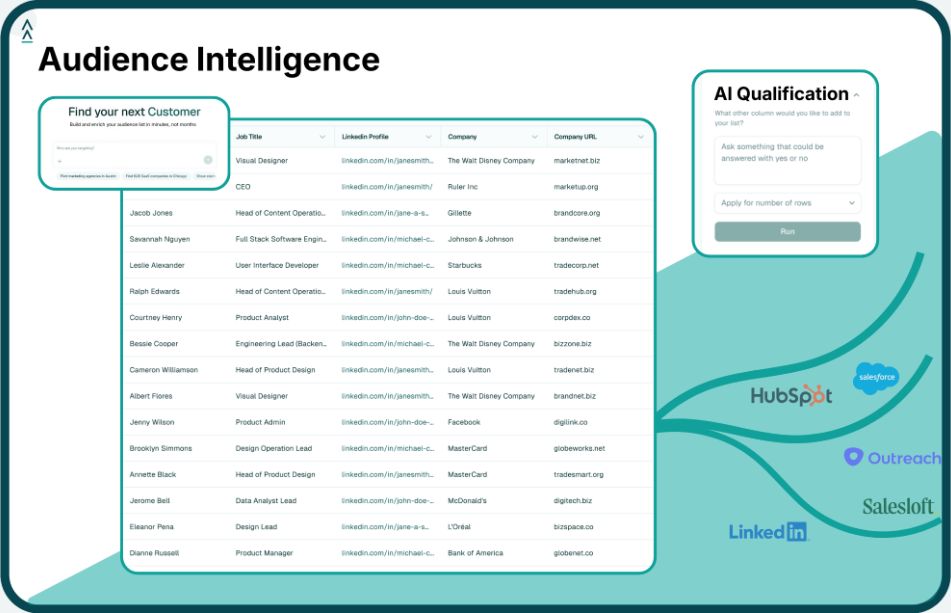
The core innovation lies in GTM-2 Omni, Landbase's agentic AI model trained on 50M+ B2B campaigns and sales interactions. This allows users to simply type plain-English prompts like "Curriculum directors at K-12 districts in Texas adopting new science standards" and instantly receive AI-qualified exports of up to 10,000 contacts ready for activation in existing tools.
Established EdTech companies benefit from Landbase's precision targeting capabilities, enabling ABM strategies that focus on high-value institutions showing real-time buying signals like new curriculum adoptions or technology stack changes. Startups appreciate the speed and cost-effectiveness, with founder-led sales teams able to generate consistent pipeline without building complex in-house systems.
The platform's integration with existing tools like Gmail, Outlook, and LinkedIn ensures seamless workflow adoption, while the continuous learning from user feedback improves AI performance over time. For EdTech companies navigating complex educational ecosystems and multi-stakeholder buying committees, Landbase provides the precision, speed, and intelligence needed to find and qualify the right institutions at the right time.
AI helps EdTech companies by interpreting natural-language descriptions of ideal customers and automatically identifying educational institutions and decision-makers that match specific criteria. Instead of manually building complex filters, users can describe targets like "IT Directors at university systems in California researching LMS platforms" and instantly receive qualified prospect lists. AI systems analyze 1,500+ unique signals including hiring activity, technology stack changes, funding events, and curriculum standards adoption to ensure both institutional fit and optimal timing for outreach. This automation saves countless hours while improving targeting precision and lead quality.
The most relevant signals for EdTech lead generation include hiring activity for curriculum or technology roles, funding announcements indicating budget availability, technology stack changes suggesting platform replacement needs, and curriculum standards adoption creating immediate relevance. Conference attendance at educational technology events also indicates active interest in new solutions. These signals indicate both institutional fit (matching ideal customer profile characteristics) and timing (active buying intent). Real-time monitoring of these signals enables perfectly timed outreach that capitalizes on existing institutional interest and need.
Landbase is particularly valuable for early-stage EdTech startups because it offers free, no-login access that enables founder-led sales teams to generate qualified prospect lists instantly without significant financial investment or technical expertise. Startups can test different targeting hypotheses quickly using natural-language prompts, allowing for rapid experimentation and iteration based on real-world response rates. The ability to export up to 10,000 contacts per session provides sufficient pipeline volume for small teams while maintaining focus on high-quality, AI-qualified prospects. This approach is far more efficient than manual research or expensive database purchases.
EdTech companies can ensure GDPR compliance by using lead generation platforms that maintain proper data privacy certifications like SOC II and GDPR compliance, as Landbase does. These platforms ensure that contact information is ethically sourced, regularly validated, and processed in accordance with data protection regulations. Companies should implement transparent data collection practices in their own marketing materials and lead capture forms, clearly explaining data usage, storage, and sharing practices to educational institution contacts. Regular audits of data handling processes and vendor compliance help maintain ongoing regulatory adherence.
While specific ROI varies by company and implementation, EdTech companies using AI-powered lead generation typically see significant improvements in key metrics. Email marketing in EdTech B2B delivers strong return on investment, and companies implementing product-led growth strategies with integrated AI qualification see improved ramp times compared to traditional approaches. Regional and standards-focused campaigns using AI-driven targeting achieve higher engagement than generic approaches, translating to higher conversion rates and reduced customer acquisition costs. The efficiency gains from automation also free up sales teams to focus on high-value relationship building.
Landbase currently integrates with Gmail, Outlook, and LinkedIn for seamless outreach activation, with CRM integrations for Salesforce, HubSpot, and Pipedrive in development. Users can easily export up to 10,000 contacts per session in standard formats for immediate import into existing tools. This export-and-activate approach ensures that qualified educational audiences can be leveraged in current workflows without requiring complex technical setup or disrupting established processes. The platform's focus on instant audience generation and activation makes it compatible with any existing EdTech sales and marketing technology stack.
Tool and strategies modern teams need to help their companies grow.