.png)
.png)

Daniel Saks
Chief Executive Officer


The MLOps market is exploding, valued at $1.7 billion in 2024 and projected to grow at a 37.4% CAGR between 2025 and 2034 to reach $39 billion—yet 80% of ML models still fail in production. The fastest-growing MLOps platforms are changing that reality by providing the infrastructure, automation, and observability needed to operationalize machine learning at scale. As 78% of enterprises now deploy machine learning models in production environments, these platforms have become the critical backbone enabling AI-driven business outcomes. For go-to-market teams, understanding how AI-powered platforms like Landbase's agentic AI leverage similar machine learning principles to identify and qualify prospects demonstrates the broader impact of AI automation across business functions.
DataRobot provides an end-to-end automated MLOps platform with strong enterprise adoption, specializing in automated machine learning (AutoML) for model selection, hyperparameter tuning, and deployment across cloud and on-premises environments. The platform combines governance and explainability features specifically designed for regulated industries, making it a preferred choice for financial services, healthcare, and government organizations.
Databricks offers a unified platform for data engineering, data science, and machine learning built on its lakehouse architecture, which combines data warehouse and data lake capabilities. The platform enables organizations to build end-to-end ML workflows with features like Unity Catalog for data governance and Mosaic AI Model Serving for production deployment, serving as a comprehensive solution for modern data and AI teams.
Weights & Biases (W&B) provides an ML developer platform specializing in experiment tracking and LLMOps (Large Language Model Operations), with comprehensive tooling for foundation model training, hyperparameter optimization, and LLM evaluation. The platform has become the infrastructure of choice for cutting-edge AI research and development teams building the next generation of AI models.
Dataiku provides a collaborative AI platform that enables data scientists and business analysts to work together on enterprise MLOps workflows. The platform combines low-code/no-code capabilities for citizen data scientists with advanced features for technical users, creating an inclusive environment for AI development across organizations with automated governance and compliance frameworks.
H2O.ai offers a complete AI platform that integrates predictive, generative, and agentic AI capabilities, serving 20,000+ organizations globally with solutions ranging from open-source H2O-3 to enterprise H2O AI Cloud. The platform provides unified AI capabilities with strong open-source heritage combined with enterprise-grade features, including air-gapped deployment for secure government and enterprise environments.
Domino Data Lab provides an enterprise MLOps platform focused on reproducibility and collaboration at scale, enabling large organizations to manage hybrid and multi-cloud ML environments with consistent model training and environment management. The platform addresses the critical challenge of ensuring that ML models can be reproduced and validated across different environments and teams.
Zilliz provides vector database infrastructure for enterprise-grade AI applications, created by the team behind Milvus, the widely-adopted open-source vector database. The platform serves as critical infrastructure for LLM and generative AI applications, enabling semantic search, retrieval-augmented generation (RAG), and similarity search at scale.
Arize AI specializes in ML observability and monitoring, providing real-time monitoring, analysis, and explainability for ML models with drift detection and performance degradation alerts. The platform addresses the critical post-deployment challenge of ensuring that ML models continue to perform as expected in production environments.
Lightning AI (formerly Grid AI) provides an AI development platform built on the widely-adopted PyTorch Lightning framework, offering Lightning AI Studio for building AI models and applications with integrated machine learning lifecycle tools. The platform leverages the founder's creation of PyTorch Lightning, which has achieved 30M+ downloads, to provide a familiar environment for AI developers.
Iguazio provides a real-time MLOps platform focused on data science automation with multifunctional MLOps and machine learning automation capabilities, built on the open-source MLRun framework. The platform specializes in real-time ML pipeline orchestration for enterprises in finance, telecom, and retail sectors requiring immediate insights from streaming data.
These fastest-growing MLOps platforms demonstrate how AI and automation have become fundamental to operationalizing machine learning at scale. From automated experiment tracking and hyperparameter optimization to real-time monitoring and observability, these platforms are transforming how organizations deploy and manage ML models in production.
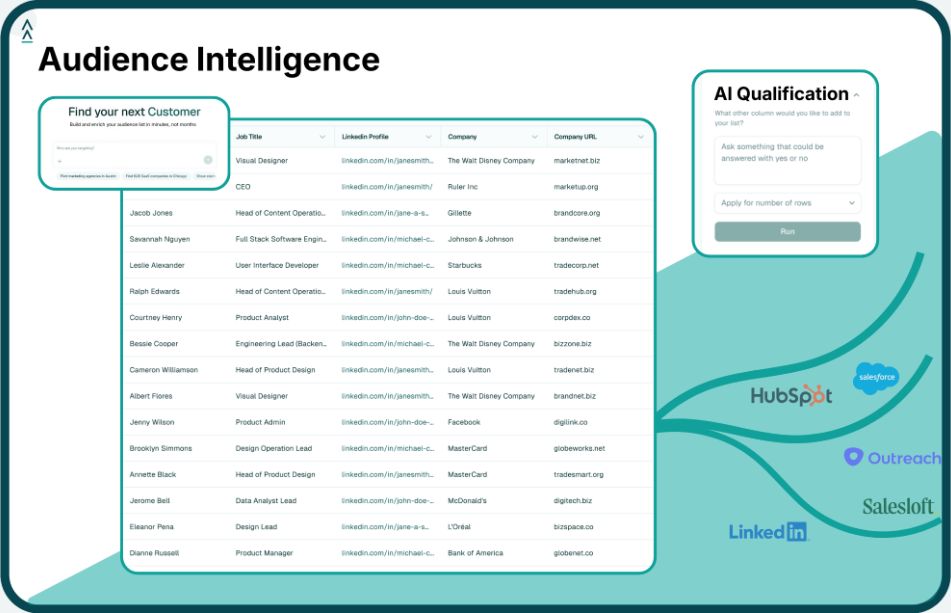
This same AI-driven automation is revolutionizing other business functions, particularly go-to-market operations. Landbase's GTM-2 Omni represents a parallel application of agentic AI principles—trained on billions of GTM data points from 50M+ B2B campaigns—to solve the critical challenge of identifying and qualifying high-value prospects. Just as MLOps platforms automate the ML lifecycle, Landbase's agentic AI automates the GTM lifecycle, enabling teams to build targeted audience lists using natural language prompts like "CFOs at enterprise SaaS companies that raised funding in the last 30 days."
The Landbase Applied AI Lab, featuring Ph.D. data scientists from NASA and core contributors from Meta's PyTorch team, engineers these autonomous GTM systems that drive real revenue impact. This demonstrates how the same foundational AI and machine learning principles powering MLOps platforms are being applied across different business domains to solve complex operational challenges.
The primary goal of MLOps is to operationalize machine learning models at scale by providing the infrastructure, automation, and observability needed to deploy, monitor, and maintain ML models in production environments. MLOps addresses the critical challenge that 80% of ML models fail in production by ensuring reproducibility, governance, and continuous monitoring. This comprehensive approach enables organizations to reliably deploy AI systems that deliver business value. Without MLOps, companies struggle to move models from development to production effectively.
MLOps platforms accelerate ML deployment by providing end-to-end automation for the machine learning lifecycle, from data preparation and model training to deployment and monitoring. Platforms like DataRobot offer automated machine learning (AutoML) for model selection and hyperparameter tuning, while Databricks provides unified data and AI workflows that eliminate silos between data engineering and data science teams. These capabilities reduce deployment time from months to weeks or days. The automation ensures consistency and reproducibility across the entire ML lifecycle.
Without robust MLOps practices, organizations face significant risks including model drift, performance degradation, lack of reproducibility, and compliance violations. These risks are particularly acute in regulated industries where model explainability and governance are critical requirements. Observability platforms like Arize AI have emerged specifically to address post-deployment monitoring challenges for production ML models. Organizations without MLOps infrastructure often discover models failing in production without early warning systems.
For enterprise adoption, MLOps platforms need robust security and compliance certifications including SOC 2, GDPR compliance, and industry-specific standards for regulated sectors like finance and healthcare. Platforms like Dataiku and Domino Data Lab have invested heavily in automated governance and compliance frameworks to meet these enterprise requirements. These certifications demonstrate that platforms can handle sensitive data and meet regulatory obligations. Without proper certifications, enterprises in regulated industries cannot adopt MLOps solutions.
While Landbase is not an MLOps platform itself, its GTM-2 Omni agentic AI demonstrates how similar AI and machine learning principles are being applied across different business functions. Just as MLOps platforms use AI to automate the ML lifecycle, Landbase uses agentic AI trained on 50M+ sales interactions to automate go-to-market workflows. Both represent applications of autonomous AI systems to solve complex operational challenges in their respective domains. This parallel demonstrates the broad applicability of MLOps principles beyond traditional data science teams.
Tool and strategies modern teams need to help their companies grow.