.png)
.png)

Daniel Saks
Chief Executive Officer


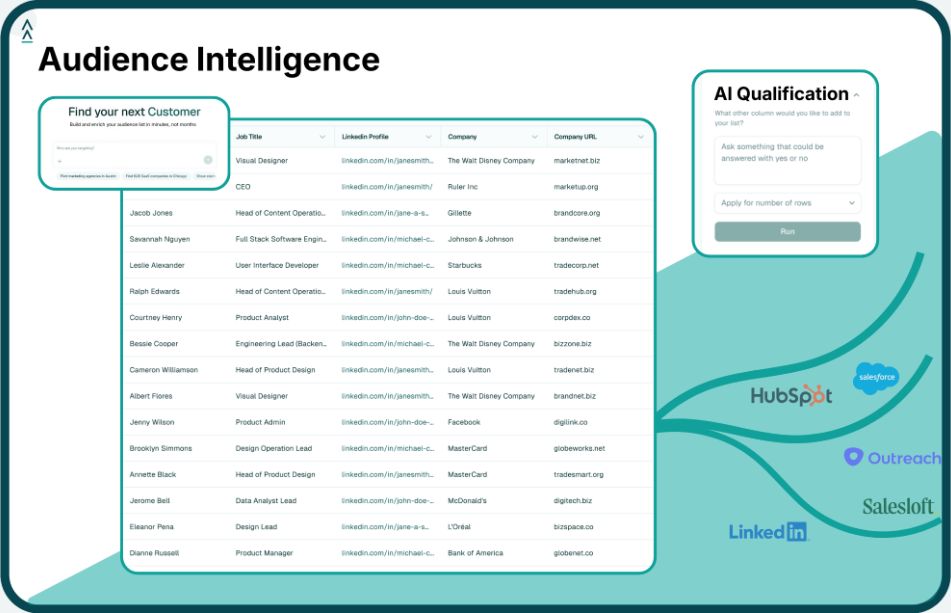
The agentic AI market has exploded, with some platforms tripling their valuations in mere months. Unlike traditional AI that responds to queries, agentic AI systems can plan, reason, and execute complex tasks autonomously—transforming how enterprises work across every function from software development to healthcare. For go-to-market teams, this revolution extends beyond productivity tools to audience discovery and qualification. Platforms like Landbase's GTM-2 Omni now leverage agentic AI to help businesses find and qualify their next customer in seconds using natural-language targeting, representing a fundamental shift in B2B sales and marketing operations.
Anysphere, known for its product Cursor, provides an AI-powered coding assistant that enables developers to generate code from natural language prompts. The platform integrates directly into the development environment as an AI-enhanced IDE, allowing developers to build entire applications through conversational interfaces—a concept they call "vibe coding." Users can create multi-file applications, debug code, and receive real-time suggestions without leaving their coding environment.
Anysphere represents one of the fastest-growing developer tools in recent history, fundamentally changing how software is built. By enabling natural language to production code conversion, it democratizes programming and dramatically accelerates development cycles. The platform reportedly reached over 1 million developers in under 2 years, demonstrating massive market demand for AI tools that enhance rather than replace human developers. This is particularly valuable as enterprises face persistent developer shortages while needing to ship software faster.
Information on recent funding rounds available through company announcements and venture capital databases.
Hippocratic AI develops specialized AI agents for healthcare settings, focusing on non-diagnostic, administrative tasks to address the critical healthcare staffing shortage. Their Polaris multi-agent LLM constellation handles inbound calls, scheduling, intake forms, and follow-ups while maintaining strict healthcare compliance and safety standards. The platform uses a Constitutional AI framework specifically designed for healthcare environments, ensuring patient safety remains paramount.
Hippocratic AI addresses one of the most pressing challenges in healthcare—the staffing crisis—by automating low-risk, non-diagnostic administrative tasks. This allows healthcare professionals to focus on patient care while AI handles routine interactions. The company's safety-first approach and healthcare-specific AI architecture demonstrate how agentic AI can be successfully deployed in highly regulated industries, setting a precedent for other vertical applications. The platform has been deployed across 20+ U.S. states in healthcare facilities.
Significant Series C funding backed by premier venture capital firms specializing in healthcare technology.
Sierra provides an AI platform for autonomous customer service, enabling enterprises to handle complex customer interactions without human intervention. Led by former Salesforce Co-CEO Bret Taylor, the platform uses goal-oriented agents that can complete entire customer service transactions like refunds, account updates, and technical support. Sierra's Agent Data Platform (ADP) maintains long-term customer context across interactions, while supporting multiple LLMs including OpenAI, Anthropic, and Meta.
Sierra represents one of the fastest ascents in enterprise software history, demonstrating massive market demand for autonomous customer service solutions. By focusing on completing entire transactions rather than just answering questions, Sierra addresses the core pain point of customer service operations—resolution rate and customer satisfaction. The company's enterprise-grade approach and outcome-based pricing model make it particularly attractive to large organizations seeking measurable ROI from AI investments. Led by high-profile Silicon Valley executive with deep enterprise experience.
Significant Series B funding from top-tier Silicon Valley investors.
Harvey provides an AI platform specifically designed for law firms and legal departments, offering AI-powered legal research, contract analysis, and document drafting capabilities. The platform uses customized foundation models trained on legal data and integrates with existing legal research databases. Harvey enables legal professionals to automate routine tasks while maintaining the precision and compliance required in legal work.
Harvey demonstrates exceptional adoption in legal tech, proving that specialized AI tools can achieve rapid enterprise adoption when they address industry-specific needs with precision. The legal profession, traditionally conservative about technology adoption, has embraced Harvey because it enhances rather than replaces lawyer expertise. The platform has penetrated 42% of AmLaw 100 law firms and reached significant annual recurring revenue milestones. By automating routine research and document review, Harvey allows legal professionals to focus on high-value strategic work.
Multiple funding rounds from premier venture capital firms specializing in legal tech and enterprise AI.
Cognition AI created Devin, positioned as an autonomous AI software engineer capable of end-to-end software development including planning, coding, testing, and deployment. The platform reportedly can accelerate software delivery significantly according to early pilots with enterprise companies. Devin operates in a virtual private cloud environment with MultiDevin capability for parallel execution of development tasks.
Cognition AI represents a paradigm shift in software development, moving from AI-assisted coding to more autonomous software engineering capabilities. This addresses the critical shortage of software developers while aiming to accelerate delivery timelines. The company's rapid growth reflects investor confidence in the transformative potential of autonomous AI agents in technical domains. As enterprises face increasing pressure to deliver software faster, Cognition AI offers solutions that could reshape development team structures and processes.
Multiple rounds from top-tier venture capital firms focusing on AI infrastructure and developer tools.
Glean provides an AI-powered enterprise search platform that unifies information across 100+ enterprise applications into a single searchable interface. The platform builds an enterprise knowledge graph that maps relationships between people, content, and activities while respecting existing permissions. Glean's AI Assistant enables natural language querying across the entire enterprise knowledge base, helping employees find information quickly without switching between applications.
Glean addresses the critical enterprise challenge of information fragmentation, where valuable knowledge is scattered across dozens of applications and systems. By creating a unified search layer with AI-powered understanding, Glean dramatically improves employee productivity and knowledge discovery. The company has earned strong analyst recognition, being named Leader in Forrester Wave™ Cognitive Search Platforms. Backed by premier venture capital firms including Sequoia, Kleiner Perkins, and Lightspeed, Glean serves 100+ large enterprises.
Series F funding from premier venture capital firms including Sequoia, Kleiner Perkins, and Lightspeed.
EliseAI provides conversational AI solutions for property management and healthcare industries, automating the entire resident lifecycle in property management and expanding into healthcare with EHR integrations. The platform achieves 90% automation of leasing conversations in property management while successfully expanding into the healthcare administrative market. EliseAI serves 1 in 8 U.S. apartments with its conversational AI technology.
EliseAI demonstrates exceptional vertical market penetration and the ability to successfully expand into adjacent markets with similar pain points. By focusing on specific industries with clear ROI cases, EliseAI has achieved widespread adoption where horizontal platforms have struggled. The company serves 1 in 8 U.S. apartments and has achieved unicorn status. The success in both property management and healthcare shows how domain-specific AI solutions can deliver measurable value by understanding industry nuances and regulatory requirements.
Series E funding establishing unicorn status in vertical AI solutions.
Moveworks provides an enterprise employee support platform that uses agentic AI to resolve employee IT, HR, and facilities requests automatically. The platform's Agentic Reasoning Engine orchestrates workflows across 100+ enterprise systems, while Agent Studio enables low-code agent development. Moveworks is positioned as an agentic AI provider suitable for government and highly regulated enterprises with strong security credentials.
Moveworks' strategic acquisition by ServiceNow represents one of the most significant validations of agentic AI's enterprise value, demonstrating that autonomous workflow automation has become a strategic priority for major enterprise software vendors. The company's success in highly regulated environments shows how agentic AI can be deployed securely while delivering measurable operational improvements. This acquisition will likely accelerate enterprise adoption of agentic AI across ServiceNow's massive customer base, with 78% of enterprises reporting significant operational transformation.
Acquired by ServiceNow in 2024-2025, validating enterprise platform value.
Kore.ai provides a comprehensive enterprise agentic AI platform that orchestrates multiple specialized agents across customer experience, employee experience, and business processes. The platform includes 300+ pre-built AI agents in its marketplace and supports 250+ enterprise integrations. Kore.ai is model, cloud, and data agnostic, allowing enterprises to use their preferred infrastructure and AI models.
Kore.ai represents one of the most comprehensive enterprise agentic platforms with proven scalability across Fortune 2000 companies. The company's triple analyst leadership recognition (Gartner, Forrester, Everest Group) and documented cost savings validate its enterprise value proposition. Named Leader in Gartner Magic Quadrant for Conversational AI for 3rd consecutive year, Kore.ai serves 400+ Fortune 2000 companies. By providing a platform that spans multiple domains and integrates with existing enterprise systems, Kore.ai enables organizations to deploy agentic AI at scale.
Established enterprise platform with sustained growth and analyst recognition.
Thinking Machines Lab, founded by former OpenAI leadership, is building foundational infrastructure for agentic AI systems. The company focuses on multi-step reasoning and self-improving systems that enable autonomous agents to plan and execute complex tasks. As a company with infrastructure focus, Thinking Machines Lab is developing foundational models and architecture for the next generation of agentic AI applications.
Thinking Machines Lab represents high-confidence investment in the category's future based on leadership pedigree and vision for foundational agentic AI infrastructure. This demonstrates enterprise recognition of the need for specialized infrastructure to support autonomous AI agents. The company's focus on multi-step reasoning and self-improvement addresses core technical challenges that have limited previous AI systems, potentially enabling the next leap in AI capabilities. Backed by premier investors including DST Global, Sequoia Capital, and General Catalyst.
Significant Series B from DST Global, Sequoia Capital, and General Catalyst.
The agentic AI market represents a fundamental shift from reactive AI systems to autonomous agents that can plan, reason, and execute complex tasks independently. This transformation is particularly evident in go-to-market operations, where platforms like Landbase are using agentic AI to revolutionize how businesses find and qualify customers.
GTM-2 Omni, Landbase's agentic AI model, interprets natural-language queries to build and qualify audiences instantly using 1,500+ signals across firmographic, technographic, intent, hiring, and funding data. This eliminates the complex workflows and technical expertise traditionally required for audience discovery, allowing sales and marketing teams to focus on high-value conversations rather than list building.
This list highlights the fastest-growing agentic AI platforms based on:
All companies demonstrate clear growth indicators that justify their inclusion as fastest-growing platforms.
These agentic AI leaders show how autonomous systems are transforming enterprise operations across every function. But having AI-rich tools in your stack is only half the story. To grow efficiently, companies also need AI-powered go-to-market engines that can identify the right accounts at the right time.
This is where platforms like VibeGTM come in. Instead of manually assembling lists or writing complex filters, GTM teams can use agentic AI to interpret natural-language prompts like: "CFOs at enterprise SaaS companies that raised funding in the last 30 days." Landbase then returns AI-qualified audiences ready for immediate activation.
By combining company data—which includes 300 million+ contacts and 24 million+ companies—with natural-language targeting, sales and marketing teams can build targeted lists in seconds instead of days, focus on high-intent prospects based on real-time signals, and shorten sales cycles while increasing engagement rates.
For B2B organizations competing in a fast-moving enterprise market, AI-powered GTM is no longer optional. It's a core layer that connects your technology stack to the right buyers at scale, enabling human teams to focus on what they do best—building relationships and closing deals.
Traditional AI solutions in go-to-market typically provide data insights or automate specific tasks within existing workflows. Agentic AI platforms like Landbase's GTM-2 Intelligence take a more autonomous approach—they can interpret natural-language prompts, coordinate multiple AI agents to evaluate prospects using 1,500+ signals, and deliver ready-to-activate audience lists. This eliminates the need for technical expertise and complex query building, making sophisticated audience targeting accessible to non-technical users.
Agentic AI delivers several key benefits including dramatically reduced time-to-value by building targeted audience lists in seconds instead of days, improved targeting precision leveraging 1,500+ signals including real-time intent and funding events, increased sales efficiency by focusing on high-intent prospects, enhanced personalization based on real-time company activities, and scalable operations handling complex targeting without expanding headcount. These benefits translate to measurable results like increased meetings booked and accelerated revenue growth.
Healthcare, legal, software development, and enterprise IT are seeing the most significant impact from agentic AI platforms. Vertical specialists like Hippocratic AI (healthcare) and Harvey (legal) are achieving faster adoption than horizontal tools by solving domain-specific problems with deep expertise. Developer productivity tools like Anysphere and Cognition AI are transforming software development, while enterprise platforms like Moveworks and Glean are automating knowledge work across industries. The common thread is that agentic AI delivers the most value in complex, knowledge-intensive domains with clear ROI cases.
Evaluate agentic AI startups based on leadership pedigree with founders having deep AI expertise and domain experience, funding momentum considering size and quality of investors, market adoption metrics including user growth and retention rates, technical differentiation through proprietary models or specialized capabilities, and vertical focus versus horizontal approach since vertical specialists often achieve faster adoption. The fastest-growing companies typically demonstrate strong performance across multiple dimensions rather than excelling in just one area.
Tool and strategies modern teams need to help their companies grow.