.png)
.png)

Daniel Saks
Chief Executive Officer


The embedded analytics market is projected to reach an estimated 200.19 Billion usd by 2033 and grow at a CAGR of 14.65% over 2026-2033, with 81% of data analytics users now relying on embedded solutions. As businesses embed intelligence directly into applications rather than forcing users to switch contexts, this space has become critical for product differentiation. Companies are moving beyond basic dashboards to AI-powered analytics engines that sit at the heart of business workflows. For go-to-market teams, understanding which platforms lead in intelligent data discovery is just as important as choosing the right CRM. Agentic AI platforms like Landbase now complement these analytics leaders, helping teams find and engage ideal customers with the same intelligence-driven approach.
Databricks provides a unified Data Intelligence Platform combining data, governance, and AI on an open lakehouse architecture. Built by the original creators of Apache Spark, the platform serves as the foundation for enterprise analytics and AI workloads. Organizations use Databricks to unify data engineering, data science, and business analytics in a single workspace.
Databricks was created by the original developers of Apache Spark with an open lakehouse architecture that serves over 60% of Fortune 500 companies. The company recently announced a strategic partnership with Toyota for unified data/AI platform "vista." Natural language tools democratize data access across organizations, enabling business users without technical expertise to query and analyze data effectively.
ClickHouse provides a high-performance OLAP database for real-time analytics with sub-second query performance at scale. The platform recently launched a native Postgres service for unified transactional/analytical workloads and acquired LLM observability platform Langfuse to position for AI/LLM analytics market. ClickHouse enables organizations to analyze massive datasets with unprecedented speed.
ClickHouse delivers sub-second query performance for real-time analytics workloads with a cloud-native architecture designed for modern data access patterns. The native Postgres service integration enables unified transactional/analytical workloads, while the acquisition of Langfuse positions the company for the rapidly growing AI/LLM analytics market. The platform's serverless architecture eliminates traditional data movement bottlenecks.
Rogo is an AI-powered analytics platform focused on enterprise solutions with rapid scaling trajectory. The company has demonstrated exceptional momentum with the largest month-over-month gain in analytics rankings, climbing 2,014 positions in January 2026. Backed by top-tier investors including Sequoia Capital and Khosla Ventures, Rogo represents the fastest-growing analytics startup by momentum metrics.
Rogo achieved the largest month-over-month gain with a +2,014 position jump in January 2026 rankings and secured a $75 million Series C just 4 days before February 2026 ranking. The company is backed by top investors including Sequoia Capital, Khosla Ventures, and Thrive Capital, representing the new wave of AI-first analytics platforms that prioritize autonomous intelligence over traditional querying models.
Embeddable is a London-based startup building a headless architecture for embedded analytics, positioning itself as the "Stripe for customer-facing analytics." The platform offers a no-code interface for custom dashboards and visualizations with hundreds of template options. With only 14 employees, the company has already secured 36 contracts and generates $100K+ in monthly new contracts.
Embeddable is purpose-built as the "Stripe for customer-facing analytics" with 800+ applications for its private beta program showing strong market demand. The headless architecture addresses limitations of traditional BI tools' iframe solutions, providing developers with complete control over the analytics experience. Despite having only 14 employees, the company generates $100K+ monthly contracts, demonstrating exceptional efficiency.
MotherDuck combines a serverless cloud analytics platform with an embedded database based on open-source DuckDB. Founded by Jordan Tigani, founding engineer of Google BigQuery, the company enables users to analyze data wherever it resides without movement. The platform launched GA in June 2024 after initial release in June 2023.
MotherDuck was founded by Jordan Tigani, the founding engineer of Google BigQuery, bringing deep expertise in cloud-scale analytics. Built on the open-source DuckDB community foundation, the platform's serverless architecture eliminates data movement requirements. The company's positioning of "Making analytics fun, frictionless and ducking awesome" resonates with developers seeking simplified analytics workflows.
Sisense is a pure-play embedded analytics platform focused specifically on software companies building data-intensive products. The platform offers a developer-first approach with the Compose SDK for fully customizable analytics experiences. Sisense's in-chip technology enables rapid data processing for interactive analytics embedded directly into software products.
Sisense is focused specifically on embedded analytics for SaaS platforms and ISVs, differentiating from traditional BI vendors with a developer-first embedding approach. The Compose SDK enables fully customizable analytics experiences, allowing software companies to maintain their brand identity while delivering powerful analytics. In-chip technology enables rapid data processing for truly interactive embedded experiences.
ThoughtSpot pioneered search-driven, self-service analytics with a Google-like interface where users type questions in natural language. The company recently launched Spotter, an agentic AI analyst tool in November 2024, followed by Analyst Studio for data preparation in January 2025. ThoughtSpot's platform brings analyst-level reasoning to business users through AI agents.
ThoughtSpot's natural language search interface removes technical barriers for business users, enabling anyone to query data using conversational language. The Spotter AI agent brings analyst-level reasoning to business users with deep reasoning and data literacy functionality. New CEO Ketan Karkhanis, appointed in September 2024, signals a fresh strategic direction for the company's Agentic Analytics Platform.
Domo is a mobile-first business intelligence platform that connects and prepares data from many sources. The company recently launched Domo Agent Catalyst in March 2025, enabling the creation of intelligent, autonomous AI agents that can analyze and complete entire business processes and automate complex workflows.
Domo Agent Catalyst, launched in March 2025, enables autonomous AI agents that can analyze and complete entire business processes. The mobile-first design differentiates from desktop-focused BI tools, enabling managers to access insights anywhere. The platform is consistently ranked as a Leader in embedded analytics Value Matrix evaluations.
Looker, now part of Google Cloud, provides an enterprise analytics platform built around LookML, a modeling language that defines data relationships and metrics within databases. The platform integrates with Google's Gemini AI for enhanced analytics capabilities and provides strong governance through consistent metrics across organizations.
Looker's LookML modeling language provides governed, consistent metrics across enterprise organizations, ensuring everyone works from the same definitions. Google Cloud native integration with BigQuery and Vertex AI enables seamless analytics workflows. The platform was recognized as a Leader in the 2025 Gartner Magic Quadrant for Analytics and BI.
Qlik offers an associative data analytics platform with Qlik Sense and Qlik Cloud Analytics. The company's unique associative data model allows users to explore data freely without predefined paths. Qlik recently acquired Upsolver in January 2025 to strengthen its real-time streaming and Apache Iceberg capabilities.
Qlik's Upsolver acquisition in January 2025 strengthens real-time capabilities for streaming analytics and Apache Iceberg support. The associative data model enables free-form data exploration, differentiating from traditional BI tools that require predefined queries. Strong embedded analytics capabilities enable ISVs to deliver sophisticated analytics within their applications.
Alteryx provides an AI Platform for Enterprise Analytics that enables data analysts and scientists to build workflows for data preparation, blending, and analytics. The company was acquired for $4.4 billion by Clearlake Capital and Insight Partners in March 2024, with new CEO Andy MacMillan hired in December 2024.
Alteryx's $4.4 billion acquisition by Clearlake Capital and Insight Partners in March 2024 signals strong growth potential backed by major private equity firms. New CEO Andy MacMillan, hired in December 2024, brings fresh leadership to drive the AI Platform for Enterprise Analytics vision. The platform enables analysts to build sophisticated workflows without coding.
The embedded analytics market has transformed from simple dashboard embedding to intelligent, AI-powered analytics engines that sit at the heart of business applications. As the market expands from an estimated $67.24 billion to $200.19 billion by 2033, companies are competing on intelligence rather than just visualization capabilities.
This evolution mirrors the shift in go-to-market strategies, where platforms like Landbase's free builder enable teams to find ideal customers using natural-language prompts rather than complex database queries. Just as embedded analytics platforms democratize data access for business users, modern GTM platforms democratize audience discovery for sales and marketing teams.
As embedded analytics platforms evolve toward agentic AI and autonomous analytics, the line between analytics and action is blurring. Platforms like ThoughtSpot's Spotter and Domo's Agent Catalyst enable AI agents to not just analyze data but complete business processes.
This same intelligence-driven approach is transforming go-to-market strategies. Instead of manually building prospect lists or writing complex filters, GTM teams can use Landbase's AI agents to interpret natural-language prompts like "CFOs at enterprise SaaS companies that raised funding in the last 30 days" and return AI-qualified audiences ready for immediate activation.
By combining comprehensive company data—which includes 1,500+ unique signals across firmographic, technographic, intent, hiring, and funding data—with natural-language targeting, sales and marketing teams can build targeted lists in seconds instead of days, focusing on high-intent prospects based on real-time signals.
For B2B organizations competing in the fast-moving embedded analytics market, having both intelligent embedded analytics in their products and intelligent go-to-market capabilities is becoming essential for success.
Fast-growing embedded analytics companies differentiate through AI-powered capabilities, developer-friendly architectures, and specialized use cases. Companies like ThoughtSpot and Domo lead with agentic AI that autonomously analyzes data and completes workflows, while pure-play specialists like Embeddable and Sisense focus on ISV/SaaS embedding with headless architectures. Ecosystem players like Tableau and Looker leverage their parent companies' infrastructure and customer bases for seamless integration. The most successful companies combine technical innovation with clear market positioning that addresses specific customer pain points.
AI has become table stakes for modern embedded analytics platforms, transforming them from static dashboards to intelligent analytics engines. AI enables natural language querying (ThoughtSpot), autonomous analytics agents (Domo Agent Catalyst), predictive insights, and automated data preparation without requiring data science expertise. These capabilities remove technical barriers for business users and enable more sophisticated analytics accessible to non-technical teams. The integration of AI also allows platforms to surface insights proactively rather than waiting for users to ask specific questions.
Businesses should consider the target user (developers vs. business users), deployment architecture (cloud-native vs. on-premise), AI capabilities, customization options, and ecosystem integration when choosing embedded analytics. For ISVs and SaaS companies, pure-play embedded specialists like Sisense or Embeddable may offer better developer experiences and customization. For enterprises invested in Microsoft, Google, or Salesforce ecosystems, native embedded analytics options (Power BI, Looker, Tableau) provide seamless integration and cost efficiency. Companies should also evaluate the platform's ability to scale with their needs, support specific use cases, and align with their technical architecture.
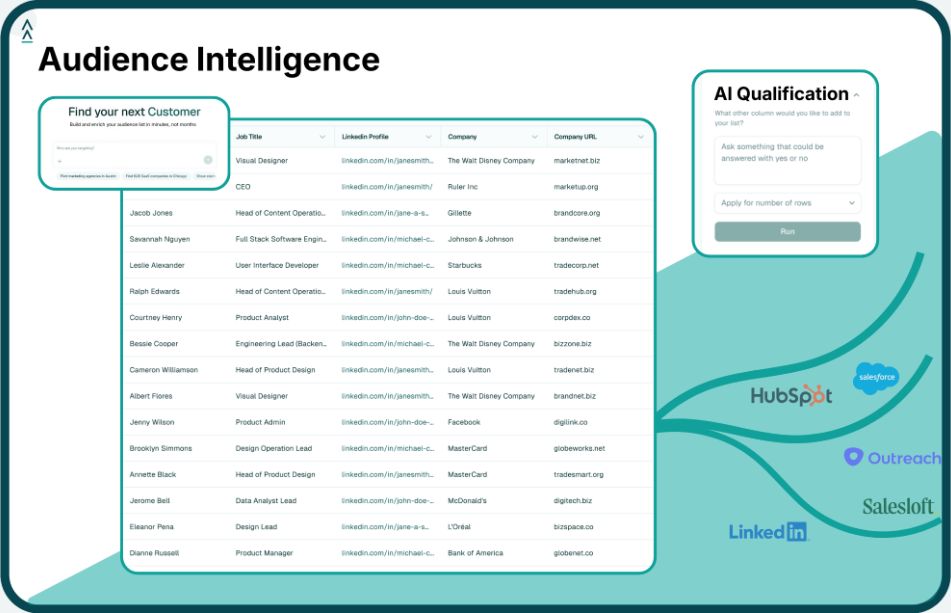
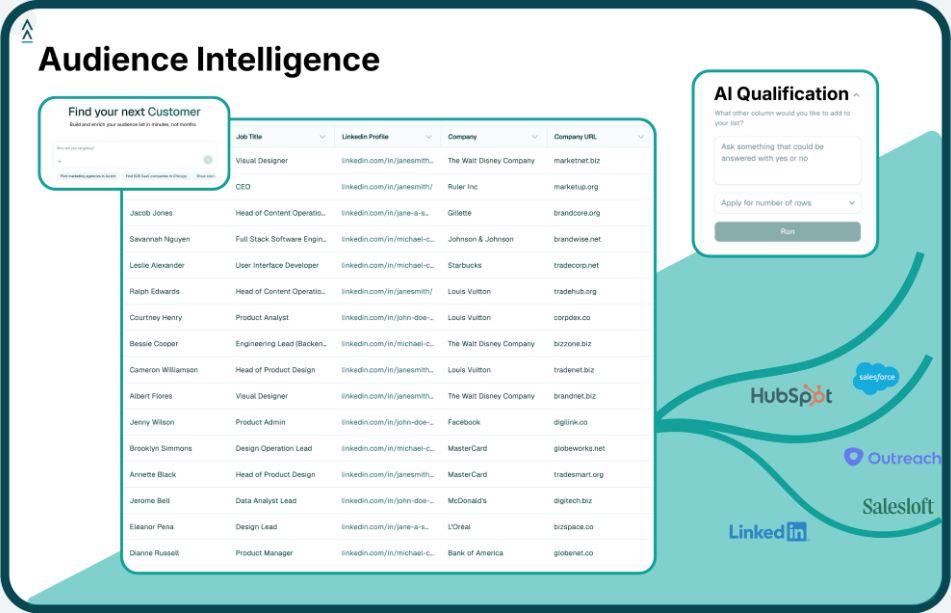
Match these accounts to your ICP, add contacts, and export to your CRM in minutes. 1000 free credits at sign-up.
Tool and strategies modern teams need to help their companies grow.