Daniel Saks
Chief Executive Officer
.png)
.png)
.png)


The AI infrastructure landscape is experiencing unprecedented growth, with companies raising an unprecedented $84 billion across just 10 mega-rounds in 2025 alone. Enterprise AI spending has reached $37 billion—a 3.2x increase from 2024—with infrastructure accounting for half of all generative AI investment. This massive infrastructure buildout is reshaping how businesses operate, from data processing to go-to-market strategies. For revenue teams navigating this complex landscape, finding the right customers requires more than just traditional data—it demands AI-powered intelligence that understands market signals and buying intent. Platforms like Landbase's agentic AI are now essential for building targeted audiences that leverage the same infrastructure innovations driving this AI revolution.
Databricks provides a unified data lakehouse platform that combines data warehousing and data lakes for AI-powered data processing at scale. Its Mosaic AI platform enables enterprises to build, deploy, and manage AI applications using their own data. The company serves as the critical data infrastructure layer that powers AI applications across thousands of enterprises.
Anthropic develops the Claude family of large language models with a focus on enterprise applications and AI safety. The company provides foundation models that power enterprise AI applications across regulated industries, with strong emphasis on reliability, safety, and enterprise-grade features.
OpenAI develops frontier AI models including the GPT series that power countless AI applications across industries. Its ChatGPT platform serves over 500 million weekly users, while its API services enable developers worldwide to build AI-powered solutions. The company operates massive computer infrastructure to train and serve its foundation models.
OpenAI defined the generative AI era and continues to set the pace for foundation model development. Its massive infrastructure investments, including partnerships with Microsoft Azure, have created the backbone for countless AI applications across the enterprise software landscape.
xAI, founded by Elon Musk, is building massive AI infrastructure including the Colossus supercomputer to train and serve its Grok AI models. The company focuses on creating the computer, data center, and networking infrastructure required for frontier AI development at unprecedented scale.
xAI's massive infrastructure investments are pushing the boundaries of what's possible in AI compute scale. Its focus on building proprietary data centers and supercomputers is creating new benchmarks for AI infrastructure capacity and performance.
Together AI provides a cloud platform that supports 200+ open-source AI models, enabling developers to train, fine-tune, and run inference on open models. The company offers specialized infrastructure optimized for open-source AI development with proprietary technologies like FlashAttention for high-performance, low-latency inference.
Together AI is democratizing access to AI infrastructure by supporting the open-source AI ecosystem. Its platform enables developers and enterprises to leverage cutting-edge open models without being locked into proprietary foundation model providers.
CoreWeave provides specialized cloud infrastructure optimized specifically for AI and high-performance computing (HPC) workloads. The company offers GPU-optimized cloud services with ultra-low latency networking tailored to enterprise AI use cases, serving as an alternative to traditional cloud providers for AI workloads.
Celestial AI develops Photonic Fabric™, a silicon-photonic interconnect technology that uses light to link compute and memory at chip and rack scales. The company addresses the critical data movement bottleneck in AI systems with breakthrough technology that enables high-bandwidth, low-latency, energy-efficient AI infrastructure.
Lambda provides GPU cloud services and AI workstations optimized for machine learning and deep learning workloads. The company offers specialized infrastructure for AI researchers, developers, and enterprises needing high-performance computing resources for AI model training and inference.
Lambda fills a critical gap in the AI infrastructure ecosystem by providing accessible, high-performance GPU resources for AI development. Its focus on specialized AI workloads makes it a preferred choice for teams requiring optimized infrastructure for machine learning.
Crusoe provides energy-efficient AI computing infrastructure powered by clean and stranded energy sources. The company has moved beyond its original focus on flared gas to a broader strategy incorporating wind, solar, and next-generation nuclear power. Crusoe Cloud offers sustainable computing resources for AI workloads while reducing environmental impact.
Crusoe is addressing the growing environmental concerns around AI computing by creating sustainable infrastructure solutions. Its innovative approach to energy sourcing is making AI computing more environmentally responsible while maintaining performance.
Scale AI provides data labeling and annotation services that form the foundation for training AI models. The company offers enterprise-grade data infrastructure that enables organizations to build high-quality training datasets for computer vision, natural language processing, and other AI applications.
Scale AI addresses the fundamental need for high-quality training data in the AI ecosystem. Its infrastructure enables organizations to build reliable AI models by providing the accurate, labeled data required for effective machine learning.
The companies profiled above represent the foundation of the AI revolution, building the computer, storage, networking, and data infrastructure that powers modern AI applications. This infrastructure explosion has created both opportunities and challenges for go-to-market teams. On one hand, the rapid pace of innovation creates new markets and customer segments. On the other hand, the complexity of this landscape makes it increasingly difficult to identify and engage the right prospects.
This is where AI-powered audience discovery becomes critical. Traditional data providers and manual prospecting methods simply cannot keep pace with the dynamic nature of the AI infrastructure market. Teams need tools that can understand complex technology stacks, track funding rounds, monitor hiring patterns, and identify companies actively investing in AI infrastructure.
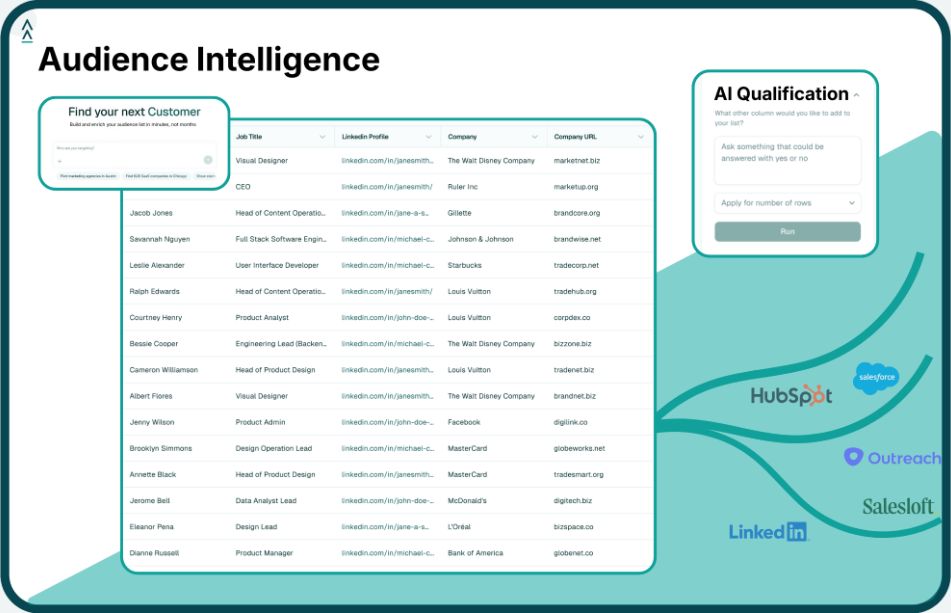
Landbase's VibeGTM interface addresses this challenge by enabling go-to-market teams to use natural-language prompts to find prospects across this complex landscape. Instead of wrestling with complex filters and query builders, teams can simply describe their ideal customer profile in plain English: "Companies using CoreWeave or Lambda that raised Series B funding in the last 6 months" or "Enterprise customers of Databricks with more than 1,000 employees actively hiring for AI roles."
By leveraging 1,500+ unique signals across firmographic, technographic, intent, hiring, and funding data, Landbase's platform can identify high-intent prospects in seconds rather than days or weeks. This capability is particularly valuable in the fast-moving AI infrastructure market, where timing is everything and the ability to move quickly can mean the difference between winning and losing major deals.
The explosive growth in AI infrastructure funding and adoption has several implications for go-to-market strategies:
Platforms like Landbase address these challenges by providing agentic AI for GTM automation that can interpret natural-language prompts and return AI-qualified audiences ready for immediate activation. This approach enables go-to-market teams to move at the speed of the AI infrastructure market while maintaining the precision required to win in this competitive landscape.
An AI infrastructure company provides the foundational technology layers required to build, train, deploy, and scale AI applications, including specialized hardware (GPUs, AI accelerators), cloud infrastructure optimized for AI workloads, data storage and management systems, networking solutions that address AI communication bottlenecks, and data platforms that enable AI model development. These companies form the backbone of the AI ecosystem, enabling other organizations to build and deploy AI applications without developing the underlying infrastructure themselves. This infrastructure is critical because AI workloads require specialized compute, storage, and networking capabilities that differ significantly from traditional enterprise computing.
AI infrastructure companies focus on building the foundational layers that enable AI development and deployment, while other AI companies typically build applications that run on top of this infrastructure. Infrastructure companies provide the "picks and shovels" of the AI gold rush—compute resources, storage systems, networking solutions, and data platforms. In contrast, application companies use these resources to build specific AI-powered products and services for end users or businesses. This distinction is similar to the difference between cloud providers like AWS and applications built on AWS.
The biggest challenges include massive capital requirements for building data centers and acquiring GPUs, energy consumption and environmental impact of AI computing, shortage of specialized talent with expertise in both AI and infrastructure, and the rapid pace of technological change that can make infrastructure investments obsolete quickly. Additionally, the complexity of integrating different infrastructure components into cohesive, efficient systems poses significant technical challenges. The $84 billion in funding across 10 mega-rounds demonstrates the scale of capital needed to compete effectively.
Look for companies that have raised significant funding rounds in 2024-2025 (particularly $100M+ rounds), are backed by top-tier investors with AI expertise, have strong technical leadership with backgrounds in AI and infrastructure, solve well-defined bottlenecks in the AI infrastructure stack (compute, storage, networking, or data), and have clear enterprise adoption or partnerships with major technology companies. Companies featured in industry lists like the Forbes AI 50 or those with rapid revenue growth (like Together AI's jump from $30M to $100M in under a year) are strong indicators of fast growth.
Funding plays a critical role because of the massive capital requirements for building data centers, acquiring GPUs, and developing specialized hardware. The $84 billion raised across just 10 mega-rounds in 2025 demonstrates the unprecedented scale of investment required to compete in this space. This funding enables companies to build the physical and technological infrastructure needed to support explosive growth in AI workloads and applications. Without significant capital, companies cannot achieve the scale necessary to serve enterprise customers effectively.
Go-to-market teams can effectively target AI infrastructure companies by leveraging platforms like Landbase that provide access to 1,500+ unique signals across firmographic, technographic, intent, hiring, and funding data. By using natural-language prompts to identify companies based on specific criteria—such as recent funding rounds, technology stack changes, hiring patterns, or geographic expansion—teams can build highly targeted prospect lists that reflect the dynamic nature of the AI infrastructure market. This approach enables teams to move quickly and precisely in a market where timing and relevance are critical to success.
Tool and strategies modern teams need to help their companies grow.