Daniel Saks
Chief Executive Officer


AI is fundamentally reshaping Revenue Operations, moving beyond simple automation to create intelligent systems that can discover, qualify, and engage target audiences with unprecedented speed and precision. More and more RevOps teams are finding that audience discovery can transform their go-to-market strategy, especially for teams drowning in manual data work or struggling to identify in-market buyers. The traditional RevOps stack—once a patchwork of disconnected tools for data, outreach, and analytics—is giving way to unified, agentic platforms that understand business context and execute complex workflows autonomously. This shift is driven by a simple truth: in a world where B2B buyers complete 70% of their research before ever speaking to a salesperson, the ability to find and engage the right accounts at the right moment is a decisive competitive advantage.
Now, the promise of AI in RevOps isn't just about working faster; it's about working smarter and more strategically. Recent AI RevOps research reveals a stark reality: while 71% of teams rate their AI knowledge as high, fewer than 10% are seeing meaningful ROI. This gap exists not because the technology is flawed, but because most implementations are fragmented and lack a clear ownership model. The most successful transformations are led by a centralized RevOps function that treats AI not as a collection of point solutions, but as an integrated, intelligent engine for revenue.
The science behind this transformation is solid. At its core, AI excels at synthesizing massive, disparate data sets—from firmographics and technographics to real-time intent signals and market events—to build a dynamic, actionable view of the total addressable market (TAM). This allows RevOps teams to move from static, quarterly planning to always-on, adaptive go-to-market motions. If you're thinking about how to leverage AI for your revenue engine, it's worth understanding the key transformation patterns, the critical role of data quality, and how to measure success beyond simple time savings.
Revenue Operations (RevOps) is the strategic function that aligns sales, marketing, and customer success teams around a single, unified revenue process. Its core mission is to break down silos, streamline operations, and provide a single source of truth for all revenue-related data and reporting. Traditionally, this has involved a heavy dose of manual work: stitching together data from CRMs, marketing automation platforms, and support systems; building static lead lists; cleaning duplicate records; and creating complex, often outdated, reports.
A traditional RevOps stack is a complex web of specialized tools:
This fragmentation creates significant challenges. Data lives in silos, making it hard to get a complete picture of a customer. Processes are manual and brittle, requiring constant maintenance. And teams spend a disproportionate amount of time on administrative tasks instead of strategic analysis. In this environment, the average sales rep spends only 28% selling. This is the foundational problem that modern AI aims to solve.
The AI revolution in RevOps is not a single event but a series of interconnected transformations that are redefining the function's capabilities. It's moving beyond simple task automation to create a truly intelligent, adaptive revenue engine.
The first and most visible layer of change is in workflow automation. AI is taking over the tedious, repetitive tasks that have historically bogged down RevOps and sales teams. This includes:
This automation directly translates to massive time savings. RevOps teams report reclaiming 15-25 hours weekly on operational tasks, allowing them to focus on higher-value strategic initiatives.
Beyond saving time, AI's true strategic value lies in its ability to process and analyze data at a scale and speed impossible for humans. This enables a shift from reactive reporting to proactive, predictive guidance.
This intelligence empowers RevOps to become a strategic growth partner, not just an operational support function, a sentiment echoed by McKinsey & Company research on martech transformation.
For sales operations leaders, AI is a game-changer for optimizing every stage of the sales cycle. The focus is on enabling reps to have more high-quality conversations and close more deals.
The age of spraying and praying is over. AI can now qualify and prioritize leads with remarkable precision. By analyzing a lead's firmographic fit, website engagement, content consumption, and even job postings, AI can assign a dynamic score that predicts their likelihood to buy and their potential deal size. This ensures that sales reps are always working the most promising opportunities.
AI is also streamlining the sales workflow itself. From automated meeting scheduling to AI-generated email drafts based on a prospect's specific context, the technology is removing friction from the sales process. This is where optimizing sales operations with an AI-native platform becomes critical.
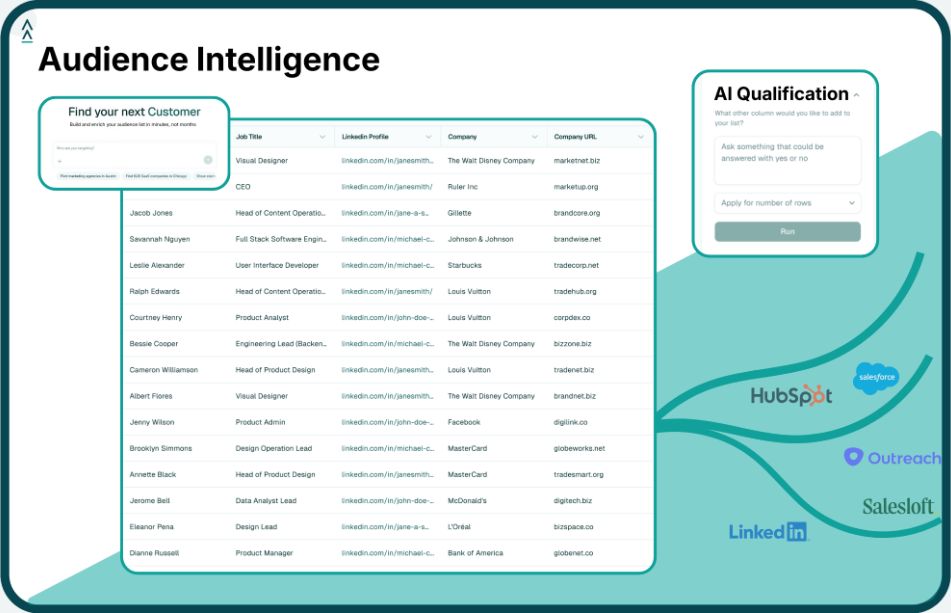
Perhaps the most profound impact of AI is in the realm of audience discovery. The traditional method of building lists—navigating complex filters in a database—is slow and often misses crucial context.
Modern AI platforms allow RevOps teams to describe their ideal customer profile (ICP) in plain English. For example, a prompt like "CMOs at cybersecurity startups with 50-200 employees that are hiring for marketing roles" can instantly generate a list of perfectly matched, AI-qualified contacts. This process, known as natural-language targeting, collapses a process that used to take hours or days into mere seconds. The result is a highly targeted, ready-to-activate audience list that streamlines marketing and dramatically improves campaign conversion rates.
This is where agentic AI comes into play. The AI doesn't just find the list; it qualifies it. It uses a network of signals—over 1,500+ enrichment fields—to validate that each company on the list is a genuine fit and is showing signs of being in-market. This two-step process of discovery and qualification ensures that marketing and sales teams are not just reaching a large audience, but the right audience at the right time. This shift from manual, keyword-based filtering to contextual, AI-driven discovery is at the heart of the modern RevOps transformation.
The rise of AI is fundamentally changing the role of the Sales Operations Manager and the broader RevOps professional. The job is shifting from a focus on data wrangling and report generation to strategic orchestration and business analysis.
The modern RevOps professional needs to be a strategic technologist. Their core responsibilities now include:
Success in this new era requires a blend of technical and business acumen.
The theoretical benefits of AI are compelling, but its real value is proven in practical application. Here's how leading teams are using AI automation tools to drive tangible results.
The market is crowded, but the trend is clear: towards consolidation. Platform consolidation is emerging as a key theme, with teams moving away from a sprawling stack of point solutions towards unified platforms that offer an integrated data layer and workflow engine. A recent survey of 300 RevOps teams found that organizations with a clear, RevOps-led ownership model for their AI stack saw significantly higher ROI than those with ad-hoc, team-by-team implementations.
When evaluating tools, prioritize:
The standard metric of "time saved" is a starting point, but the most successful teams measure business outcomes. Fewer than 10% of teams currently measure pipeline impact, but this is the gold standard.
In a market full of specialized, single-purpose AI tools, Landbase stands out as a purpose-built platform for the core RevOps challenge: finding and qualifying the next customer. Landbase's GTM-2 Omni agentic AI model is trained on billions of data points from over 50 million B2B sales interactions, giving it a deep, contextual understanding of go-to-market dynamics.
The platform directly addresses the key pain points identified in the research. Its free audience builder eliminates the friction of traditional list-building, allowing any RevOps professional to type a plain-English prompt and instantly receive an AI-qualified export of up to 10,000 contacts. This capability directly tackles the "insight to action" gap, turning a strategic ICP definition into a ready-to-activate audience list in seconds.
For teams looking to move beyond fragmented tooling and reclaim their day from manual data work, Landbase offers a streamlined, powerful solution. Its focus on natural-language targeting and agentic qualification aligns perfectly with the industry's shift towards conversational analytics and autonomous execution. By providing immediate, high-quality audience lists, Landbase empowers RevOps teams, sales reps, and founders to focus on what they do best: building relationships and closing deals. Its impressive customer success stories, like P2 Telecom adding $400k in MRR, demonstrate the tangible revenue impact of this approach.
The ultimate promise of AI in RevOps is a simple one: to let humans be more human. By automating the repetitive, data-intensive work that has historically consumed so much time, AI frees sales, marketing, and RevOps professionals to focus on the creative, strategic, and relational aspects of their jobs. This is the core of Landbase's "Reclaim Your Day" philosophy.
The benefits are both quantitative and qualitative. On the quantitative side, teams see 30-50% improvements in forecasting accuracy and can generate high-intent pipeline at a fraction of the traditional cost. On the qualitative side, employee satisfaction increases as roles become more strategic and less administrative. This focus on high-value work directly translates to a better customer experience, as buyers are engaged by knowledgeable, strategic partners rather than data-entry clerks.
The data is clear: 70% of businesses are already using AI to optimize operations, and 96% of revenue leaders expect their teams to be using AI tools by the end of 2026. The question for any RevOps leader is no longer if they should adopt AI, but how to do it in a way that's unified, strategic, and delivers real ROI. The path forward lies in treating AI as an integrated, intelligent engine for revenue, led by a central RevOps function with a clear vision for the future.
AI contributes by analyzing vast datasets of historical sales interactions, current pipeline health, and external market signals to identify subtle patterns and correlations that humans miss. This leads to a standard improvement in forecasting accuracy of 30% to 50%, allowing for more confident strategic planning. AI models continuously learn from new data, making predictions more accurate over time and flagging potential risks in live deals before they become critical issues.
Yes, significantly. By automating time-intensive tasks like manual data entry, list building, and report generation, AI allows RevOps teams to reclaim 15-25 hours weekly. This can reduce the need for a large operational headcount and lower the cost of data acquisition. The efficiency gains translate directly to cost savings while simultaneously improving data quality and process reliability.
Successful RevOps professionals in the AI era need to develop skills in data literacy and governance, AI tool orchestration and management, strategic process design, and cross-functional change management. The focus shifts from executing manual tasks to strategically designing and governing an AI-augmented revenue engine. Technical understanding of AI capabilities and limitations, combined with the ability to translate insights into business strategy, becomes essential for leadership roles.
Landbase is built on a foundation of a massive, continuously updated B2B database of over 300M contacts and 24M companies. Its AI model, GTM-2 Omni, is trained on billions of GTM data points from 50M+ B2B campaigns to understand and filter for high-quality signals. The platform maintains SOC II and GDPR compliance, ensuring data is handled securely and in accordance with privacy regulations while providing real-time enrichment and validation.
The key benefits are speed, precision, and strategic focus. Agentic AI can move from a natural-language prompt to an AI-qualified, ready-to-activate audience list in seconds, eliminating the manual workflow gap. This ensures targeting is based on a deep analysis of 1,500+ enrichment fields and real-time signals, allowing the RevOps team to focus on higher-level strategy and analysis rather than execution. The result is dramatically improved conversion rates and faster time-to-market for campaigns.
Tool and strategies modern teams need to help their companies grow.