.png)
.png)
.png)

Daniel Saks
Chief Executive Officer


Your pricing page is your highest-intent asset—yet 98% of visitors leave without a trace. These anonymous visitors represent your warmest prospects, actively evaluating your solution but never filling out a form. Capturing and converting this hidden demand requires identifying companies that viewed your pricing page and building them into actionable, AI-qualified prospect lists. Tools like the Landbase platform can instantly generate these lists using natural-language prompts, turning anonymous intent into qualified leads ready for your sales team.
In the B2B buying journey, not all website visits are created equal. A casual blog reader is in a very different place than someone who has navigated directly to your pricing page. This specific behavior is a powerful indicator of a prospect's position in the buying cycle and their readiness to engage with sales.
Research consistently shows that a visit to the pricing page is one of the strongest signals of purchase intent a prospect can give outside of an explicit action like a demo request. In most sophisticated lead scoring frameworks, this single action is assigned a high point value of 20-25 points, placing it just below a direct sales inquiry in terms of sales readiness.
When a prospect lands on your pricing page, they are no longer in the early discovery or research phase. They have moved into the evaluation and comparison stage. Their primary questions are no longer "What is this?" but rather "How much does it cost?" and "Is this a good fit for my budget and needs?"
This shift in intent is what makes the signal so valuable. A staggering 98% of visitors will leave your website without leaving a trace. By focusing on pricing page behavior, you can capture a significant portion of this hidden demand that traditional lead generation methods miss entirely.
A pricing page visit often signifies a prospect has completed their initial research. They have likely consumed your content, understood your value proposition, and are now ready to understand the financial commitment. This is a critical juncture in the funnel.
The timing of your follow-up is crucial. The same research indicates that responding to a high-intent signal like a pricing page visit within just 5 minutes can lead to a 100x higher conversion rate compared to a 30-minute delay. This urgency underscores the need for a system that can not only identify these visitors but also alert your sales team in real-time.
To turn this powerful signal into a list of actionable companies, you first need the technical capability to identify who is visiting your site. This is the domain of website visitor identification and intent tracking technology, a core capability of the Landbase platform.
These systems work by embedding a small piece of JavaScript code on your website. When a visitor arrives, the code captures their IP address and matches it against a massive B2B database of company IP ranges. This process, known as IP-to-company matching, can successfully identify the organization behind 60% of business website traffic.
There are several types of tools in this space:
The setup is typically straightforward: install the tracking code, and the platform's dashboard will begin showing you a feed of identified companies visiting your site. From there, you can create a custom segment or filter for any page URL that contains your pricing path (e.g., /pricing).
It's important to set realistic expectations about identification accuracy. Residential IPs, VPNs, and small businesses are often unidentifiable. The goal is not to catch every single visitor but to capture a statistically significant sample of your most valuable traffic.
Once your tracking is in place, you can layer on additional filters to refine your signal. For instance, you might only want to target companies that have visited your pricing page at least twice in the past week or have spent more than a minute on the page. These secondary signals help you prioritize the hottest leads from the broader group.
Identifying a company that viewed your pricing page is just the first step. The real power comes from combining this intent signal with your ideal customer profile (ICP) to build a hyper-targeted list that your sales team can actually convert.
A raw list of pricing page visitors is noisy. It will include competitors, students, and companies that are far outside your target market. The key is to use firmographic, technographic, and other data points to filter this list down to only your most promising prospects.
This is where the concept of audience discovery and qualification becomes critical.
For example, a cybersecurity vendor wouldn't want to chase every company that visited their pricing page. They would want to filter for companies in their target industries (e.g., financial services, healthcare) that have a technology stack indicating they are a potential buyer (e.g., using a legacy security solution) and are of a size that fits their pricing model.
Enriching your high-intent company list is the critical next step:
The process of building a list from a simple intent signal can be manual and time-consuming, involving multiple tools and a series of complex filters. This is the exact problem that agentic AI is designed to solve.
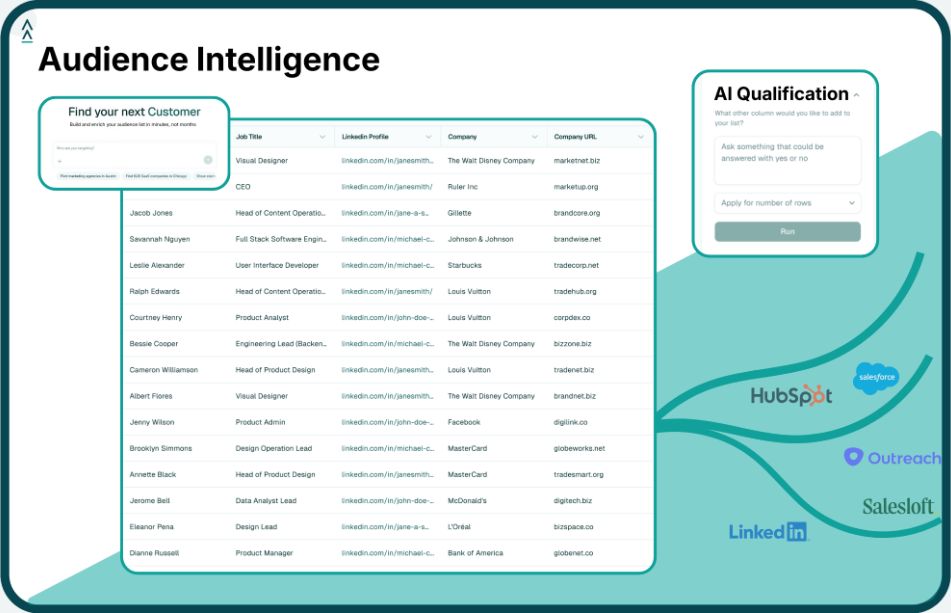
Instead of navigating a complex UI with dozens of filters, you can simply describe your target audience in plain English. This is the power of natural-language targeting, a core feature of the VibeGTM interface. A prompt like "Find me CISOs at financial services companies in the US with 1,000+ employees that have visited our pricing page in the last 30 days" can instantly generate your list.
The engine behind this capability is GTM-2 Omni, an agentic AI model trained on billions of data points from over 50M+ B2B campaigns. This model doesn't just perform a simple keyword search. It uses its deep understanding of the B2B go-to-market landscape to interpret your request, identify the relevant signals (including your first-party "visited pricing pages" signal), and cross-reference them with its vast database of company and contact information.
For a platform like Landbase to leverage your pricing page signal, it must first be able to ingest and understand that data. This is part of its broader capability for real-time intent tracking. By integrating with your website analytics or by providing a list of domains that have triggered this event, the AI can mark these accounts as "high intent."
The AI Qualification process then goes to work. It doesn't just accept the intent signal at face value. It cross-checks the company against 1,500+ other signals to ensure they are a good fit. Is the company in your target industry? Do they have the right employee count? What is their current technology stack? Are they showing other signs of market activity, like hiring or funding? This multi-layered qualification ensures your final list is not just high-intent but also high-fit.
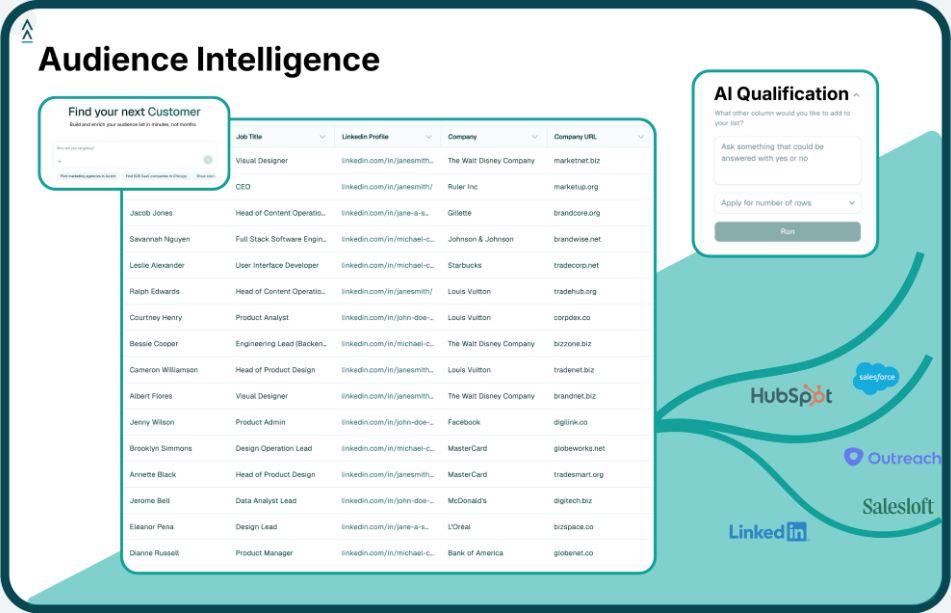
After the audience is qualified, the AI automatically enriches each account with verified contact information. This includes not just a name and email, but often direct dials, social profiles (like LinkedIn), and other relevant professional details. This enriched data is what transforms a list of companies into a sales-ready list of actionable leads. You end up with an AI-qualified export of up to 10,000 contacts that can be activated in your existing outreach tools immediately.
You have your high-intent, high-fit list of prospects. Now what do you say to them? The messaging for this audience should be markedly different from a cold outreach sequence.
Because these prospects have already shown a clear interest in your product and its price, your outreach should be direct, value-focused, and offer a clear next step. You are no longer trying to create awareness; you are trying to accelerate a decision that is already in motion.
Your subject line and opening line should acknowledge their interest. You can be direct: "Saw you were checking out our pricing—have any questions?" or "Noticed your team was on our pricing page—would a quick chat help clarify anything?"
The body of your message should focus on the specific value you can deliver and address the most common objections or decision criteria for your price point. Since they are in the evaluation phase, they are likely comparing you to competitors or seeking final validation. Your message should provide that validation and make the next step as easy as possible, such as a link to book a 15-minute call or a live calendar.
Timing, as mentioned, is critical. An automated alert to your sales team the moment a high-fit account visits your pricing page can be the difference between a new customer and a lost opportunity.
Personalization is also key. If your visitor identification tool provides any additional context—like which other pages they visited before the pricing page—you can weave that into your message. For example, if they read your "Integration with Salesforce" post before checking pricing, you might say, "Glad to see you're interested in our Salesforce integration. Our pricing is designed to scale with your use of that feature..."
Like any marketing or sales initiative, your strategy for leveraging pricing page signals must be measured and optimized. The goal is not just to build a list but to drive real business outcomes like pipeline and revenue.
The most important metrics to track are directly tied to your sales funnel:
By tracking these metrics, you can determine the true ROI of your effort. A successful strategy will show a significantly higher conversion rate and faster deal velocity than your average inbound lead. One case study on Segment showed that using intent data like this can improve conversion rates from 1.5% to 3.2%, more than doubling the effectiveness of the lead source.
Your first list is just a starting point. The data you gather from your outreach will be invaluable for refining your qualification criteria. Perhaps you find that pricing page visitors from a certain industry convert at a much higher rate. You can then weigh that signal more heavily in your AI prompts. Or, you might discover that a visit isn't enough—you need two visits within a week to signal true intent.
This is the power of a feedback loop. Each campaign you run with your AI-qualified list provides data that can be used to train your models and make the next list even more effective.
Traditional methods of building a list from your pricing page signal are fragmented. You might use one tool to identify visitors, export a CSV, import it into a separate data enrichment platform, apply your ICP filters manually, and then export again for your sales team. This workflow is slow, error-prone, and often takes days.
Landbase consolidates this entire process into a single, frictionless experience. As a free, no-login audience builder, it's designed for speed and simplicity. You don't need to be a data scientist or a sales ops expert to use it.
Here's how it works in the context of a pricing page signal:
This workflow turns what was once a multi-day project into a task that takes minutes. It allows your team to act on high-intent signals with the speed they require, ensuring you never miss an opportunity hidden in your website analytics.
A 'viewed pricing page' signal is a behavioral data point that indicates a website visitor has navigated to your product's pricing page. This action is a strong indicator of purchase intent, as the visitor has moved beyond initial research and is now evaluating the financial commitment. In lead scoring models, this behavior is typically assigned a high weight of 20-25 points, making it one of the most valuable intent signals for identifying sales-ready prospects.
Speed is critical when capitalizing on pricing page visits. Following up within 5 minutes of a pricing page visit can lead to a conversion rate that is 100 times higher than a follow-up that is delayed by 30 minutes. This underscores the need for real-time alerts and a rapid response process to capture the prospect while their interest is at its peak. The window for optimal engagement is very short, making automation and instant notification systems essential for sales success.
While a pricing page visit is a powerful signal, it should not be used in isolation to qualify a lead. A company may visit your pricing page out of curiosity, for competitive research, or because they are far outside your ideal customer profile (ICP). The most effective strategy is to use the pricing page view as a primary intent signal and then layer it with your ICP criteria—such as company size, industry, and technology stack—to ensure the lead is both high-intent and high-fit before sending it to sales.
AI dramatically streamlines and enhances the process by eliminating manual filtering across multiple tools. Instead of navigating complex interfaces, you can use natural-language targeting to describe your audience (e.g., "Give me CFOs at recently funded startups that visited our pricing page"). An agentic AI model like GTM-2 Omni can then instantly cross-reference your intent signal with a massive B2B database, apply your ICP filters, and perform deep enrichment to deliver an AI-qualified export of verified contacts in seconds.
Yes, privacy is a critical consideration when implementing visitor identification technology. These tools work by matching an IP address to a company, not an individual person, which generally falls under legitimate business interest for B2B marketing in most regions. It's important to be transparent and have a clear privacy policy on your website that discloses the use of tracking technologies. Most platforms are SOC 2 and GDPR compliant, and the focus remains on identifying the business entity rather than individual persons, which aligns with B2B marketing best practices and regulations.
Tool and strategies modern teams need to help their companies grow.