.png)
.png)
.png)

Daniel Saks
Chief Executive Officer


The enterprise SaaS landscape is experiencing unprecedented acceleration, with AI-powered platforms reshaping how businesses operate and grow. In 2024-2025, these companies have collectively raised billions in funding while achieving extraordinary growth metrics—some doubling their ARR every few months rather than years. For go-to-market teams navigating this competitive landscape, identifying the right prospects among these fast-moving companies requires more than traditional databases. AI-powered audience discovery platforms like Landbase now enable teams to find and qualify their next customer in seconds using natural-language targeting, delivering AI-qualified exports of up to 10,000 contacts ready for immediate activation.
OpenAI develops frontier AI models that power applications across industries—from conversational assistants to embedded AI features in third-party products. Its ChatGPT platform serves both end users and developers via APIs, enabling enterprises to add natural language, reasoning, and automation capabilities into existing tools and new SaaS products.
OpenAI has fundamentally transformed enterprise software by making advanced AI capabilities accessible via simple API calls, enabling a new generation of AI-powered applications. The company's models have become the de facto standard for human-AI interaction in both consumer and enterprise contexts.
Valuation: Around $500B | Founded: 2015
Recent Funding: Series Unknown (2024)
Anthropic provides enterprise AI platforms built on "Constitutional AI" principles that prioritize safety, alignment, and interpretability. Its Claude models feature extended context windows (100K+ tokens) enabling complex enterprise use cases in regulated industries like healthcare, finance, and government.
Anthropic represents the enterprise-first approach to AI, prioritizing safety, interpretability, and alignment—critical for regulated industries. The company's Constitutional AI methodology has established new standards for responsible AI deployment in enterprise settings where reliability and compliance are non-negotiable.
Founded: 2021
Recent Funding: $3.5B Series E (March 2025)
Anysphere's Cursor IDE integrates natural language code generation directly into the development workflow, predicting changes and surfacing answers from existing codebases in real-time. The platform includes a fusion model for instant, high-quality tab code suggestions that boost developer productivity without sacrificing control.
Cursor is redefining software development by making AI a core part of the coding workflow rather than an add-on. The platform demonstrates the hunger for AI-native development tools that boost productivity while maintaining developer agency and code quality standards.
Valuation: $9.9B | Founded: 2022
Recent Funding: $900M Series C (May 2025)
Stripe provides complete payment infrastructure from processing to revenue optimization and financial operations. The developer-first API platform enables rapid integration while expanding beyond payments into banking, lending, and comprehensive business management tools.
Stripe has fundamentally modernized payment infrastructure for the internet economy, making it trivial for companies to accept payments globally. The platform has enabled countless SaaS businesses to monetize effectively while evolving into comprehensive financial infrastructure for modern businesses.
Valuation: $92B+ | Founded: 2010
Recent Funding: $694M (2024)
Databricks provides a unified data and AI platform combining data engineering, science, and machine learning in a single workspace. Built on open-source foundations with Delta Lake and MLflow, the platform enables enterprises to build lakehouse architectures that power large-scale analytics and AI applications.
Databricks pioneered the "data lakehouse" architecture, unifying data warehousing and data lake capabilities. The platform has become essential infrastructure for enterprises building AI/ML applications at scale, processing massive datasets efficiently across hybrid cloud environments.
Valuation: over $100B | Founded: 2013
Recent Funding: $1B Series K
Perplexity provides an AI-powered answer engine that returns direct, cited answers from multiple sources instead of traditional link lists. The conversational search experience is available on the web, desktop and mobile apps, plus browser extensions, combining live web search with multiple large language models to deliver up-to-date, source-backed answers.
Perplexity is reimagining search for the AI era by prioritizing cited, conversational answers instead of SEO-optimized link pages. Its answer-engine approach—paired with real-time web access and multi-model routing—positions it as one of the most credible challengers to traditional search engines.
Valuation: $20B | Founded: 2022
Recent Funding: $200M late-stage round at a $20B valuation (Sept 2025)
Klaviyo provides data-driven marketing automation for consumer brands with an owned-channel focus. The platform combines email and SMS automation with AI-powered analytics, real-time segmentation, and a built-in customer data platform—positioning Klaviyo as a B2C CRM for brands that want to personalize marketing at scale.
Klaviyo pioneered owned-channel marketing, enabling brands to reduce dependence on third-party ad platforms (like Facebook and Google) by owning more of their customer data and relationships. As it has evolved into a full B2C CRM—combining marketing automation, analytics, and customer service in one stack—Klaviyo has become essential infrastructure for e-commerce and D2C brands seeking durable, data-driven growth.
Valuation: $8.35B | Founded: 2012
Recent Funding: IPO raised $576M (September 2023)
Glean provides AI-powered work assistant capabilities that search across all company apps and data sources. The platform respects existing permissions while enabling natural language queries across fragmented enterprise systems, with Glean Agents deploying AI agents at enterprise scale.
Glean is pioneering enterprise knowledge management through AI, making institutional knowledge instantly accessible across fragmented data sources. The company's agentic AI platform represents the next evolution beyond search—autonomous AI agents that can take actions across enterprise systems.
Valuation: $7.2B | Founded: 2019
Recent Funding: $150M Series F (2025)
ClickHouse provides a fast, cost-effective real-time analytical database for AI, BI, and cybersecurity use cases. Built on an open-source foundation with a bring-your-own-cloud deployment model, the platform enables resource-efficient performance for enterprise-scale data workloads.
ClickHouse provides critical infrastructure for real-time analytics at scale, enabling AI companies, cybersecurity firms, and enterprises to analyze massive datasets efficiently. The open-source foundation combined with cloud-native SaaS offering has driven rapid adoption across technical organizations.
Valuation: $6.0B | Founded: 2021
Recent Funding: $350M Series C + $100M credit facility (May 2025)
Workato provides a low-code automation platform with 1,200+ connectors enabling enterprise-scale integration and workflow automation. The platform includes AI-powered agents for intelligent workflow automation, B2B/EDI automation, and comprehensive API management capabilities.
Workato is enabling enterprise automation at scale by connecting disparate systems through low-code workflows. The platform has become critical infrastructure for digital transformation, allowing business users to automate complex processes without developer resources while maintaining enterprise-grade security and governance.
Valuation: $5.7B | Founded: 2013
Recent Funding: $200M Series E (November 2021)
Harvey provides an AI-powered platform for legal professionals, automating document review, contract drafting, legal research, and compliance checks. The platform integrates with existing legal software and is purpose-built for law firms and legal departments.
Harvey is transforming legal work through AI, automating document-heavy tasks that consume billable hours. The platform's rapid adoption by top law firms demonstrates AI's potential to reshape professional services while maintaining quality and compliance standards in highly regulated environments.
Valuation: $3B | Founded: 2022
Recent Funding: $300M Series D (February 2025)
ElevenLabs provides realistic AI voice generation and cloning technology, enabling conversational AI agents with multilingual dubbing capabilities. The platform includes a voice marketplace for custom voice creation and serves content creators, customer service teams, and entertainment companies.
ElevenLabs is pioneering realistic AI voice synthesis, enabling new use cases in content creation, accessibility, customer service, and entertainment. The platform's rapid Fortune 500 adoption demonstrates voice AI's transition from experimental to mission-critical technology for global enterprises.
Valuation: $3.3B | Founded: 2022
Recent Funding: $180M Series C (January 2025)
Supabase provides an open-source Firebase alternative built on PostgreSQL, offering a managed Postgres database with authentication, real-time subscriptions, instant REST & GraphQL APIs, file storage, Edge Functions, and vector embeddings for AI workloads. The platform is positioned as a full Postgres development platform that can be self-hosted or run in Supabase’s managed cloud.
Supabase is democratizing backend development by delivering “Firebase-like” developer experience on top of Postgres and open-source tooling. Developers get SQL, ACID transactions, real-time capabilities, granular Row-Level Security, and the option to self-host, making Supabase a core building block for modern web and AI applications that want performance and data portability without proprietary lock-in.
Valuation: $5B | Founded: 2020
Recent Funding: $200M Series D (April 2025)
Persona provides an identity verification platform built for the AI age, combating AI impersonation through dynamic collection of passive, active, and behavioral signals. The platform expanded Know Your Business (KYB) services in 2025 to combat fraud across fintech, crypto, and regulated industries.
Persona is addressing critical identity verification challenges in the AI era, where deepfakes and synthetic identities threaten traditional authentication. The platform's multi-signal approach has become essential for fintech, crypto, and regulated industries requiring robust identity assurance.
Valuation: $2.0B | Founded: 2018
Recent Funding: $200M Series D (April 2025)
MaintainX provides AI-powered asset management with machine health monitoring capabilities, featuring a sensor-agnostic approach that works with any industrial sensor or control system. The platform includes AI CoPilot features that recommend actions from technician photos and auto-generate work order summaries from voice notes.
MaintainX is modernizing industrial maintenance operations through AI, bringing predictive maintenance and real-time asset monitoring to sectors traditionally slow to adopt technology. The platform's sensor-agnostic approach enables rapid deployment across diverse industrial environments, from manufacturing to utilities.
Founded: 2018
Recent Funding: $150M Series D (2025)
These 15 fastest-growing enterprise SaaS companies demonstrate the transformative power of AI across every business function—from development and data to legal, voice, and industrial operations. However, identifying and engaging with these high-growth companies as prospects requires a fundamentally different approach to go-to-market.
Traditional database querying and manual list-building simply cannot keep pace with the dynamic nature of these rapidly evolving organizations. Companies like Anysphere grew ARR by doubling roughly every two months through early 2025, while others like Harvey are achieving $75M ARR in just three years. This velocity demands AI-powered audience discovery that can identify the right accounts at the right time based on real-time signals.
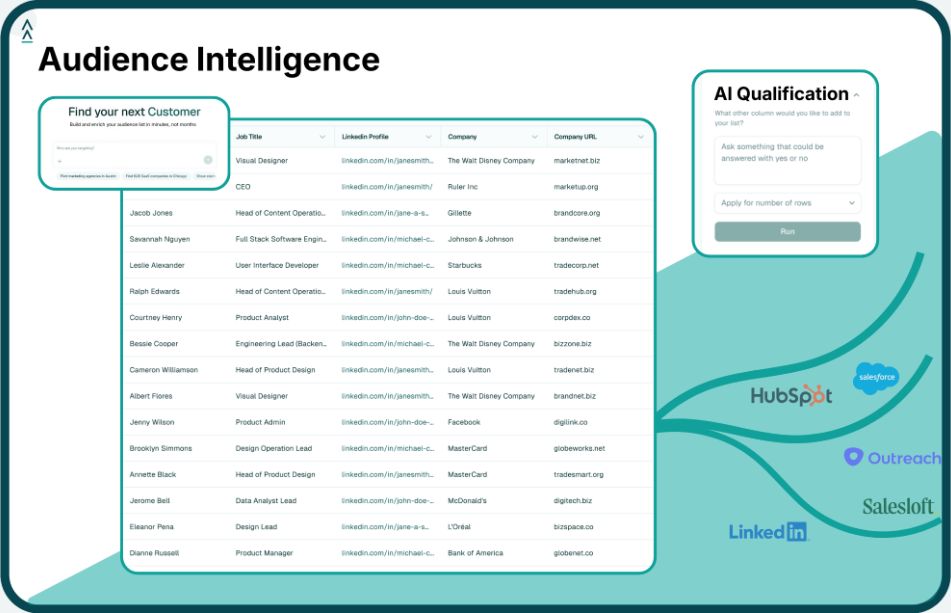
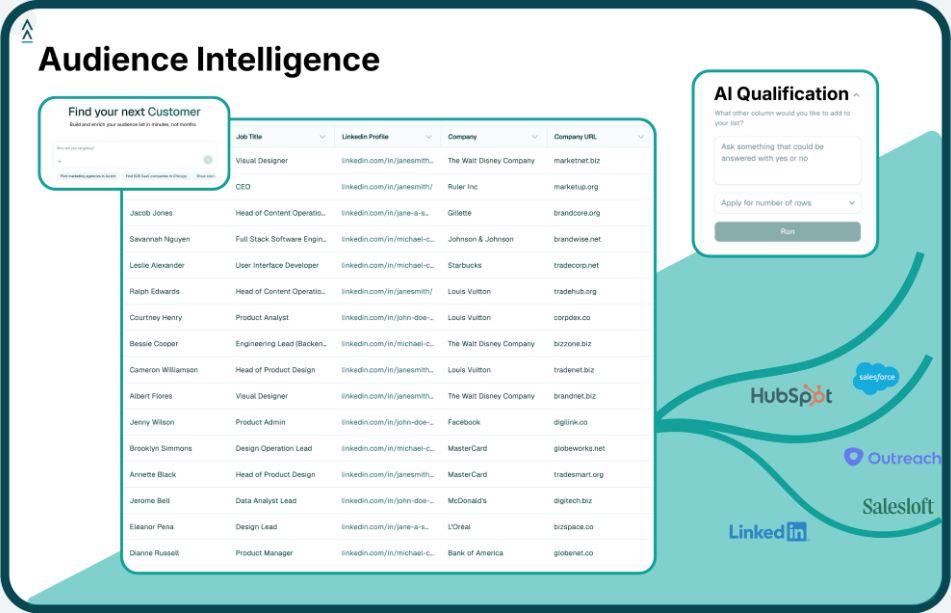
This is where Landbase's GTM-2 Omni platform transforms go-to-market operations. Instead of wrestling with complex filters or outdated contact databases, sales and marketing teams can use natural language to describe their ideal prospects: "CFOs at AI-native SaaS companies with $50M+ ARR that raised funding in the last 6 months."
Landbase's agentic AI then coordinates across 1,500+ unique signals—including firmographic, technographic, intent, hiring, and funding data—to build and qualify audiences instantly. The platform delivers AI-qualified exports of up to 10,000 contacts ready for immediate activation in existing tools, enabling teams to:
For B2B organizations selling into the enterprise SaaS ecosystem, this agentic AI approach is no longer optional—it's essential for keeping pace with the market's accelerating velocity and complexity.
Fastest-growing enterprise SaaS companies are defined by exceptional metrics across multiple dimensions: funding velocity (raising significant rounds in 2024-2025), valuation growth (achieving unicorn or decacorn status rapidly), ARR expansion (doubling every few months rather than annually), and user/customer adoption (attracting millions of users or thousands of enterprise customers). Companies like Anysphere with $500M ARR achieved by doubling every two months through early 2025 exemplify this accelerated growth profile.
AI, especially agentic AI, contributes to enterprise SaaS growth by automating complex workflows, enhancing decision-making with real-time insights, and creating new product categories entirely. Agentic AI goes beyond simple automation by coordinating multiple AI agents to accomplish complex tasks—like Glean's platform processing 100M+ agent actions annually. This technology enables companies to scale operations exponentially while maintaining quality and personalization, driving the extraordinary growth metrics seen across these fastest-growing SaaS companies.
Rapidly growing SaaS startups face several critical challenges: maintaining product quality while scaling engineering teams, managing customer success with accelerating customer acquisition, navigating complex enterprise sales cycles while maintaining growth velocity, and ensuring data security and compliance as they serve increasingly regulated industries. Companies like Persona address these challenges by building robust identity verification systems that meet enterprise security requirements from day one.
Investors evaluate enterprise SaaS companies based on several key metrics: revenue growth rate (particularly net revenue retention), customer acquisition cost (CAC) efficiency, gross margins, market size and positioning, and competitive differentiation. The extraordinary funding rounds seen in 2024-2025—like Databricks' $1B Series K or Anthropic's $3.5B Series E—reflect investor confidence in both the massive addressable markets and the proven ability of these companies to execute at scale.
CEOs play a pivotal role in enterprise SaaS growth by setting strategic vision, building exceptional leadership teams, maintaining company culture during hyper-growth, and making critical decisions about market positioning and product direction. The fastest-growing companies are often led by experienced executives like Aaron Katz of ClickHouse (formerly at Salesforce and Elastic) or Arvind Jain of Glean (formerly at Google and Rubrik), who combine technical expertise with enterprise go-to-market experience.
Landbase's GTM-2 Omni platform exemplifies the future of enterprise SaaS tools by replacing complex workflows with natural language interfaces, automating manual processes through agentic AI coordination, and delivering immediate value without lengthy implementation. The platform's ability to interpret plain-English prompts like "AI startups with recent funding hiring RevOps leaders" and return AI-qualified exports of up to 10,000 contacts in seconds represents the shift toward software that works for users rather than requiring users to adapt to software complexity.
Tool and strategies modern teams need to help their companies grow.