.png)
.png)
.png)

Daniel Saks
Chief Executive Officer


The biotechnology sector is experiencing unprecedented growth in 2024 alone to pursue breakthrough treatments for previously incurable diseases. From AI-powered drug discovery to cellular reprogramming that could reverse aging itself, today's fastest-growing biotech companies are tackling medicine's biggest challenges with unprecedented capital and scientific firepower. For go-to-market teams in the life sciences sector, identifying and engaging with these high-growth companies requires sophisticated audience discovery capabilities. AI-driven platforms like Landbase now enable precise targeting of biotech decision-makers based on 1,500+ unique signals including funding events, leadership changes, and technology stack data.
Kailera Therapeutics is developing GLP-1/GIP dual agonist therapies for obesity and type 2 diabetes, with both injectable and oral formulations in development. The company licensed assets from China and is rapidly advancing them through Western clinical development, with Phase 3 trials planned for the end of 2025.
Kailera aims to challenge Eli Lilly's Zepbound in the $100B+ obesity market with its lead asset KAI-9531. Their fastest funding velocity in the obesity space and ex-China licensing strategy accelerates development timelines compared to traditional biotech approaches.
Recent Funding: $600M Series B (October 2025)
Mirador Therapeutics is developing precision medicines for immune-mediated, inflammatory, and fibrotic diseases using its Mirador360 development engine. The platform analyzes millions of patient molecular profiles to identify genetic associations with immune-fibrotic diseases, enabling targeted therapeutic development.
The company's data-driven precision approach studies millions of patient molecular profiles with proven leadership pedigree. Founded in March 2024, Mirador leverages large-scale patient data for precision immunology with strategic partnerships providing extensive genetic and phenotypic data.
Valuation: $480M | Founded: 2023
Recent Funding: $400M Series A (February 2024)
Lila Sciences is building "scientific superintelligence" through autonomous AI-powered research labs called AI Science Factories. Backed by Flagship Pioneering (the firm behind Moderna), Lila leverages cutting-edge AI to generate genetic medicines and discover new antibodies.
The company operates AI Science Factories in Boston, San Francisco, and London with autonomous research capabilities. NVIDIA's investment as a key backer validates Lila's computational infrastructure for autonomous pharmaceutical discovery.
Valuation: $550M | Founded: 2023
Recent Funding: $115M Series A (October 2025)
Altos Labs is pioneering cellular rejuvenation through partial epigenetic reprogramming to reverse cellular aging. The company operates under a dual-structure model with Altos Institutes of Science focused on fundamental research and Altos Institutes of Medicine on therapeutic translation.
In 2024, Altos demonstrated proof-of-concept in mammals through targeted partial reprogramming that extends lifespan. The record-breaking funding and Amazon founder backing has positioned Altos as the leader in cellular rejuvenation therapeutics.
Valuation: $6.33B | Founded: 2022
Recent Funding: $3,000M Series A (January 2022)
Seaport Therapeutics is developing small molecule therapeutics for neuropsychiatric disorders using its proprietary Glyph platform, which enables oral drugs to move into the lymphatic system for easier patient administration. The company's lead asset SPT-300 for major depressive disorder is already in Phase 2 trials.
Rapid clinical progression demonstrates the efficiency of Seaport's approach, with Phase 2 trials achieved within 6 months of the April 2024 launch. The novel Glyph delivery platform makes oral drugs easier on patients compared to traditional administration methods.
Valuation: 1.2B | Founded: April 2024
Recent Funding: $225M Series C (October 2024)
Treeline Biosciences is advancing precision oncology with three clinical-stage programs targeting high-value cancer pathways: TLN-121 (BCL6 degrader), TLN-254 (EZH2 inhibitor), and TLN-372 (pan-KRAS inhibitor). The company launched all three Phase 1 trials simultaneously in 2025.
Backed by a massive $1.1 billion war chest, Treeline is one of the best-funded private oncology biotechs. The company's molecularly defined targets are selected for disease biology relevance with a data-driven decision-making culture.
Valuation: over $1.1B | Founded: 2021
Recent Funding: $200M Series A (August 2025)
Isomorphic Labs leverages AlphaFold-based AI drug design models to revolutionize pharmaceutical discovery. Founded within Alphabet/Google and led by Nobel Prize winner Demis Hassabis, the company combines DeepMind's AI capabilities with Alphabet's computational resources.
Isomorphic recently secured its first external funding round, opening the company to strategic partnerships beyond Alphabet. The company's Google AI infrastructure provides unparalleled computational resources for next-generation therapeutics design.
Valuation: $3B | Founded: 2021
Recent Funding: $600M Series D (March 2025)
Avenzo Therapeutics in-licenses high-potential cancer therapeutics from Asia for Western development, with a portfolio spanning kinase inhibitors and bispecific ADCs. The company has established strategic partnerships with multiple Chinese biotechs including Allorion, DualityBio, and VelaVigo.
Since its 2022 founding, Avenzo has become one of the fastest-funded new biotechs in precision oncology. The Asian licensing model provides access to de-risked clinical assets with multi-partner pipelines spanning different oncology mechanisms.
Recent Funding: $60M Series B (August 2025)
Insilico Medicine is a clinical-stage AI drug discovery pioneer founded in 2014 before "techbio" was a recognized category. The company's Pharma.AI platform includes Chemistry42, PandaOmics, and Generative Biologics modules for comprehensive drug discovery.
With over 600 patents filed and 200+ peer-reviewed papers, Insilico has established itself as a leader in AI-powered pharmaceutical development. The company has global operations across Asia, Europe, and North America with expanding presence in emerging markets.
Valuation: $1B | Founded: 2014
Recent Funding: $110M Series E (March 2025)
Recursion operates BioHive-2, the fastest supercomputer in the biopharma space (ranked #35 globally in 2024), to power its AI drug discovery platform. The company has successfully pivoted to a dual model serving both as a research platform for Big Pharma customers and as a clinical-stage company.
Following its acquisition of rival Exscientia in late 2024, Recursion now has 10 in-house drugs in preclinical and clinical development. The platform revenue model includes a $30M option from Roche Genentech with Big Pharma customers using the platform to analyze 1,500+ compounds.
Valuation: $2,878.43M | Founded: 2013
Recent Funding: $50M Post IPO (July 2023)
The biotechnology sector's explosive growth reflects a fundamental shift in how medical innovation is funded and developed. Instead of relying solely on traditional pharmaceutical companies, the ecosystem now includes AI-native platforms, serial entrepreneur ventures, and manufacturing innovators that collectively address the industry's biggest challenges—from drug discovery costs to cell therapy scalability.
Within this dynamic landscape, go-to-market teams targeting biotech companies need sophisticated intelligence platforms that can identify high-growth firms based on real-time signals. Landbase's agentic AI enables precise audience discovery by monitoring 1,500+ unique signals including funding rounds, clinical milestones, leadership changes, and technology stack data across the 24M+ companies in its database.
This list highlights companies that demonstrate exceptional growth across four key dimensions:
All companies featured raised significant funding in 2024-2025 and represent the cutting edge of biotechnology innovation across therapeutic areas including obesity, oncology, rare disease, longevity, and platform technologies.
These fastest-growing biotech companies operate in a highly competitive environment where timing is critical. To effectively engage with them, go-to-market teams need real-time intelligence on funding events, clinical progress, and leadership changes. This is where AI-powered audience discovery platforms become essential.
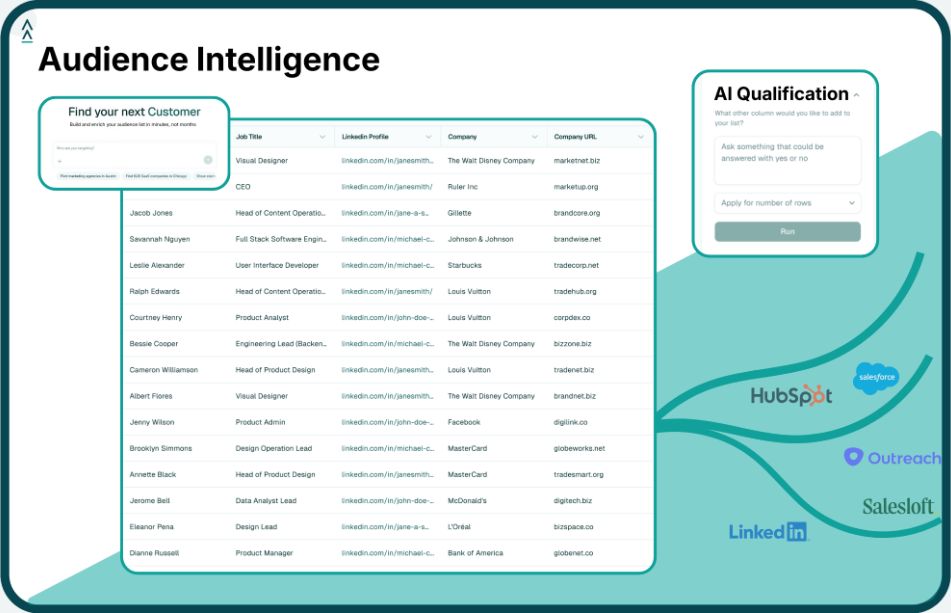
The VibeGTM interface enables biotech vendors to use natural-language prompts like "CFOs at Series B-funded biotech companies working on cell therapy" to instantly generate AI-qualified prospect lists. By combining comprehensive company data—including 1,500+ unique signals across firmographic, technographic, intent, hiring, and funding data—with agentic AI qualification, sales and marketing teams can:
For vendors serving the biotech ecosystem, AI-powered go-to-market intelligence is no longer optional—it's the foundation for timely, relevant engagement with the industry's fastest-growing companies.
Fastest-growing biotech companies are defined by exceptional funding velocity (raising $100M+ in single rounds or $500M+ cumulatively in 12-24 months), innovative therapeutic approaches or platform technologies, industry validation through partnerships or regulatory milestones, and strong growth trajectories. Companies like Kailera Therapeutics ($1B in 12 months) and Lila Sciences ($350M in 7 months) exemplify this explosive growth pattern. The combination of massive capital raises, novel scientific approaches, and clinical milestone achievements distinguishes these companies from the broader biotech ecosystem. These metrics reflect investor confidence, scientific differentiation, and commercial potential that collectively indicate exceptional growth momentum.
Government regulation significantly impacts biotech growth through FDA designations, which can accelerate development timelines and attract investment. Regulatory pathways for novel modalities like cell therapies and gene editing also influence market entry strategies, with companies that navigate requirements effectively achieving faster clinical progress and commercial success. Companies with experienced leadership teams often demonstrate superior regulatory navigation capabilities, translating to competitive advantages in clinical development timelines. The regulatory environment shapes both funding opportunities and strategic partnerships, as pharma partners seek biotechs with de-risked regulatory profiles. Overall, regulatory expertise has become a critical success factor in the modern biotech landscape.
AI is transforming biotech R&D by reducing discovery costs and cutting development timelines. Companies like Isomorphic Labs ($600M raised), Lila Sciences ($550M raised), and Recursion (BioHive-2 supercomputer) leverage AI to design superior molecules, predict protein structures, and analyze massive datasets. AI-native platforms now demonstrate capabilities to generate medicines that outperform commercially available therapies, with autonomous research labs accelerating the entire discovery process. This technological shift represents one of the most significant innovations in pharmaceutical development since the Human Genome Project.
Early and growth-stage biotech companies primarily secure funding from specialized healthcare venture capital firms (like OrbiMed, New Enterprise Associates), corporate venture arms of pharmaceutical companies (like Novo Holdings), and increasingly from tech-focused VCs recognizing the convergence of AI and biotechnology. Record-breaking rounds like Altos Labs' $3B Series A demonstrate that differentiated science with strong leadership can still attract massive capital even in challenging funding environments. Serial entrepreneur leadership with billion-dollar exit track records (like Mark McKenna's $10.8B Prometheus exit) significantly enhances fundraising capabilities. Strategic partnerships with Big Pharma, as demonstrated by Soufflé's four partnerships at launch, also validate platforms and attract follow-on investment.
Effectively targeting fast-growing biotech firms requires real-time intelligence on funding announcements, clinical milestones, and leadership changes. Platforms like Landbase provide access to 1,500+ unique signals across 24M+ companies, enabling go-to-market teams to use natural-language prompts to identify and qualify prospects based on specific criteria like therapeutic focus, funding stage, or technology platform. This precision targeting ensures timely, relevant engagement with biotech decision-makers when they're most likely to need external solutions. The ability to monitor funding rounds, FDA designations, clinical trial initiations, and executive appointments in real-time enables vendors to reach out at optimal moments in the buyer journey. AI-powered audience discovery has become essential for biotech-focused sales and marketing teams seeking competitive advantage in this fast-moving market.
Tool and strategies modern teams need to help their companies grow.